 Pencil Dao
By Pencil Dao, author: Xiyan
An insider in the shared massage chair industry once calculated that even if a single device generated 100 yuan per day, the revenue would still be unable to cover later-stage costs. Rent, operations, and maintenance are massive burdens on practitioners in the shared massage chair sector.
Under the pandemic, offline business for shared massage chairs suffered even more. Major placement sites became key areas for epidemic prevention and control, and many massage chairs were not even connected to a power source. Even with daily disinfection, customers stayed away from these public massage chairs as if they were virus sources.
Some shopping malls even put up “warning lines” around the areas where shared massage chairs were located to prevent passersby from “casually sitting”, which would hinder epidemic control. A regional agent for a shared massage chair brand told Pencil Dao that during the pandemic, the usage rate of his deployed massage chairs dropped by more than 80%.
Fortunately, the pandemic also made consumers pay more attention to hygiene and health. The development of shared massage chairs over the past two years has effectively educated consumers, and together with the explosive growth of livestream e-commerce in 2020, the online business of shared massage chairs achieved unexpected leaps forward.
According to Tmall data monitoring, in June 2020, the sales of the shared massage chair brand Momoda on Tmall increased by 190% year-on-year. Although an entrepreneur’s brand saw usage drop by more than 50% in Q1 2020, the sales volume of its products on e‑commerce platforms increased by more than 50%.
Even so, after the complete collapse of the sharing economy in 2019, shared massage chairs could no longer ride the trend. Some industry insiders believe that the fundamental reason is that the past pure offline model of shared massage chairs is unreliable.
For the industry to grow and thrive, it must find a suitable profit model, evolving from a “valuable” product to a “profitable” product, breaking away from the “sharing” gameplay — or at least not being confined to “sharing”. Offline scenarios should be transformed into effective traffic portals, generating revenue through advertising models or selling health-related peripheral products, thereby achieving scale effects.
Shared massage chairs saw an 80% drop in usage
“There are hardly any people in the mall. Most just pass through to use the restroom, let alone use shared massage chairs.” In February, a mall manager told Li Jia while inspecting the usage of his massage chairs.
Li Jia entered the shared massage chair track in 2018, becoming a regional agent for a leading brand, hoping to build a successful career.
“For individual or small agents to make money from massage chairs, you need capital and you must find cost-effective locations.” Li Jia never placed devices in train stations or airports because he would have to share 30%‑60% of revenue. Instead, he chose shopping malls, hotels, cinemas, and other high‑traffic venues where people are willing to pay.
But unexpectedly, these venues were also the hardest hit by the pandemic.
Take shopping malls as an example: around the Spring Festival, the mall was crowded every day. Although there weren’t many paying users of shared massage chairs, there were many passersby just occupying the seats.
During the worst of the pandemic, he found that basically all massage chairs at his venues were empty. Many were not even connected to a power source. Even with daily disinfection, customers shunned these public massage chairs as if they were sources of the virus.
Some malls even put up “warning lines” around the areas where shared massage chairs were placed to prevent people from “casually sitting”, which would be detrimental to epidemic control.
During the pandemic, the usage rate of the massage chairs Li Jia deployed dropped by more than 80%. The only good news he received was that most of his placement sites waived the venue rent.
Yet, looking back on his two years of experience, Li Jia feels that shared massage chairs may not be a good business at all.
Shared bikes, shared umbrellas, shared massage chairs, shared power banks… In the years when the sharing economy was hyped up, Li Jia saw wave after wave of entrepreneurs fail and leave, but soon the next wave of newcomers eager to get rich would flood in.
He was no exception. In 2018, when he first became an agent, Li Jia made a “theoretical” calculation: depending on the scenario, a shared massage chair could generate 600 to 1,000 yuan per month, and in premium scenarios, the investment could be recouped in as little as 3 to 5 months.
However, when reality hit, it was utterly disappointing. At its peak, Li Jia deployed several hundred massage chairs, with monthly revenue of nearly 100,000 yuan, but the average revenue per chair was only 300 yuan — a world away from the ideal.
Because shared massage chairs require high maintenance costs later on, such as leather peeling, damage to components caused by spilled drinks or snacks, etc., in addition to franchise fees, brand agents also bear exponentially growing maintenance expenses.
An industry practitioner calculated the maintenance cost of shared massage chairs: if the placement site lacks regular inspection and maintenance, the chairs will show significant wear within just a few months. A single piece of artificial leather costs nearly 500 yuan, switches and electronic components range from 100‑300 yuan. If more serious damage occurs, return-to-factory repairs also require paying technician fees, plus employee salaries and site rental fees. Even if a device earns 100 yuan per day, the revenue simply cannot cover later costs.
“Some agents choose lower-cost products to reduce purchase costs, but such goods are more likely to have problems later. Once repairs are needed, they have to spend even more money.” Li Jia increasingly felt that even without the pandemic, the shared massage chair business might be a messy, unprofitable affair.
An unexpected online boon
Offline promotion and user consumption were blocked, but some entrepreneurs in shared massage chair brands gained an unexpected harvest online.
Currently, shared massage chairs have three revenue models: charging by service type and usage duration; renting machines to public venues for a fee; and selling advertising space on display screens for promoters.
During the pandemic, Zhao Kang, an entrepreneur in the shared massage chair space, discovered that his products experienced explosive growth on e‑commerce platforms.
Zhao Kang explained that in Q1 2020, the usage rate of his company’s shared massage chairs fell by more than 50%, but the sales volume of their massage chair products on e‑commerce platforms increased by more than 50%.
“Most of the customers who bought products had used our shared massage chairs offline before. After the pandemic, when they developed the desire to buy a massage chair, they were more inclined to choose our brand,” Zhao Kang found through user surveys.
In Zhao Kang’s view, “later entrepreneurs” like him are just “getting the leftovers”. In fact, this phenomenon is driven by pandemic‑induced channel shifts.
Since Q1 2020, due to the pandemic and people working from home, consumers have become more health‑ and hygiene‑conscious. Offline store sales of massage equipment companies declined, while the share of online sales increased significantly.
Industry insiders believe this trend is due to two factors: firstly, shared massage chairs have effectively educated consumers; secondly, the livestream e‑commerce boom in 2020. Both have contributed to the growth of the traditional massage chair industry.
According to Tmall monitoring data, in Q2 2020, brands like Rongtai and OGAWA saw year‑on‑year Tmall sales growth of 79% and 84% respectively. Low‑ and mid‑range brands also achieved rapid growth: in June 2020, Momoda’s Tmall sales increased by 190% year‑on‑year.
In fact, Zhao Kang has never valued offline usage fees. In his opinion, it is impossible to make big money solely through service fees and usage charges. Offline massage chairs are more like experience and traffic generation portals.
In some shopping malls where he placed chairs, Zhao Kang set up offline stores or brand counters. He cooperated with malls to place massage chairs in areas outside the counters, allowing consumers to experience them on a self‑service basis. After trying them, users could go to the counter for more information, thereby directing traffic to offline stores.
And this time, thanks to the pandemic, diverting customers to e‑commerce was indeed an unexpected bonus for shared massage chair players.
From “valuable” to “profitable”
By the second half of 2020, the pandemic had largely stabilized in China. Regional agent Li Jia also found that the usage rate of his massage chairs gradually returned to the previous year’s level.
But the two‑year journey and the pandemic made Li Jia hesitant about the sharing track he once believed in.
Starting in 2017, shared massage chairs emerged, with 15 new registered companies that year — five times the number in 2016. 2018 was the peak of capital influx into the shared massage chair industry, with 29 new registered companies, nearly double that of 2017.
At the same time, investor enthusiasm for the shared massage chair industry rose: in 2017, the sector raised 240 million yuan; in 2018, it raised 260 million yuan.
Shared massage chairs enjoyed the windfall and were sought after by capital — well‑known firms such as ZhenFund, Plum Ventures, and Jishi Capital have invested in such projects.
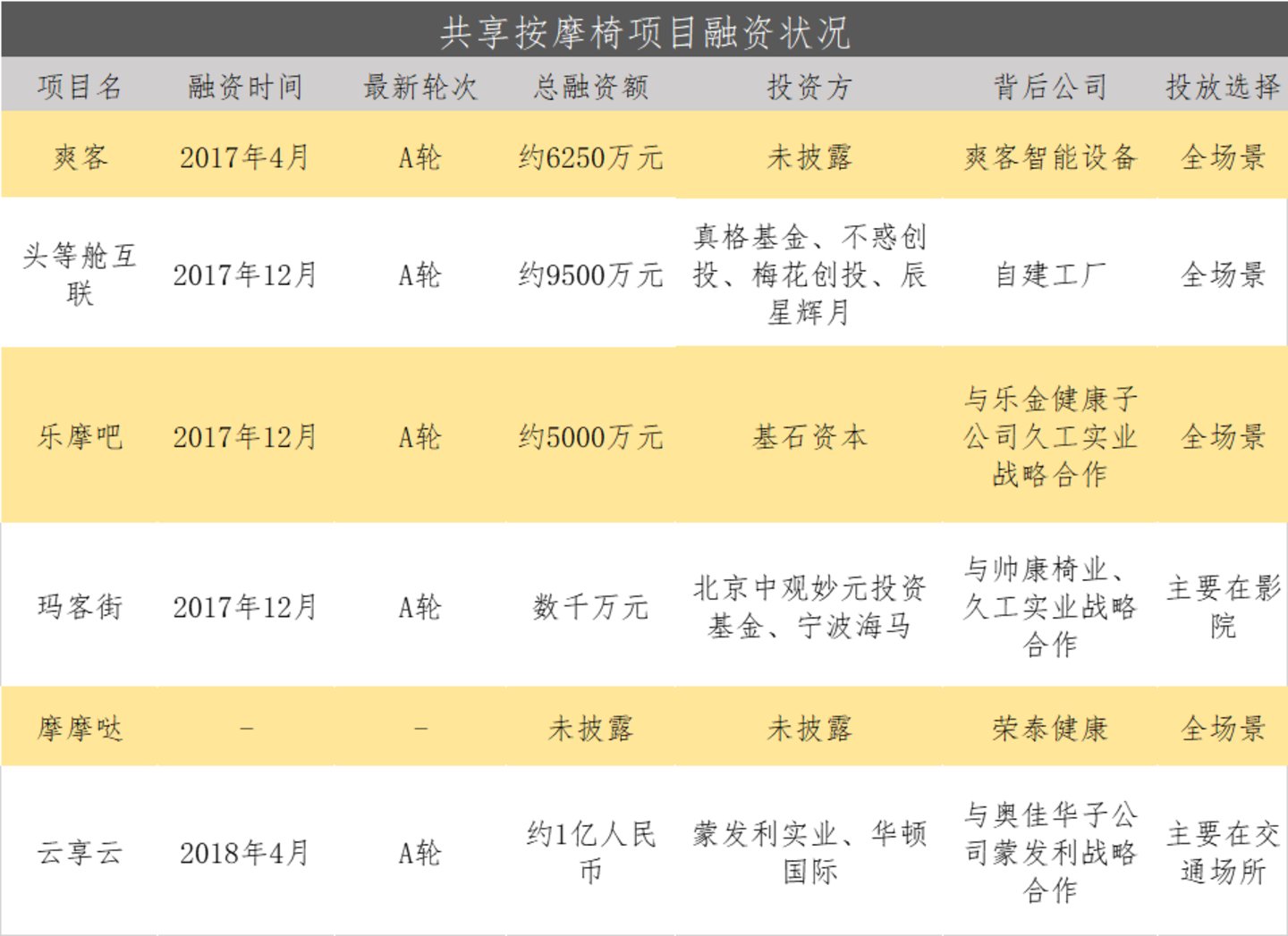
However, in 2019, the shared massage chair industry suddenly went silent — there were no more large‑scale financing rounds, and the concept was no longer a topic of interest among investors.
Entering 2020, the capital environment became even harsher, with no echoes heard in the shared massage chair field. The financing progress of many companies in the industry has stagnated at the Series A stage for two or three years. The most recent public financing in the sector was in April 2018, 27 months ago.
Meng Fan, an industry insider, believes that for the shared massage chair industry to develop, it most needs to break away from the “sharing” gameplay, or at least not be confined to “sharing”.
Although it once received capital and public attention, offline shared massage chairs have always been a lukewarm industry. To date, no industry giant has emerged.
Meng Fan believes that shared massage chair companies must first do a good job with traffic. Massage chairs can gain massive offline exposure, but in many places, chairs are occupied by people loitering without paying, causing huge waste of traffic. “The massage chair itself is a medium. In some locations, it gets thousands of exposures per day, but that traffic is not well utilized. If 30% of the traffic could be converted, that would mean at least 300 effective users.”
He thinks the best strategy for the industry is actually to offer a “free card”. People sitting without paying are still using the chairs, and some seats remain empty anyway. Instead, they should be used efficiently. Attract eyeballs with the word “free” to capture traffic, then find appropriate opportunities for conversion or monetization through other means.
“Most consumers haven’t formed a habit of paying for massage chairs, so their willingness to pay is very low. It’s extremely difficult for merchants to expect users to pay directly for the experience,” Meng Fan explained.
In his view, once traffic is secured, companies can adopt strategies not limited to “sharing”, such as the common advertising model or selling peripheral products and massage chairs to generate profit.
Some shared massage chair players have already started adopting similar profit models. For example, Leba and Momoda not only sell massage chairs on e‑commerce platforms but also offer fascia guns, neck massagers, and other fitness/health products.
As consumers’ health awareness increases, demand for health care devices will grow. Meng Fan believes that shared massage chairs are always a valuable business, but there is a gap between value and profitability that requires strategic measures.
“Furthermore, after the capital markets and the public have calmed down and the bubbles have burst, this is actually the best time for entrepreneurs who want to do real things,” Meng Fan said.


