By Jingzhe Institute · Author: Xiaoman
If not for the trending topic “9 months to earn 100 million yuan,” few would realize how profitable those massage chairs in cinemas and shopping malls can be. Another overlooked fact is that shared massage chairs are still in an expansion phase — one of the few surviving sharing-economy tracks.
In fact, besides cinemas and malls, airport departure halls and train station waiting areas have also been infiltrated by shared massage chairs in recent years. However, specific market and business developments are rarely reported, just like genuine consumer reviews remain uncommon.
The huge contrast between trending buzz and real-life perception sparks curiosity: from neglected devices in shopping centers to “lie-flat money-making” tools for IPO candidates — what kind of business lies behind shared massage chairs?
From marginal equipment to scenario-based standard
As part of the sharing economy, the shared massage chair was born in 2016, known as the “first year of the sharing economy.” Riding the wave of capital enthusiasm, the sector attracted numerous entrepreneurs and investors in 2017, accelerating industry expansion.
Tianyancha data shows that the number of newly registered enterprises in the shared massage chair industry in 2017 was five times that of 2016. By 2018, the total number of shared massage chairs nationwide exceeded one million. Several brands including LEMOBA, OGAWA, Yunxiangyun and Qila secured financing.
 *Image: LEMOBA official Weibo
Initially, shared massage chairs were mostly found in first-tier city airports, banks, and cinemas — places where people have fragmented waiting time (arriving 30 minutes early for a flight, waiting for bank numbers, or queuing before a movie).
At that stage, compared to ordinary waiting seats (or even no seats at all), shared massage chairs seemed a “better” choice, attracting first-time users. After receiving capital injection, the rationality of placement was no longer the main driver for expansion.
Therefore, from train station waiting halls to limited corners near escalators in shopping malls, shared massage chairs became as ubiquitous as regular seating, weaving into various consumption and transit scenarios of daily life.
LEMOBA’s prospectus reveals that it has established more than 45,000 service points, deployed over 500,000 smart massage devices, covering 31 provincial-level regions and 339 cities in mainland China. The cumulative identifiable service users exceed 150 million, with more than 28 million registered members.
 *Screenshot from LEMOBA official site
It is worth noting that although the deployment scope and volume continue to grow, shared massage chairs in different scenarios have vastly different “profit efficiency” due to audience and frequency variations.
According to iiMedia Research, among the main places where Chinese consumers used shared massage chairs in 2024: 36.08% chose shopping malls/supermarkets, 25.49% cinemas, 24.71% stations, 22.35% entertainment venues like KTVs, and 21.18% airports. This preference distribution reflects varying levels of demand intensity in each scenario.
In busy shopping malls, tired shoppers and male companions waiting for girlfriends often need rest areas; free seating is limited, so shared massage chairs become an alternative — a “boyfriend deposit zone” or resting spot.
 *LEMOBA massage chairs in a mall (photo by Jingzhe Institute)
In airports and train stations, waiting times are often controllable and seats are relatively sufficient; thus shared massage chairs are not a superior choice. As for KTVs/entertainment venues, the lower proportion is because people are in social settings — leaving friends to go massage alone is rare.
Real demand or “sharing myth”?
Compared to sharing-economy stars like bike-sharing and power-bank sharing, shared massage chairs have always had a low profile. The “last mile” from subway to office or powerless phones while shopping are urgent, real needs. Shared massage chairs essentially create new demand within waiting scenarios, requiring longer market cultivation, and such “non-urgent” contextual demand tests brands’ ability to expand from niche markets.
From the initial focus on airports, banks, and cinemas, the core user groups were young white-collar workers and urban middle class.
For example, office workers after long hours at desks could get a 10–30 minute relaxation while grabbing coffee downstairs. Frequent business travelers could take a short break between flights or train rides.
As deployment scaled up, service scenarios expanded from business settings and middle-class elites to everyday users, shifting primary goal toward mass coverage.
The current operation in China’s shared massage chair market mainly follows two models: direct operation (brands rent venues, deploy chairs, keep all revenue) and joint operation (venues provide space, operators handle placement and maintenance, revenue is split).
Thus, the core costs are venue rental and hardware. According to New Retail Business Review, placing one shared massage chair in a second-/third-tier mall requires an entry fee of 100 to 300 yuan per unit.
As reported by红星资本局 (Red Star Capital Bureau), if each chair sees 5 users per day at 10 yuan per session, daily revenue is 50 yuan, monthly revenue 1,500 yuan. After splitting half with the venue (750 yuan left) and deducting cleaning etc, monthly profit is around 700 yuan.
If each device costs 5,000 yuan, the operator can recoup investment in less than a year. With a typical lifespan of 3–5 years, “lie-flat profit” can last another 2–4 years. But the core issue is: ignoring hygiene concerns, high damage rates, delayed maintenance, and freeloaders — are there really that many daily users? Data from LEMOBA’s prospectus may serve as a reference.
According to the prospectus, as of September 2024, LEMOBA’s total transaction count reached 604 million, with approximately 402,100 smart massage devices deployed in commercial complexes, cinemas, airports, and high-speed rail stations. Simple calculation shows an average of about 4.1 transactions per device per day.
Though slightly below the “5 times per day” break-even threshold, raising average ticket value and repurchase rates might achieve “lie-flat profit.” Nevertheless, compared to the vibrant sharing economy environment of 2017, shared massage chairs now face more challenges.
The sharing economy can’t “win while lying down”
Essentially a time-based rental, the profit ceiling for shared massage chairs relies on utilization rate improvement. Hence, brands have been expanding deployment since 2017. Yet scale alone does not guarantee bigger success.
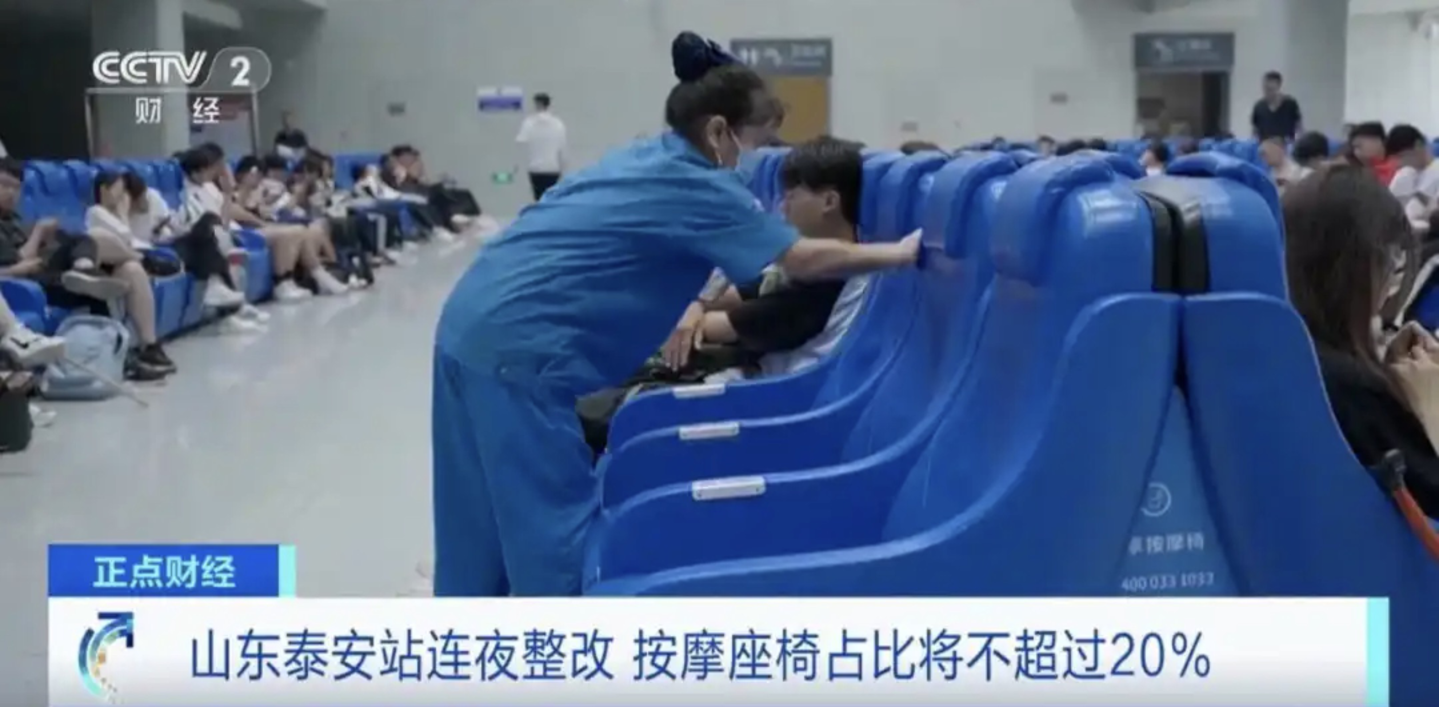
In August 2023, due to shared massage chairs occupying excessive public space in Tai’an Station, leaving insufficient ordinary seats, China Railway issued a notice criticizing the station’s service and requiring that the total number of waiting seats not be reduced, and that multi-functional chairs must not exceed 20% of all waiting seats.
For enterprises, as the number of deployed chairs grows, the business becomes an asset-heavy project. The financial report of Rongtai Health, parent company of the shared massage brand Momoda, shows that from 2017 to 2018, Momoda’s revenue increased from 233 million yuan to 366 million yuan, but due to soaring deployment costs (up to 280 million yuan), gross margin plunged to 23.38%, a year-on-year drop of 18.65 percentage points.
After 2018, Rongtai Group gradually reduced investment in shared massage chairs. In May 2020, Rongtai Health told investors that about 90% of shared massage chairs had been transferred out by 2019. From this perspective, LEMOBA’s growth might be partly due to competitors’ retreat, but it also raises the question: has LEMOBA truly found a profitable formula for asset-heavy operations?
Beyond corporate operations, the mismatch between service model and user demand has gradually surfaced. On a macro level, while the massage chair market has grown thanks to rising health awareness, shared massage chairs are neither the sole solution nor the optimal one.
First, the proliferation of home massage devices meets the anytime, anywhere relaxation needs of young white-collar and middle-class workers. Industry data shows that the number of home massage chairs in China increased from 2.37 million units in 2018 to 6.013 million in 2022, a CAGR of 26.21%. According to Qianzhan, the small massage device market in China reached approximately 10.81 billion yuan in 2023.
 *Image: OGAWA official Weibo
Second, brick-and-mortar massage stores and on-demand massage platforms have grown rapidly, posing strong competition. With the experiential advantage of human massage over mechanical chairs, physical stores diversify services from traditional foot massage and tuina to foot care, foot cosmetology, and TCM physiotherapy.
Moreover, hybrid business models like “foot massage + buffet” or “foot massage + KTV” appeal to diverse consumer needs while broadening competitive moats.
Regarding the potential loss of users due to service quality gaps, LEMOBA has also expressed concern. The prospectus states: “If our products fail to resonate with consumers, or if we are unable to keep up with changing consumer preferences in a timely and sustained manner, revenue from smart massage services might decline in the short term.”
Looking back at the evolution of shared massage chairs, this sharing-economy player survives because it aligns with broad lifestyle needs, leverages scenario advantages, and replaces human labor with 7×24 machines to create new channels.
Yet the scenario itself becomes a limitation. As home massage devices and offline/online massage services spread, shared massage chairs lose their locational advantage; instead, the constraints of the settings restrict service experience upgrades.
Perhaps as competitors exit and scale increases, shared massage chair companies can still deliver impressive performance reports. But beneath the façade of the sharing economy, addressing personal wellness needs through shared massage chairs will likely remain far from a “lie-flat victory.”