2026 China Children & Youth Functional Frames Consumer Insight White Paper
Myopia Control as a Long-term Battle · Frames Evolve from Accessory to Professional Category
| Executive Summary
Scale Children myopia remains large-scale, younger, and long-term. Prevention is shifting from one-time correction to continuous management. Defocus lenses are accelerating, and stable fitting & optical alignment become key variables — frames upgrade to a professional category with independent value.
Decision Parents aged 31-40 are core decision-makers, with rising attention to professional fit, willing to pay a premium. But shifting and misalignment still undermine control outcomes; the industry lacks a unified, easy-to-understand professional evaluation standard.
Future Functional composite, smart integration, and individual adaptation are three product trends; channels move from “selling” to “service co-construction”. Future competition will be a system capability race across product, technology, data, and channel.
01 Market Status: Myopia Severe, Frame Value Independent
Myopia becomes “younger”, prevention turns into a prolonged battle — In 2024, the myopia rate among children and adolescents dropped to 50%, but the rate for 6-year-olds reached 11%. Primary, junior high, and senior high rates are 34%, 70%, and 81% respectively, all above 2030 targets. The predicted high myopia rate for 16-18 year-olds will rise from 7% (2001) to 22% (2050). 70% of children use near-vision >4 hours daily; 90% of parents are willing to invest more in myopia control.
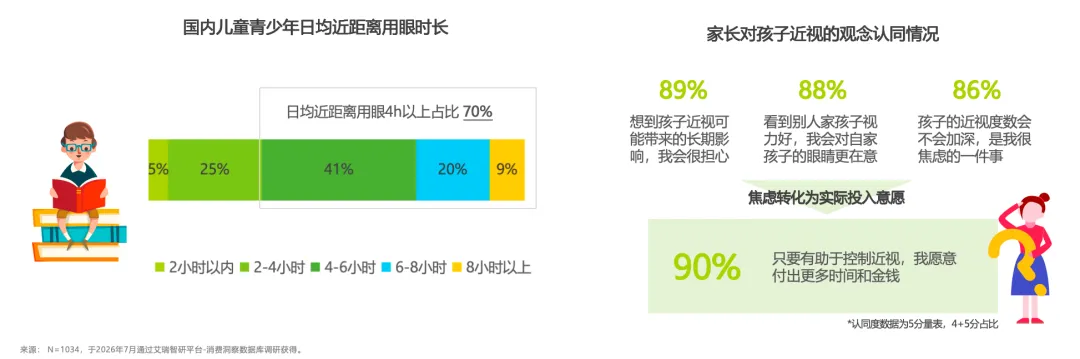
Defocus lenses popularize, transforming frames from “accessory” to “professional category” — Defocus lens sales penetration is expected to rise from 6% (2024) to 15% (2029). Frame slippage or misalignment will shift the defocus zone, severely reducing efficacy. In H1 2026, social media discussions on “cannot stay in place, slipping” grew 26% YoY. Frames already account for ~30% of the children’s eyewear market, and 61% of experienced parents value frame professionalism more. Stability, fit, safety, and synergy with control lenses are the four core dimensions.

02 Consumer Insights: Parents Pay for Professional, but Fit Issues Persist
Experienced parents are willing to pay more for “professional” — 82% of parents are willing to pay a premium for precise or custom-fit frames, though current premium is mostly “within 10%”. Parents aged 31-40 account for 64%; 46% are not buying their child’s first pair — they are more sensitive to slipping, nose pressure, and deformation.
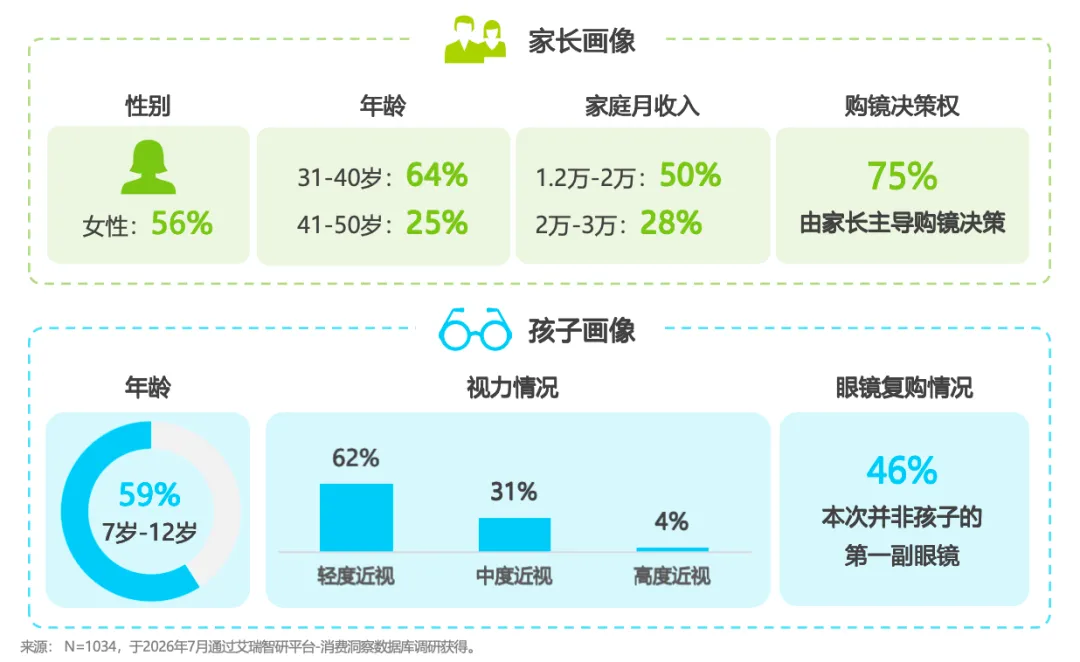
Professional fit is valued, but “unstable wear” remains a common pain point — 86% of parents report fitting pain points; 24% have encountered “frame shift causing the lens not in the correct position”. Essential features of a “professional frame” include lightweight, impact-resistant, adjustable for growth, stable vertex distance and optical alignment. But “too heavy, nose pressure”, “sports impact slippage”, “sliding and needing frequent adjustment” are frequent. Among children aged 16-18, the “misalignment” rate reaches 39%. Fit failure is evolving from a comfort issue to a direct impact on control efficacy.
03 Professionalization Status: Unified Standard Missing, Capability Gap Needs Collaboration
The more “professional” the frame, the harder it is for parents to understand — Frame professionalism has three layers: compliance (national standards), wearing experience (perceptible), and optical fit (requires professional measurement). The optical layer is hardest to verify, yet it is the core of brand professional capability. The industry lacks a unified, easy-to-understand, and verifiable evaluation language.
Parametric fitting is emerging, but no single player can go it alone — 88% of parents consider precise vertex distance and optical center alignment important. The professionalization of functional frames extends from structural engineering to optical engineering, requiring collaboration with clinical institutions, universities, and tech companies. Long-term collection of facial and visual data, clinical efficacy observation, and smart algorithms all need co-construction.
04 Trends: From Single-point Competition to System Capability Competition
Functional composite, smart integration, individual adaptation — three parallel tracks — 67% of parents are interested in behavior monitoring; 80% value frames that adapt to face shape and growth. Sports require impact resistance, study requires comfort, daily life requires willingness to wear — functional composite becomes the norm. Smart eyewear covering wearing duration, viewing distance, and outdoor activity is emerging; individual adaptation moves from “experience-based” to “parametric design”.
Channel competition: from “selling” to “accompanying service” — 93% of children’s eyewear transactions happen offline. Channel roles upgrade to fitting training, follow-up support, and clinical collaboration. Eye hospitals/optometry clinics continue to gain influence.
The future moat is system capability, not a single hit product — Product capability, technology accumulation, data & validation, and channel service are long-term assets that determine whether a company can survive product cycles. A single new material or marketing campaign cannot build lasting advantage. The true scarcity is the ability to continuously translate children’s needs into product design, cross-year technology paths, data feedback from real use, and professional channel delivery.
📊 Overall Analysis
The white paper reveals a structural shift: defocus lens technology elevates frames from accessories to key variables in myopia control. On the market side, younger-age myopia and high myopia risks coexist; parents have strong willingness to pay but lack professional knowledge — 86% pain points indicate “professional fit” is not yet effectively delivered. On the industry side, the optical adaptation layer lacks unified standards; parametric fitting exists but has no public scale; no single company can do it alone — collaboration is essential. Trends show functional composite, smart monitoring, and parametric design as three parallel tracks; channels move from distribution to service enablement. Ultimately, competition revolves around data, technology, product, and channel system capabilities. The frame industry is evolving from “selling products” to “managing myopia” in an ecosystem race.
🧩 Core Problem Solution · Execution & Acceptance Model
Core problem: Frame shift causes defocus zone misalignment, reducing efficacy; lack of unified professional standard makes it hard for parents to judge.
Execution: ① Establish “optical alignment parametric fitting” protocol, promote vertex distance and optical center measurement standards with optometry clinics; ② Develop smart frames with built-in micro-sensors for real-time position monitoring and shift alerts; ③ Collaborate with universities to develop a graded standard (basic/experience/optical) with visual query tools; ④ Channel-side fitter certification and follow-up service, building a “fitting-delivery-tracking” loop.
Acceptance model: ① Complaint rate on frame shift drops 30% in pilot cities within 6 months; ② Smart frame prototype maintains optical alignment rate ≥95%; ③ Parental awareness accuracy of “professional frame” rises to ≥70% (survey); ④ Partner channel follow-up rate ≥60%, and alignment qualification rate after adjustment ≥90%.


💬 Comments · Parents & Industry Voices