
By Tech Planet, Author | Lin Jing
Shared massage chairs are trying every means to drive away “seat squatters”. While waiting at the cinema, Miao Yu sat on a shared massage chair for four minutes without paying. During that time, the machine voice reminded him three times: “Please get up and let me serve others.” Finally, it warned: “I will flip over immediately. Please leave now.”
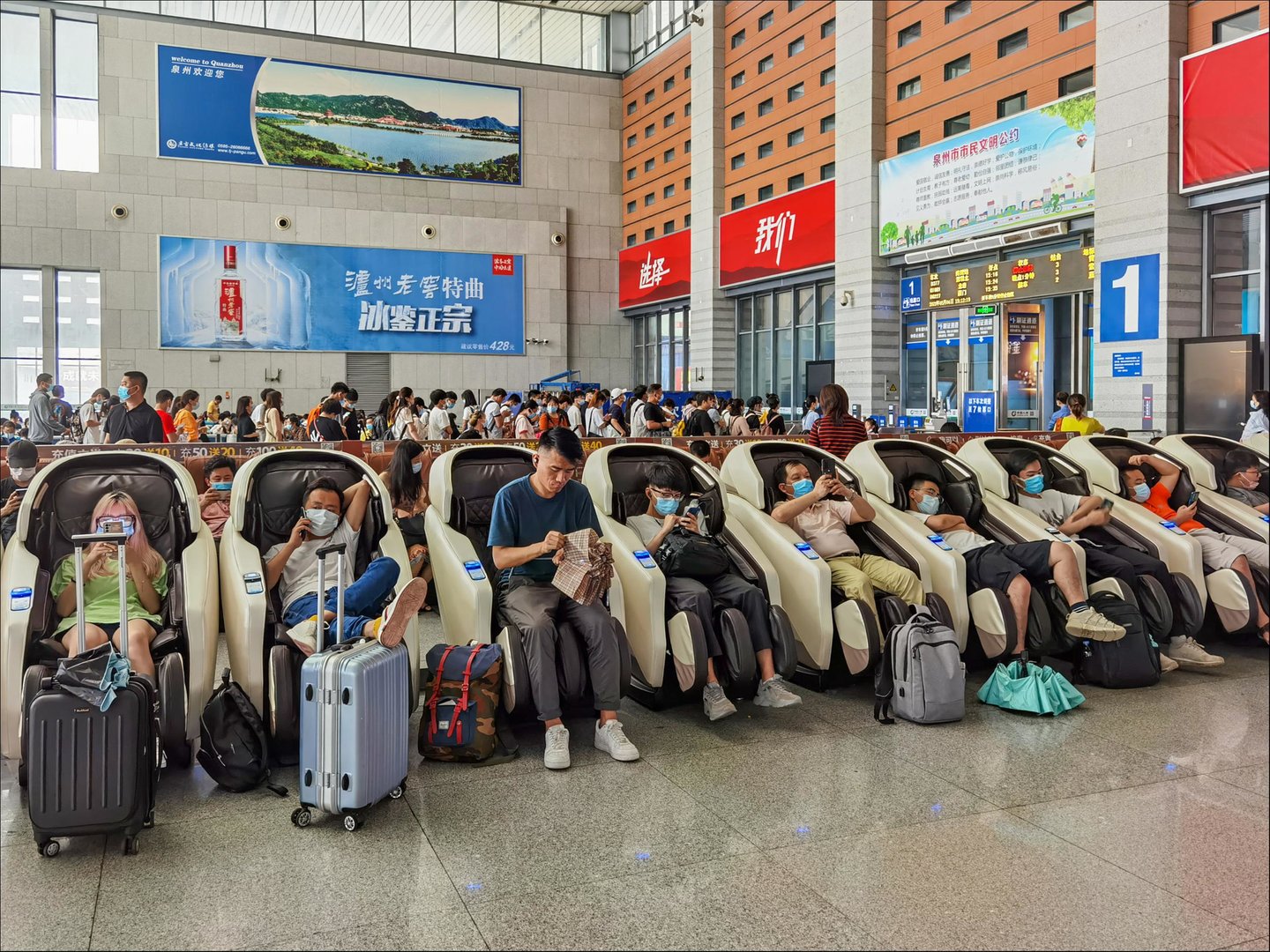
This urgency reflects the pressing need for shared massage chairs to make money. These chairs were born during the wave of the sharing economy. Six years later, most sharing models have ended in chaos. Even bike-sharing and power-bank sharing have been forced to raise prices to survive. Yet shared massage chairs, seemingly ignored, have become ubiquitous in our lives — not only in high-speed rail stations, airports, and shopping malls, but also inside cinema halls, occupying one-third or even half of the prime seats.
A shared massage chair sales agent told Tech Planet that after the pandemic restrictions were lifted, major brands started a new round of aggressive expansion, even venturing into overseas markets. Countless small and medium-sized brands have flooded the market with cheap OEM devices, avoiding already saturated markets and looking for other crowded areas to deploy.
So, how do shared massage chairs make money? Who actually benefits? Can it really be a “lie-down win”?
Agents Lose Millions, Chairs Without Profit “Evict” Sitters
Shared massage chairs were once considered a “lie-down win” business. A device costing an average of 6,000 yuan could theoretically pay for itself within half a year if used by 3-5 people daily at a cost of 10 yuan per use. With a 3-5 year replacement cycle, the period after that would be “effortless profit”.
Compared to bike-sharing and power banks, shared massage chairs have a lower damage rate and require less maintenance and operation costs. Li Yang, a marketing agent for shared massage chairs, told Tech Planet that cleaning is the main ongoing task, and agents can tip or give small gifts to mall cleaning staff to manage it. One or two staff members can oversee thousands of devices in a city. In addition, they ensure the devices are connected; agents can monitor them in real-time via background systems and perform regular inspections.
But reality is different. For Wang Lei, after a year of acting as an agent for hundreds of shared massage chairs, not only did he fail to achieve instant wealth — he did not even recover his costs. Although he declined to disclose the exact loss, he said it is common for agents around him to lose anywhere from hundreds of thousands to millions of yuan. “I have yet to see anyone who really made money,” he said.
Operators generally adopt two models: direct operation (paying rent to the property in exchange for placement, keeping all revenue) or joint operation (the property provides space and takes a share of the revenue).
However, malls rarely accept the revenue-sharing model. Wang Lei noted that most shared massage chairs are OEM-produced by manufacturers in Fu'an, with little product differentiation. The final competitive factor is the agent's network to secure good locations at low rental costs. Otherwise, the highest bidder gets the spot.
Rents vary significantly depending on the mall's grade, scale, and foot traffic. In Hangzhou, for instance, the average daily rent per unit at Longfor Paradise Walk is over 50 yuan; at Intime, it ranges from 10 to 30 yuan depending on the district; and at lower-traffic malls like MIXC, it ranges from 8 to 20 yuan.
A single consumption costs at least 10 yuan, meaning each device needs at least 1-2 paying users per day to cover rent. In Wang Lei's view, after the initial novelty wears off at each location, the conversion rate gradually declines. He tried deploying in lower-tier counties, but results were disappointing, and the damage rate was higher.
Wang Lei is not an isolated case. Li Yang provided operational data from a mall for newly deployed devices, showing average daily revenue per device between 20 and 40 yuan, with a conversion rate (those who pay after scanning) of only 10%-20%.
Agents must push for revenue sharing, but they need negotiation skills. Wang Lei said that early on he would split 70/30 with gyms, but after recovering costs, he promised to give the gym 70%.
Today, shared massage chairs are struggling to make money. On one hand, they have strengthened anti-occupancy features — using various voice prompts to “drive away” non-paying users, and some even add “anti-prolonged sitting” functions. On the other hand, they try to attract users, e.g., providing charging ports on many chairs at high-speed rail stations.
Behind the low usage rate is not only declining novelty. Hygiene issues have become frequent in the past two years, discouraging some users. The massage effect is also heavily criticized, with many users on social media comparing it to “being beaten up”.
Miao Miao had a vivid experience. While waiting at a high-speed rail station, she needed an emergency charge and scanned a “12-min massage + charging” package for 9.99 yuan. However, the loud noise embarrassed her in public, and the charging was very slow — the overall experience was pointless.
Young people inside cinemas are also driven mad by such chairs, complaining about paying high ticket prices only to endure torture. Shared massage chairs are typically placed in prime cinema seats since targeted customers are likely to have ability to pay.
A cinema employee told Tech Planet that the chairs often get complaints, including hair getting caught and poor massage quality, which usually end in refunds.
Hard Business: Did the Boom Only Inflate Manufacturers’ Wallets?
Shared massage chairs had a brief golden era. In 2017, major brands expanded at astonishing speed, placing chairs in airports, high-speed rail stations, hospitals, hotels, and other public spaces. By 2018, over one million units were deployed nationwide, according to incomplete statistics.
Tianyancha data shows that the number of new registered companies in the shared massage chair industry in 2017 was five times that of 2016. 2018 marked the peak of capital inflow, and the number of new registrations nearly doubled compared to 2017.
Entrants included listed massage chair manufacturers such as Rongtai Health (creating the “Momoda” brand) and OGAWA (launching “Mosquare”). Non-manufacturer brands like Qila, Shuanke, First Class Interconnection, Yunxiangyun, and LeMoore also secured funding. Notably, First Class Interconnection was backed by ZhenFund, Buchuang Capital, Meihua Angels, and other prominent investors.
Major brands focused on two main channels: Momoda and LeMoore concentrated on shopping malls and cinemas, while Shuanke focused on high-speed rail stations, airports, and hospitals.
According to Rongtai Health’s financial reports, Momoda’s experiential massage service revenue reached 233 million yuan in 2017 (12% of total) and 366 million yuan in 2018. However, due to heavy equipment deployment, Momoda's costs surged to 280 million yuan in 2018, causing gross margin to plummet to 23.38%. After that, Rongtai announced a slowdown in deployment and took measures to improve efficiency.
Liu Jin, an early shared massage chair agent, still vividly recalls the frantic scramble for locations. He negotiated “500 yuan monthly rent per device” with a mall, only to be outbid by another brand. In his view, if rent exceeds 500 yuan, costs including rent, logistics, and more cannot be recovered. He eventually cut his losses and exited.
Another early agent told Tech Planet that while the business was decent at the outset, the agents’ share was too small to earn much. However, surging demand allowed manufacturers to sell chairs and profit immensely — after all, whether the equipment ultimately operates successfully or not, the devices have already been sold.
The turning point came in 2019 when the sharing economy fizzled. As a capital-heavy business, shared massage chairs struggled to generate enough revenue and fell from grace. No new financing announcements were made after that.
Afterwards, the chairs reappeared in public mostly due to hygiene and safety issues — hair getting caught, bugs in crevices, etc.
The pandemic further reshuffled the market. A business head at a shared massage chair manufacturer told Tech Planet that many clients suffered severe losses and even disappeared. In the first half of this year, they focused on reviving existing equipment to recover costs.
Tech Planet observed that the “First Class Interconnection” WeChat official account stopped updating after March 2021, and its mini-program no longer works. Unlike other brands backed by manufacturers, First Class Interconnection had an internet background and might have struggled to withstand risks once capital stopped flowing.
A regional representative of “Jiudian Massage Chairs” said they are no longer deploying new equipment, bluntly stating: “Business is tough.” They declined to elaborate further.
Rongtai Group's Momoda brand has also reduced its shared market investment, focusing more on home massage chairs. Rongtai Health’s 2022 annual report shows that experiential massage service revenue fell by 90.73% year-on-year to 5.5673 million yuan.
Eyeing Office Workers, New Rush of “Gold-Diggers” Continue to Harvest?
After the market shakeout, surviving brands are mostly those backed by established groups: LeMoore behind Jiugong Industrial, Mosquare behind OGAWA, and Shuanke behind VK Group.
Data shows that LeMoore currently has over 180,000 shared massage chairs nationwide, 70% in shopping malls — far from founder Xie Zhonghui's 2017 goal of “one million units within five years”. Shuanke has over 250,000 chairs mainly in airports, high-speed rail stations, and hospitals.
Nevertheless, these brands are not “effortless winners.” After the pandemic, countless small and medium brands have become new disruptors, grabbing market share. They compete for existing locations. Although shopping malls, high-speed rail stations, and airports are already saturated and brands often sign exclusivity agreements, “mall leases are short-term, allowing opportunities to switch,” says Li Yang. She advises keeping daily rent below 10 yuan; otherwise, entering malls could be risky.
Li Yang added that as Momoda gradually exits the shared market, about half of its cinema channel has been taken by LeMoore and the rest by many small brands. “It's hard to monopolize mall resources. As long as you have good business relationships, even a small team can get in,” she said.
Meanwhile, brands are seeking new channels and spots. A salesperson from a small massage chair brand told Tech Planet that she monitors Dianping and Meituan daily, contacting newly opened amusement arcades or play centers and proposing a “50/50 revenue split”. For example, waiting parents at children’s play areas represent potential demand. With a device cost of 4,000 yuan and daily income of 30 yuan, recovery could take more than a year.
LeMoore and Shuanke are also leveraging agents’ networks to expand. A Shuanke agent stated that commercial centers near office buildings have shown promising results, with conversion rates as high as 60%. “The target is office workers during lunch breaks when they are tired. They truly need massage,” she elaborated.
LeMoore has launched a city partner program. A LeMoore employee revealed that the company currently has over 1,000 staff and is pushing for an IPO, expected next year.
Even though it won't bring instant riches, the shared massage chair business continues to attract “gold-diggers”. After all, the barrier is low: you can spend tens of thousands of yuan to buy a few units and test the market. With a good location, there is a chance to make money.
Thus, the business that claims to be “effortless profit” has yet to reach its final chapter. However, consumer experiences, safety, and hygiene issues are increasingly debated on social media. In the future, how many people will still be willing to pay for it?
(Note: Miao Yu, Wang Lei, Liu Jin, Miao Miao in the article are pseudonyms.)


