TMTpost note: This article is sourced from WeChat public account Mengma Capital Bureau (ID: mengmazibenju). Authors: Shen Jinrui, Xie Silin. Editor: Shi Chengchao. Published with permission from TMTpost.
In April this year, a Mr. Zhao from Jiangsu booked a traditional Chinese massage via the Dongjiao Daojia App. As the session neared its end, the female masseuse allegedly harassed him and urged him to “add more time.” The incident was reported by Xiaoxiang Morning Post, yet Dongjiao Daojia has not issued a full explanation.
A Times Weekly reporter contacted Dongjiao Daojia customer service, who said the order had been processed. The platform firmly prohibits any irregular services, adding that the incident was a masseuse’s personal conduct.
Founded in 2018, Dongjiao Daojia is an O2O platform for door-to-door massage. Its advertisements have appeared frequently in public spaces — community elevators and transit hubs — boasting “five-star home massage without leaving your home” and “24/7 on-call massage.”
The operating entity, Chongqing Jumi Network Technology Co., Ltd., was established in 2013. Tang Fan serves as both CEO and legal representative, with registered capital of RMB 1.0377 million. Its business scope includes value-added telecom services (category II) and beauty therapy. Chongqing Fuling Juyan Interactive Technology Co., Ltd. holds 94.4% of shares, while Tang Fan owns 7.2% of that holding company.
During this year's “March 15” consumer rights period, Dongjiao Daojia was singled out for alleged sexual services by “HaiBo TV,” a digital platform under Fujian Radio & Television Group. The company quickly responded, emphasizing its compliance and stating that all masseuses undergo standardized training, with severe penalties for violators.
Yet the negative news does not seem to have materially affected Dongjiao Daojia. Recently, Tang Fan declared at the inaugural Chongqing O2O Industry Development Conference that as of the end of 2023, the company had completed IPO planning and compliance groundwork. He also noted that top-tier intermediaries had been engaged, laying a solid foundation for an IPO.
O2O home services are nothing new. Years ago, multiple startups attempted on-demand massage, only to be crushed by high expansion costs and the challenge of standardization. Does Dongjiao Daojia stand a chance?
Walking a fine line?
Dongjiao Daojia’s IPO ambitions have drawn skepticism. Critics first point to service compliance and employment legality.
Massage packages range from RMB 198 to 498. A Times Weekly reporter booked a RMB 218 Chinese massage package; with travel fees, the total came to RMB 254.
The masseuse who arrived, Zhao Jing (pseudonym), did not wear the required uniform. Instead, she wore a purple jacket, a short skirt, and heavy makeup. When asked why she ignored the dress code, she simply said the uniform “doesn’t look good on the street.”
Standardization is touted as one of Dongjiao Daojia’s key strengths. The company claims to have long-term training systems, incentive mechanisms, and standardized service management to rapidly scale quality teams.
Zhao Jing explained that the platform prefers recruiting masseuses with prior experience in massage parlors or spas. Before joining Dongjiao Daojia, she had worked in the beauty industry, performing oil massages and back treatments.
Zhao also stated that the platform provides seven days of free training before onboarding. However, she admitted that one week is insufficient to turn a novice into a satisfying masseuse; it mainly standardizes techniques, explains company rules, and teaches the app interface. Regarding allegations of sexual services, she said she had heard rumors but does not offer such “services.”
The cooperation model: the platform provides customer leads, masseuses deliver services, and the platform takes a commission. Before joining, masseuses must register as individual businesses and sign a cooperation agreement. Dongjiao Daojia customer service confirmed that the platform only partners with individuals, not agencies or multi-person entities.
Employment lawyer Lin Hao (pseudonym) told Times Weekly: “The cooperation model may violate the law. Employers are not allowed to force or induce workers to register as individual businesses.” He noted that requiring masseuses to register as businesses suggests an attempt to evade labor responsibilities. According to the national credit information system, Dongjiao Daojia reported only 19 insured employees in its 2022 filing.
“Dongjiao Daojia has repeatedly claimed that it solves employment for women through the gig economy. While it increases income, the personal safety of female masseuses remains inadequately protected,” Lin added.
A copy of the “Dongjiao Daojia Business Plan” obtained by Times Weekly shows a clear capital roadmap, recognition from multiple brokerages, and high probability of successful listing.
The document also says Dongjiao Daojia has completed a VIE structure, with King & Wood Mallesons, PwC, and CICC already engaged. It planned to complete shareholding reform in 2023 and list on the Hong Kong Stock Exchange by 2027, with a reasonable market value exceeding RMB 10 billion.
Times Weekly attempted to contact Tang Fan for verification, but calls went unanswered. Customer service could not confirm the document’s authenticity. Notably, CICC has denied any cooperation with Dongjiao Daojia.
The business plan disclosed that Dongjiao Daojia’s GMV in 2023 reached RMB 21.5 billion. By Times Weekly’s estimate, with a commission rate of 30–40%, the platform’s 2023 revenue could be around RMB 8 billion.
Dongjiao Daojia’s original thesis: offline massage has low digital penetration, inconvenient access, and high time costs for practitioners. Combined with a growing sub-health population, demand far exceeds supply — a powerful growth engine. But after several years, the industry’s problems of “standardization” and “normalization” remain unsolved, casting doubt on sustained profitability.
“Planning a 2027 IPO but starting full-fledged advisory work in 2023 seems premature,” said Li Tong (pseudonym), who has experience in public company audits. He added that listing in Hong Kong requires submitting a prospectus with details on sponsors, corporate history, and structure — a process that typically takes 3–6 months.
Media reports indicate that from 2019 to the end of 2022, Dongjiao Daojia’s user base grew from under 100,000 to over 7 million. In four years, it expanded from 1 to 22 cities with 28 operations centers and nearly 20,000 certified masseuses. It achieved break-even within 19 months of founding.
The BP further notes that in 2023, platform users exceeded 10 million — a 67% year-on-year increase. Merchant count reached 30,000, up 110%. Its official account now claims presence in more than 50 cities across China.
The inherent dilemma of on-demand massage
The reporter’s investigation found that the relationship between Dongjiao Daojia and its masseuses is relatively unstable. First, the platform’s support for masseuses cannot match the lavish subsidies of internet companies during the “thousand-group war” era. Second, masseuses’ loyalty to the platform is shallow and easily broken — a challenge for rapid expansion.
Masseuses can choose their own working hours. Zhao Jing sets hers from 4:00 PM to 2:00 AM. Compared to fixed shifts in a beauty salon, she enjoys much more flexibility.
Turnover among masseuses is high. Some move freely between cities where Dongjiao Daojia operates, taking orders while traveling. Zhao also said that once a masseuse builds a good rapport with a client, they often arrange to bypass the platform for future transactions.
Zhao Jing mentioned that when she joined the platform in October 2023 with a friend, she handled three or four orders per day on average. In 2024, daily orders have dropped significantly — currently only one or two, sometimes zero.
Lower order volume means lower income. At Dongjiao Daojia, masseuses earn by commission. Zhao’s backend dashboard shows that the platform uses 15-day cycles: turnover below RMB 6,500 yields a 50% cut; RMB 6,500–11,500 gives 55%; above RMB 11,500 with a 20% renewal rate and growth value over 2,000 gives 70%; above RMB 14,500 with 25% renewal rate and growth value over 4,000 can raise the masseuse’s cut to as high as 80%.
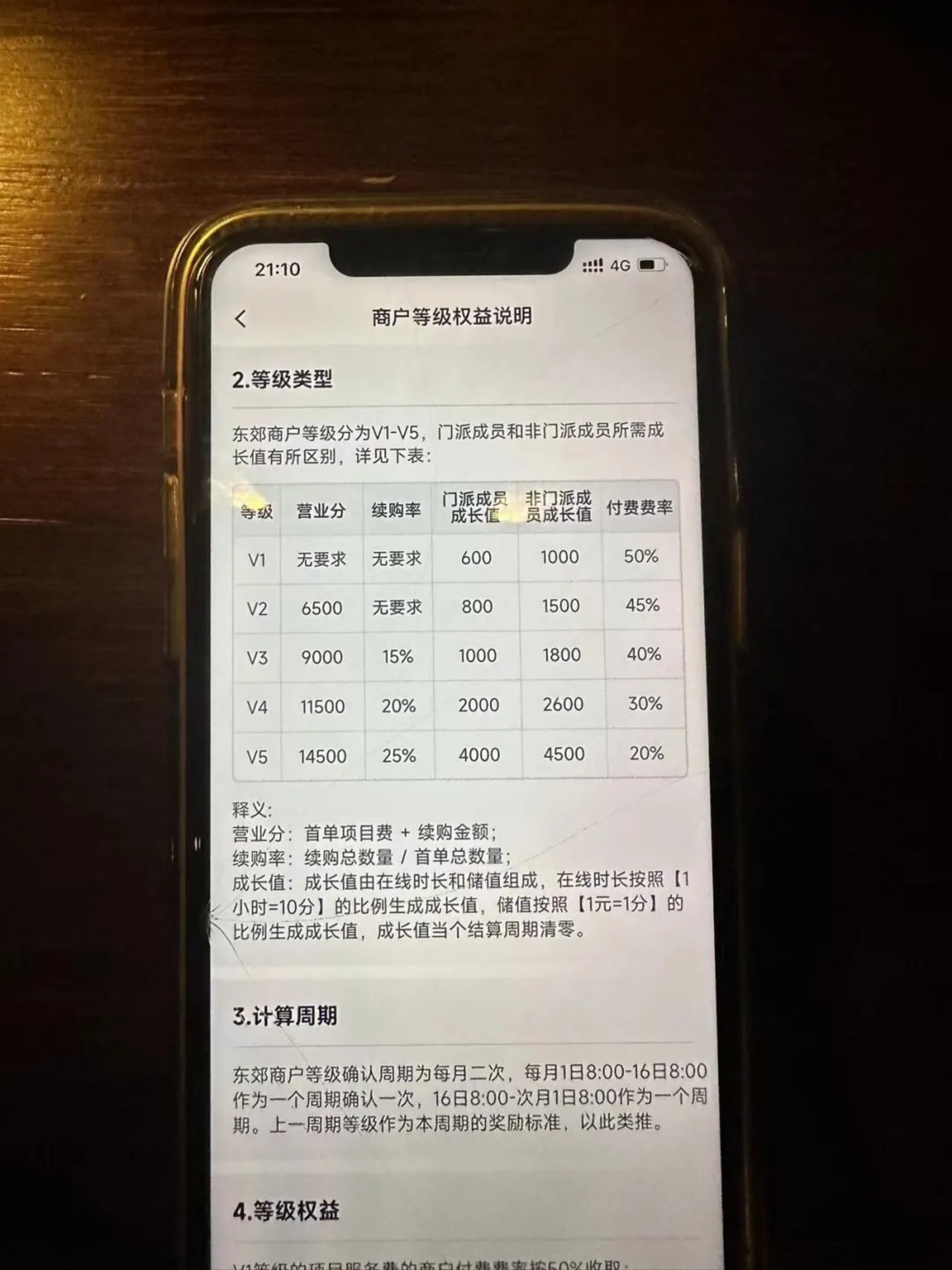
Zhao explained that the “renewal rate” refers to whether a client adds extra time during a session, not repeat purchases. The “growth value” combines online hours and card sales. In a single quarter, online hours alone can contribute around 1,500 growth points; to go higher, masseuses must sell membership cards to customers.
Based on an average order price of RMB 268 and Zhao’s 2023 daily order count, her monthly income would have been around RMB 15,000. But in the assessment period from April 16 to April 30, her personal dashboard showed only RMB 5,500 in turnover. After the platform’s cut, she took home just over RMB 2,000 — a two‑thirds drop.
The Dongjiao Daojia BP claims that as early as 2022, the platform captured over 70% of the market. Yet just as economies of scale were supposedly taking shape, masseuse income plummeted.
Declining income inevitably destabilizes the masseuse team. If more masseuses join, greater choice attracts more customers, creating a virtuous cycle. But if order volume falls sharply, the reverse could happen: masseuses leave, customers follow, and operations become unsustainable.
Early O2O players used heavy subsidies to rapidly expand market share and cultivate user habits. Around 2014, O2O home services became a hot sector. Startups such as TuiTuiXiong, HuaTuoJiaDao, DianMiaoShou, ShangMenBang, and GongFuXiong emerged. GongFuXiong was once valued at over $15 million, and many companies offered its vouchers as employee perks. By 2017, consumers found that GongFuXiong’s app and WeChat public account had ceased functioning.
“The O2O space has seen a shakeout, leaving only the most resilient players. The profit model for O2O home services remains unclear, largely because services account for a large portion of costs, making standardization elusive. Capital has not yet been able to ripen this market,” commented internet analyst Zhang Bocheng. “Today, investment focus has shifted to hard tech like AI. To continue expanding, Dongjiao Daojia will face significant funding pressure.”