Text by Frontline of Entrepreneurship. Authors: Lian Zhou, Feng Yu. Editor: Feng Yu.
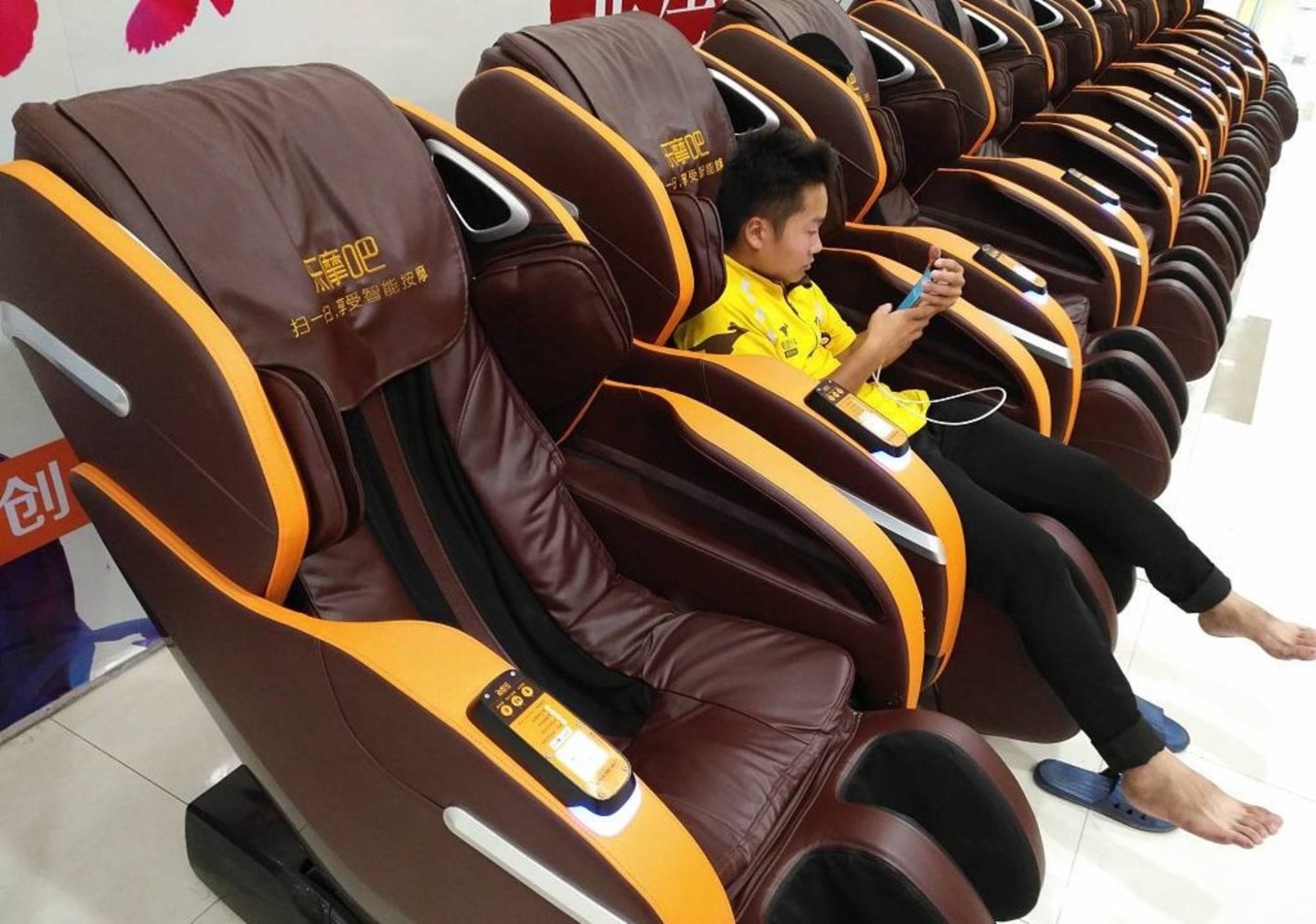
When we walk into cinemas or high-speed railway stations and see the neglected shared massage chairs in corners, it's hard to imagine that they were once the target of fierce capital competition.
For a long time, massage chairs have been rejected by ordinary Chinese families due to their inconvenience to move and high cost. But once the concept of sharing was added, it was like "dropping a bomb" in the industry: users can enjoy massage services in public places at a single, low price.
Purely from a service perspective, shared massage chairs clearly provide Chinese consumers with a "consumption upgrade" in massage services.
Coincidentally, shared massage chairs also caught the industry's spring warming. The global massage器具 market began to recover in 2016, reaching nearly $14 billion in 2018. At the same time, investor enthusiasm for the shared massage chair industry rose: in 2017, shared massage chairs raised 240 million yuan; in 2018, the sector raised 260 million yuan.
However, in 2019, the shared massage chair industry suddenly went silent — not only were there no large-scale financings, but the concept of shared massage chairs was no longer a hot topic among investors.
A promising track suddenly turned cold: is it a problem with the massage chairs, or should the "sharing" concept take the blame? Is shared massage chairs actually a good business?
1. Massage Chairs on the Windfall
Looking back at the development of shared massage chairs, it's not hard to see that the sector's early capital appeal did not rely entirely on the "sharing" tailwind. Chinese consumers' rigid demand for massage accelerated the rise of shared massage chairs.
On one hand, consumers' demand for health-oriented consumption is increasing.
With the improvement of urbanization and the acceleration of urban life, unreasonable eating habits and lifestyles directly affect residents' health. A report by iiMedia Research shows that more than 75% of China's population is sub-healthy, and the distribution across age groups is relatively even.
Today, residents' health needs have shifted from traditional, single medical treatment to disease prevention, health care, and health promotion.
On the other hand, China's aging population continues to accelerate. This group generally has medium-to-high spending power and is the main consumer group for massage chairs.
Compared to the rigid demand for massage, the penetration rate of massage chairs in the Chinese market is far lower than the world average. Huachuang Securities research report shows that the current penetration rate of the massage appliance market in mainland China is only 1.13%, significantly lower than markets such as Japan and South Korea.
Therefore, since "shared massage chairs" appeared in various public places, they have indeed solved the current development pain points of the massage industry, both in cultivating residents' habits of using massage health products and in promoting the development of the massage chair industry.
So what is the actual operating status of shared massage chairs?
Frontline of Entrepreneurship visited and found that massage chairs generally provide users with three types of services: a 5-minute short experience, 20-minute full-body massage, and a 30-minute comprehensive fatigue relief package.
In addition to providing services, shared massage chairs usually charge users in three ways: according to the service item and number of uses, renting the machine to public places and then collecting rent, and providing display advertising space for advertisers to promote.
When deploying points, shared massage chair operators adopt two operating models: direct operation and joint operation. The direct operation model means the brand pays rent to the property for point placement and takes all the revenue. Joint operation means the brand and the enterprise share costs and split the revenue according to a certain proportion, for example, the property bears all costs, the brand provides operation services and takes a certain percentage of revenue, or the property only provides the venue and takes a certain proportion of massage chair revenue according to the contract.
Some industry insiders have optimistically estimated the profit prospects of shared massage chairs: depending on the scenario, one shared massage chair can generate monthly revenue of 600 to 1,000 yuan, and in high-quality scenarios, the cost might be recovered in three to five months.
It is still too early to draw such conclusions. A shared massage chair agent who wished to remain anonymous told Frontline of Entrepreneurship that by early 2019, the total monthly revenue of the 50 shared massage chairs he represented was 10,000 yuan. Spread out, some equipment revenue obviously cannot cover rental costs.
Wu Xiaogang, general manager of shared massage chair brand "Momoda", also said that shared massage chairs have experienced large-scale expansion and encountered many operational difficulties. In the future, enterprises' businesses and structures urgently need to be adjusted to adapt to a comprehensive efficiency-enhancing strategy.
However, the challenges facing the shared massage chair industry are not limited to these.
2. The Unbearable Weight
Frontline of Entrepreneurship sorted out and found that currently well-known shared massage chair operators in the market include major brands such as Le Mo Ba, Momoda, Shuangle, and Maker Street.
In fact, at this stage, the shared massage chair industry is not highly concentrated, and no small giant enterprise with industry integration capabilities has truly emerged.
Beyond the chaotic competition, some industry difficulties have gradually emerged – for example, many players are dragged down by high later maintenance costs.
Taking brand agents as an example, in addition to franchise fees, they must bear exponentially growing maintenance costs.
A practitioner in the massage field once calculated the maintenance cost of shared massage chairs: if there is no patrol inspection and maintenance at the deployment site, mass wear and tear will occur within just a few months, such as leather peeling, beverage and snack spills causing damage to components.
It is understood that the cost of a piece of artificial leather is close to 500 yuan, and switches and electronic components cost 100-300 yuan. If there is more serious damage, returning to the factory also requires paying the technician's repair fee, plus employee rent and site entry fees. Even if calculated as 100 yuan per device per day, the revenue simply cannot cover later costs.
For internet companies, reducing marginal cost may be an important means of seeking profitability. But for shared massage chairs, the situation where economies of scale can reduce costs does not exist.
As the usage time of massage chairs increases, the degree of component damage deepens, and large-scale offline deployment can only further expand losses.
Frontline of Entrepreneurship also found that many shared massage chairs often end up as shelves, unable to be used to their full potential and unable to attract users to consume.
Especially in shopping malls, many customers use shared massage chairs as rest places but do not consume; children jump on the chairs, which over time will cause damage to the equipment.
Moreover, shared massage chairs have also been exposed to safety hazards. According to media reports, as early as 2018, a woman's hair was caught in the gap of a shared massage chair while using it, narrowly escaping disaster.
Undoubtedly, this negative information once again casts a shadow over the shared massage chair industry.
3. The Final Chapter of "Sharing"?
Some industry insiders believe that among the shared economy tracks, shared massage chairs are an underestimated category. Massage is not only a consumption upgrade but also a rigid need in waiting scenarios.
However, judging from the collective ebb of the shared economy, the charm of shared massage chairs has largely faded.
2016 is called the "first year of the sharing economy" by industry insiders. Starting with the entry of shared bicycles represented by ofo and Mobike into the market, thousands of sharing projects emerged in less than two years, and the sharing economy experienced a big explosion.
From shared bicycles and shared cars in transportation to shared power banks, shared umbrellas, and shared massage chairs in daily life — everything was available. In the first half of 2017, this sharing track was crowded, which attracted capital. According to IT Juzi data, the total amount of financing that year reached 10.433 billion yuan.
However, in the second half of 2017, the sharing economy began to decline. Led by shared bicycles, projects such as shared cars, shared basketballs, and shared umbrellas faced a wave of closures.
Shared massage chairs were no exception. In 2018, the field also experienced problems such as excessive large-scale deployment, rising rents, declining cinema foot traffic, and the closure of small manufacturers. The shared massage chair industry entered a period of consolidation, and discussions on profit models remained inconclusive.
Times have changed. Entrepreneurs were once full of expectations for the sharing economy. In 2016, when asked, "Can the sharing economy really make money?" the interviewee might smile and say, "Yes, it can."
When asked again about related issues at the end of 2018, entrepreneurs would say, "The sharing economy is too difficult" — when the company encountered operational difficulties, he decisively closed the company, paid employees' salaries, and refunded all deposits to users.