[TMTpost Image Series "Online" aims to accurately document individuals in the Internet era. All text, photo and video copyrights belong to TMTpost. Reproduction or use without permission is prohibited. Legal liability will be pursued.]
China has over 17 million people with visual impairments, including both totally blind and partially blind individuals: totally blind people have no light perception, while the partially blind have vision lower than 60% of normal vision. Their daily lives and employment are severely restricted due to visual impairment.
Blind massage is the most common profession among visually impaired people, and blind massage shops can be found on the streets of every city. As Labor Day arrives, we focus on these special workers — blind massage therapists — who are the subjects of the 103rd episode of TMTpost's "Online".
As a line in the film "Blind Massage" goes: "Eyes have a division of labor; some see light, some see darkness."
Blind massage therapists have not given up on life due to blindness. On the contrary, they have an even stronger desire to take control of their own destiny than able-bodied people. In real life, they share a common light; within their dark vision, each has their own darkness.
6 people, 6 beds – a simple blind massage shop
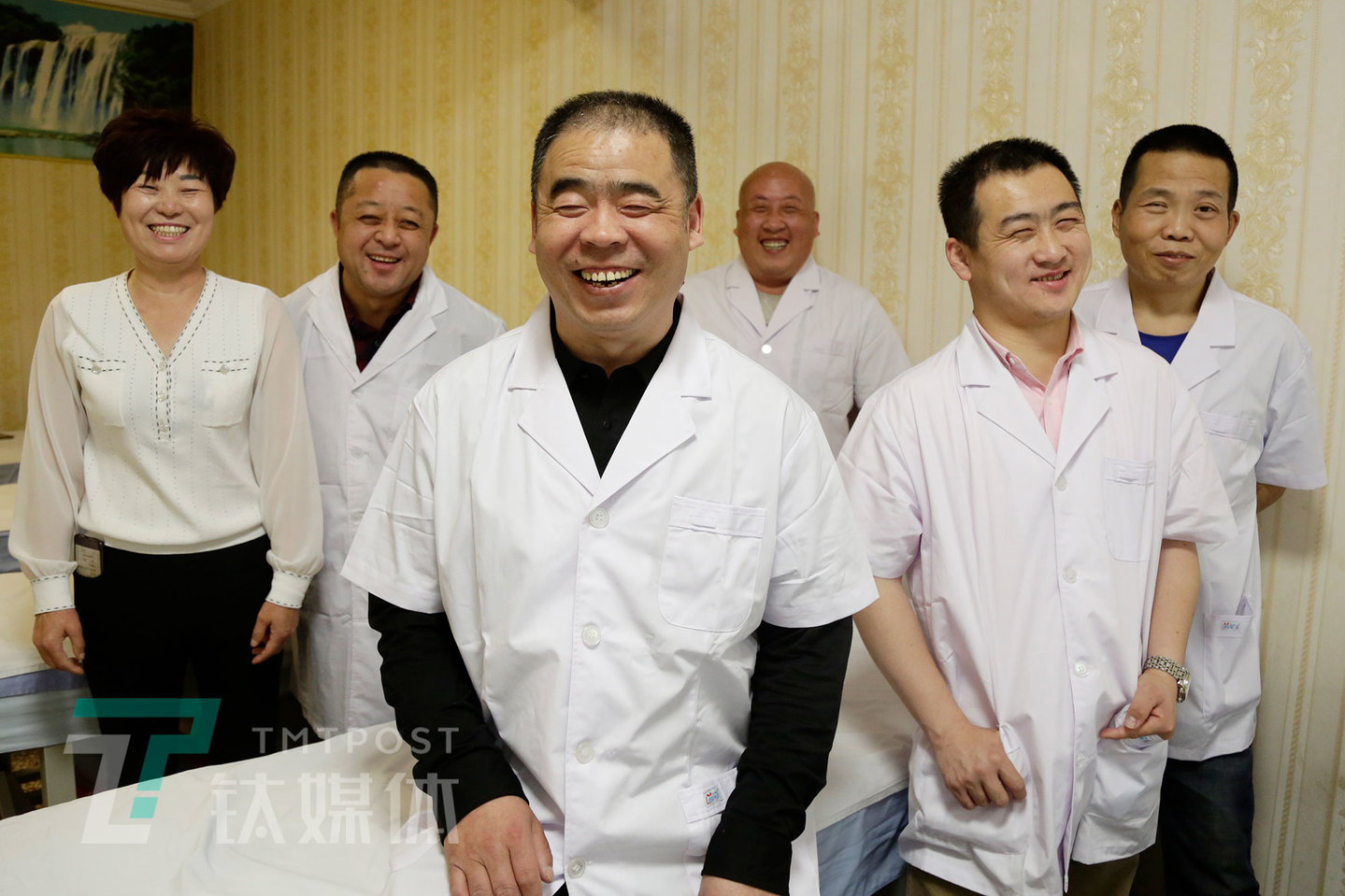
April 24, Beijing. Xinyuantang Blind Massage Shop staff (from left: receptionist Sister Zhang, massage therapist Lao Jiang, shop manager Lao Li, Xiao Lu, Xiao Zhu, Lao Zhang).
Xinyuantang Blind Massage Shop is located near Zaoyuan Station on Beijing Subway Line 4. It is a very ordinary small shop, covering about 40 square meters, with simple decoration and six massage beds taking up most of the space.
The shop opened in 2016 and has five massage therapists and one support staff member, each with their own story.
Boss Lao Li and massage therapist Lao Jiang are totally blind. Massage therapists Xiao Lu and Lao Zhang are partially blind. Massage therapist Xiao Zhu has normal vision but a physical disability — a high fever at age one caused encephalitis, leaving him with unsteady walking as a lasting aftereffect.
Support staff Sister Zhang is not disabled. She is responsible for cleaning, changing sheets, and buying and cooking food for everyone.
The shop opens at 9:30 every morning and closes at 11:00 PM. A half-hour massage costs 60 yuan, and one hour costs 100 yuan. On average, 20 to 50 customers visit each day, most of them local residents.
The shop provides room and board. Massage therapists have a guaranteed monthly salary of 4,000 yuan, with performance pay calculated by the number of hours worked. Each person earns between 4,000 and 6,000 yuan per month.
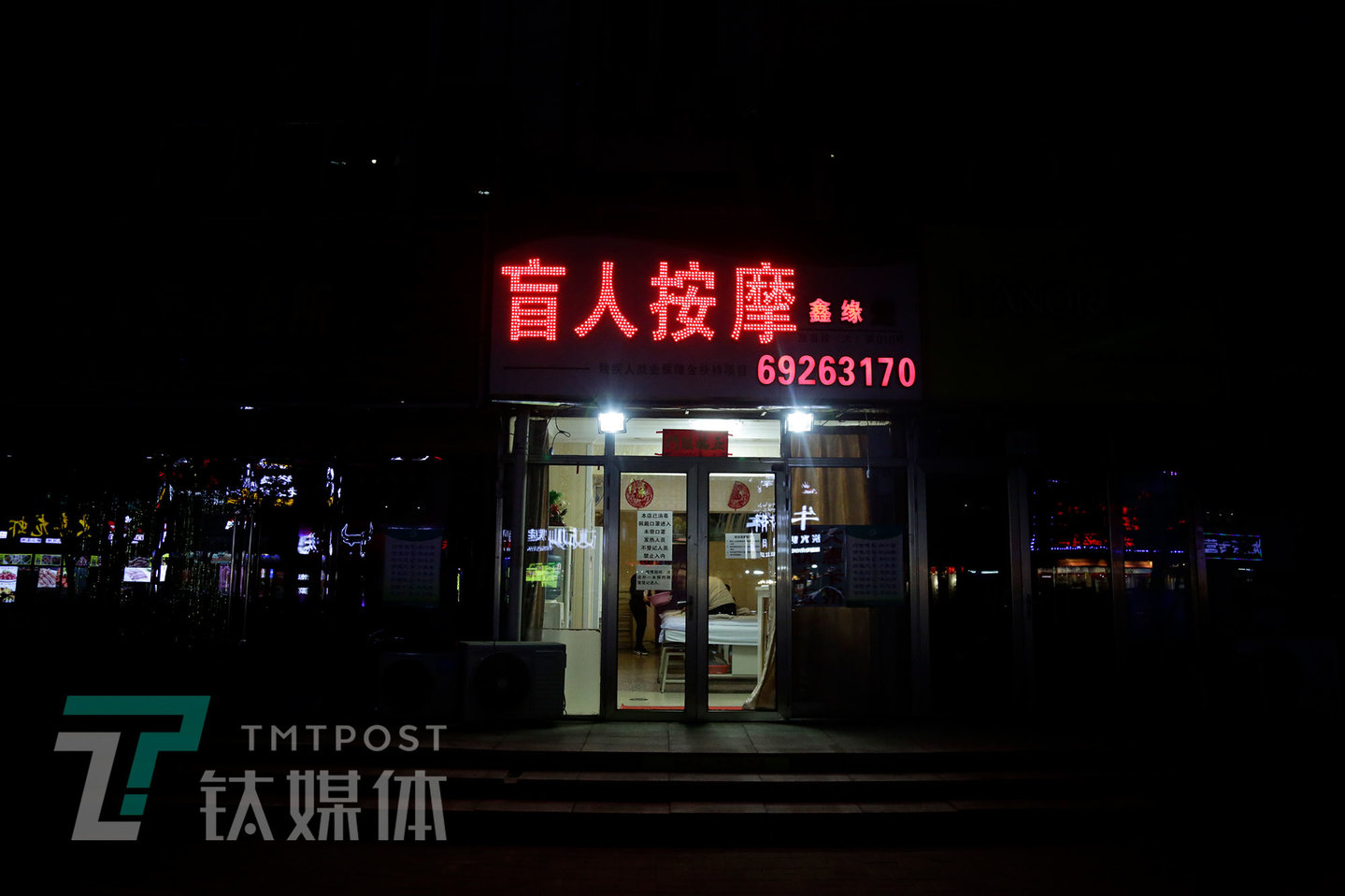
22:28, April 22, Beijing, Xinyuantang Blind Massage Shop.
The shop closed for the New Year holiday in mid-January 2020, and everyone went back to their hometowns. At the end of January, the pandemic broke out. Lao Li told everyone not to rush back to Beijing after the holiday and to wait until it was safe to resume work.
Affected by the pandemic, the massage shop was closed for nearly three months and only resumed operations on April 16. In the first week back, customer traffic was nearly half of what it was before the pandemic.
Lao Li said the landlord did not reduce the rent. To help business recover more quickly, the shop launched a 50% discount on membership cards.
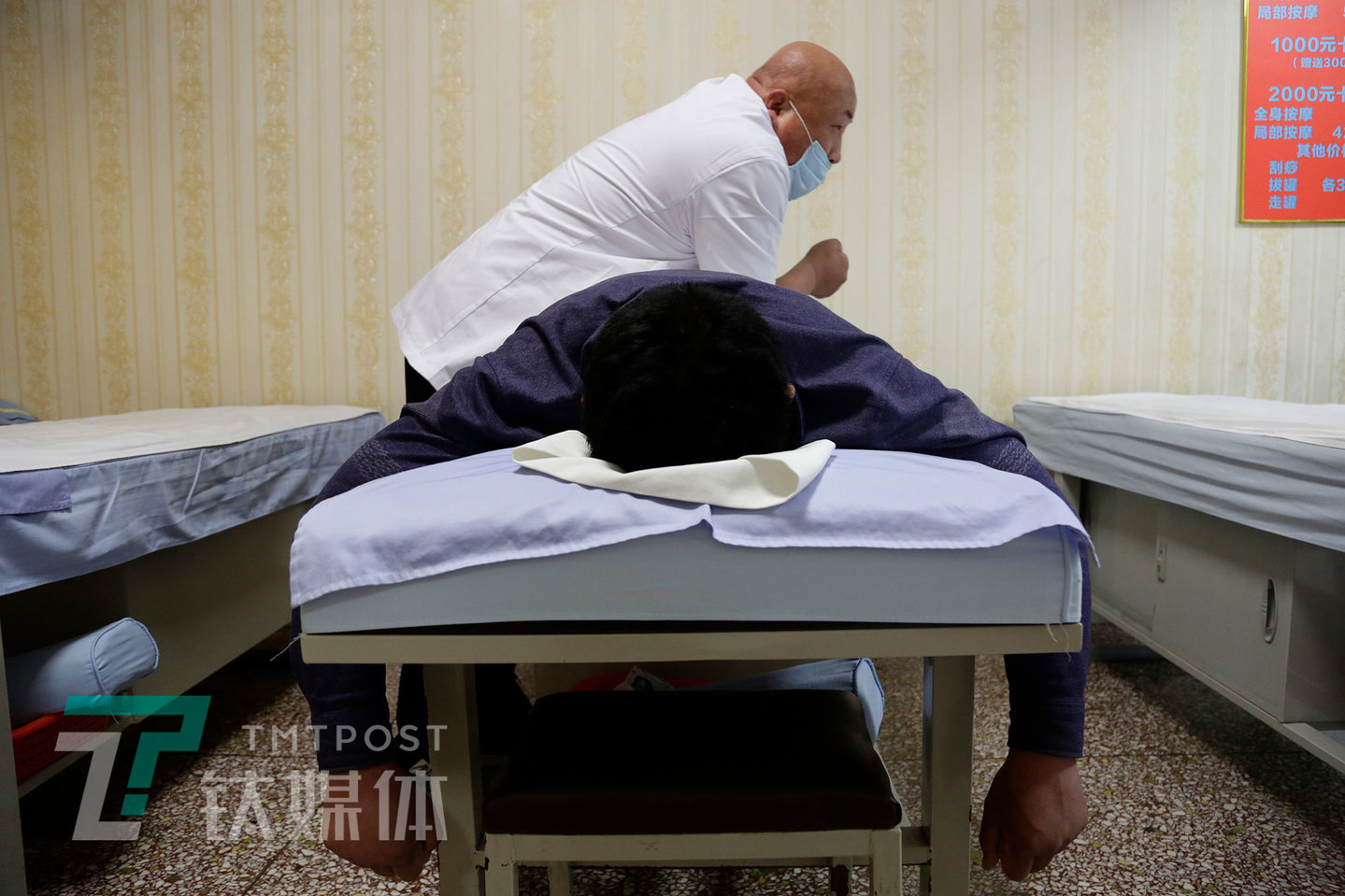
Xinyuantang Blind Massage Shop: blind massage therapist Xiao Lu working on a client.
During the pandemic, Xiao Lu kept busy back in his hometown. He used his massage skills to attract customers, massaging villagers for 30 yuan per session, earning more than 2,000 yuan over those two months. He said, "I'm quite content."
A 1.5-point difference: fainting after failing the college entrance exam, high fever damaged the optic nerve
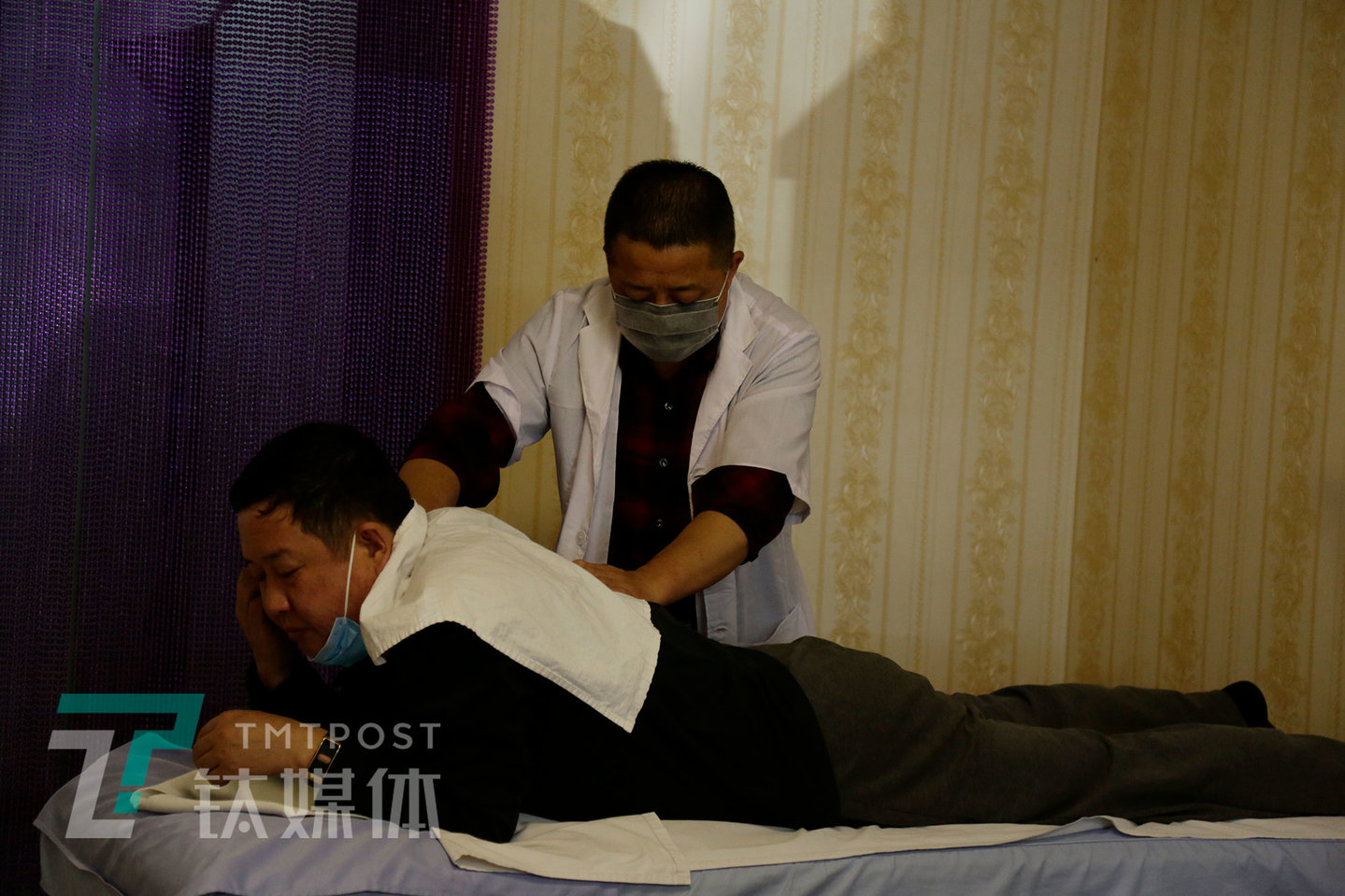
Blind massage therapist Lao Jiang giving a massage.
Lao Jiang, 48, is totally blind, but he wasn't born blind. The turning point in his life came 27 years ago, when he was just 21 years old.
In 1993, 21-year-old Xiao Jiang was a senior high school student in Daqing, Heilongjiang, working hard to prepare for the college entrance exam.
To get more study time before morning self-study, he got up earlier than his dormmates every morning and often went alone to the grove behind the teaching building to memorize. His life revolved around the classroom, dorm, and cafeteria; even while walking or eating, he was "racing against the clock" thinking about exam material.
Lao Jiang said that for him, getting into university was the only way to leave the countryside. If he didn't get in, he would have to farm the land at home. He didn't want to be a manual laborer or work on a farm; he wanted to be a knowledge worker and become the first university student in his family.
His dream was to be admitted to Beijing Normal University, then become a high school Chinese teacher, with a "tenured iron rice bowl" for life.
After the exam, while waiting for the results, the anxious Xiao Jiang started having a fever and caught a cold. Fever reducers didn't help, but he didn't go to the hospital. He was too eager to see his name on the acceptance list, thinking only about "scores and cutoffs."
On the day the results were released, Xiao Jiang excitedly rode his bicycle 20 kilometers from his village to the county seat. Sweating profusely, he squeezed through the crowd to get to the bulletin board.
Perhaps from nervousness or the fever, when he stood before the list, Xiao Jiang couldn't see the characters clearly. On the bright red paper, the black brushstrokes all appeared as blurred double images.
Xiao Jiang asked a classmate to help find his name and the cutoff score for Beijing Normal University. After a while, the classmate told him the result: "You got 585.5. Beijing Normal University's cutoff is 587."
585.5, 587 — just 1.5 points short! That 1.5 points shattered him. He "completely broke down" and fainted on the spot.
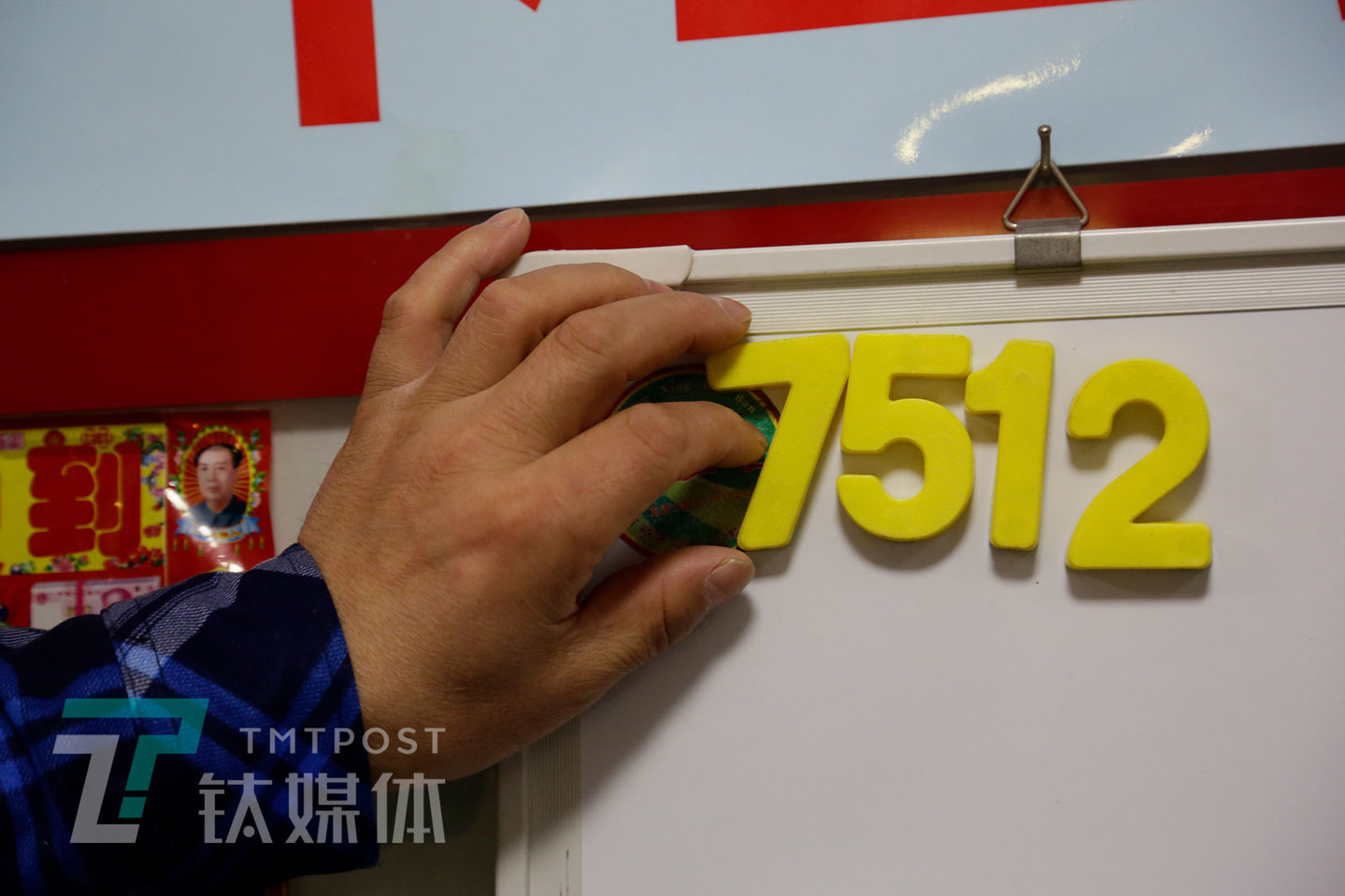
Numbers of the four blind massage therapists: 7512 correspond to Lao Jiang, Xiao Lu, Lao Zhang, Xiao Zhu.
Teachers and classmates took him to the hospital. When he opened his eyes again, he still had a fever, especially a burning sensation in his eyes. His anxious parents begged the doctors to use the best fever reducers.
No fever reducer worked. The fever persisted.
One night, thirsty, Xiao Jiang picked up a glass of cold water by his hospital bed and drank it down. Not long after drinking, his vision deteriorated rapidly until everything was blurry, "as if covered by a layer of gauze."
Xiao Jiang was diagnosed with "optic nerve damage caused by high fever." The doctor said it was an irreversible eye disease — his vision would gradually worsen until he became completely blind.
At 21, Xiao Jiang could have tried again for the exam, but the irreversible optic nerve damage was like an abyss of darkness, making him live in the despair of his light fading day by day.
His first choice was Beijing Normal University. His second choices were Northeast Normal University and Shenyang Normal University. His third choices were Suihua Teachers College, Hulan Teachers College, and Jilin Teachers College.
He met the score for his second choices but was not admitted. In the end, he was accepted to Suihua Teachers College, his third choice. But because he could no longer see clearly enough to read, he gave up on university.
After being discharged, Xiao Jiang shut himself in his bedroom. He refused to socialize, didn't go anywhere, did nothing. Except for meals, he stayed in bed.
"If I had gotten into university, I'd be in Beijing right now, sitting in a classroom. If I hadn't missed by 1.5 points, I might not have fainted. If I hadn't gotten sick with a fever, I would have been able to repeat the exam."
Lying in bed, his thoughts racing, the more he thought, the more hopeless his life seemed. The son his parents had seen as "quiet, introverted, and sensible" became irritable and "prone to losing his temper."
No one dared to mention "eyes." His parents could only carefully reassure Xiao Jiang: "Don't be afraid. We'll do everything we can to find a doctor and treat your eyes."
From 1993 to 1998, for five years, Xiao Jiang's parents took him to major hospitals across Northeast China to treat his eyes. After each examination, nearly all the doctors advised them to give up: this eye disease was a global medical challenge — incurable, with no possibility of recovery.
In 1998, after a visit to the First Bethune Hospital of Jilin University, his parents were preparing to take Xiao Jiang to Beijing for treatment. The doctor told the family: "You're from the countryside; it's hard work to earn money. Believe me, don't go. Even if you go, the doctors there will tell you the same thing as I am."
The doctor said that ophthalmologists nationwide share knowledge and research on such difficult cases: "I'll be honest with you. It's best to give up sooner. Continuing to seek treatment will only waste money. This disease really cannot be cured."
To treat Xiao Jiang's eyes, the family spent over 30,000 yuan, half of which was borrowed from relatives. At the time, that was a considerable sum for a rural family.
After five years of traveling to hospitals and following the doctors' advice, they gave up and stopped visiting medical centers.
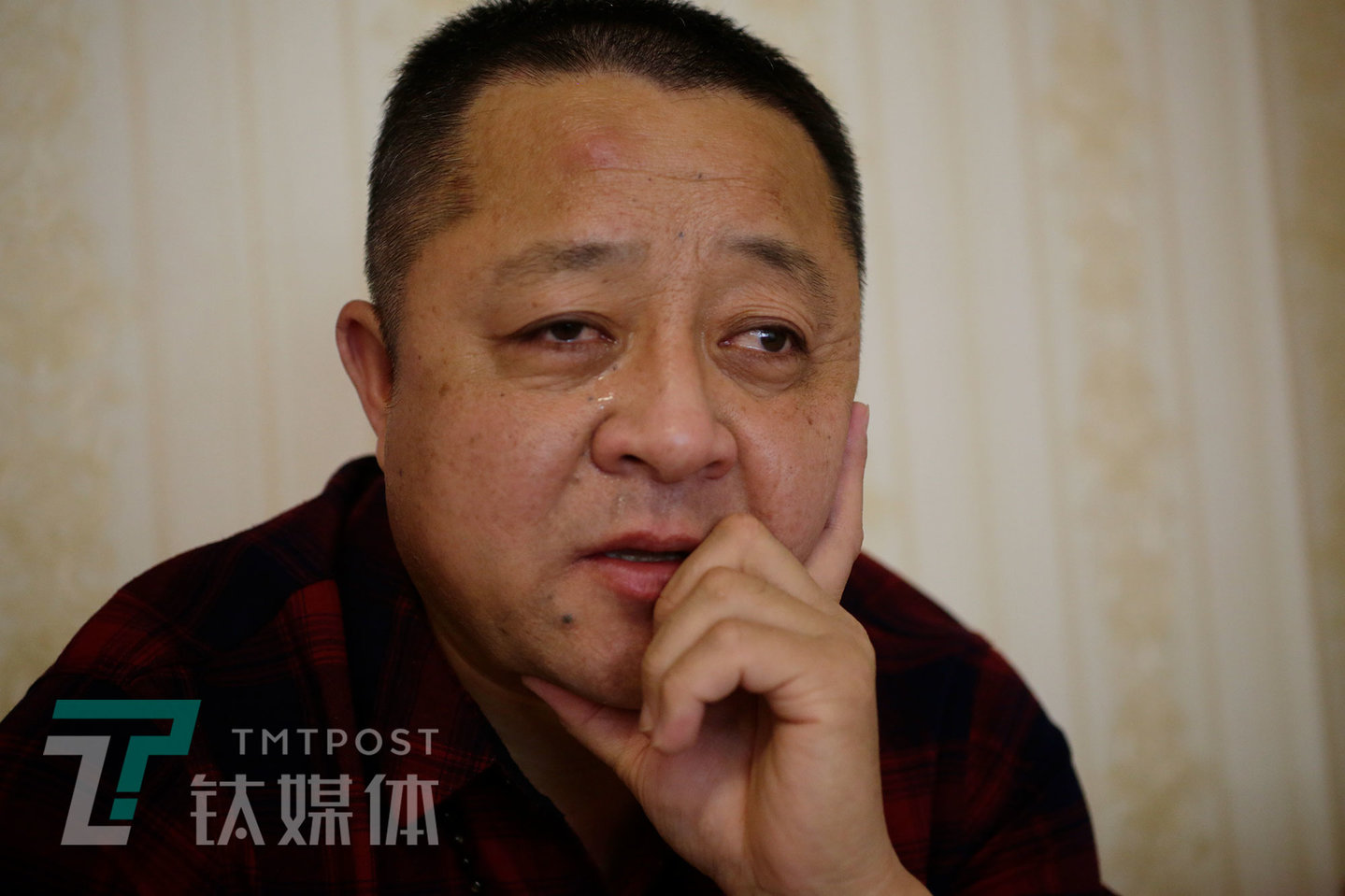
April 24. Lao Jiang recalls the past, thinking of the hardships his parents endured for him, and tears begin to fall.
Xiao Jiang understood that his parents actually bore even more. Once, he saw his mother wiping tears while cooking in the kitchen. The sight made him cry too, but he quickly wiped away his tears and went to comfort his mother.
In his despair, his vision gradually deteriorated. When he was discharged in 1993, he could still make out people's faces. Six months later, he couldn't see the road clearly. After a few years, the large farm tractor was only a blurry shape. Later, he couldn't even make out the shape of the tractor.
Nine years of struggle before accepting reality; entering a blind school changed his life
Xiao Jiang spent nine years in self-isolation. During those nine years, he thought about suicide, but the thought of his parents made him abandon those ideas. Xiao Jiang became Lao Jiang and began to accept reality, deciding to step out.
His parents were aging, and he would eventually have to live on his own as a blind person. He understood that he needed a skill to support himself, so he took a relative's advice and went to a blind school to study massage.
Back in 1993, a relative had suggested he go to a blind school, but he flatly refused. He firmly believed his eyes could still recover and didn't want to be seen as disabled. He even felt that attending a blind school was an insult — he didn't want to be around other blind people.
The first step out was to acknowledge his identity as a "disabled person" and get a disability certificate. Lao Jiang first had a physical exam and then went to the Disabled Persons' Federation to complete the paperwork.
"Enough under the clothes, not losing ambition." His family helped bring the certificate home. He recalled that day in 2002 when his father handed him a "booklet," telling him it was his disability certificate.
The "booklet" was smaller than his palm. He repeatedly felt the cover with his hands. After nine years of struggle, his identity was now finalized. At that moment, he accepted that he was a person with a disability.
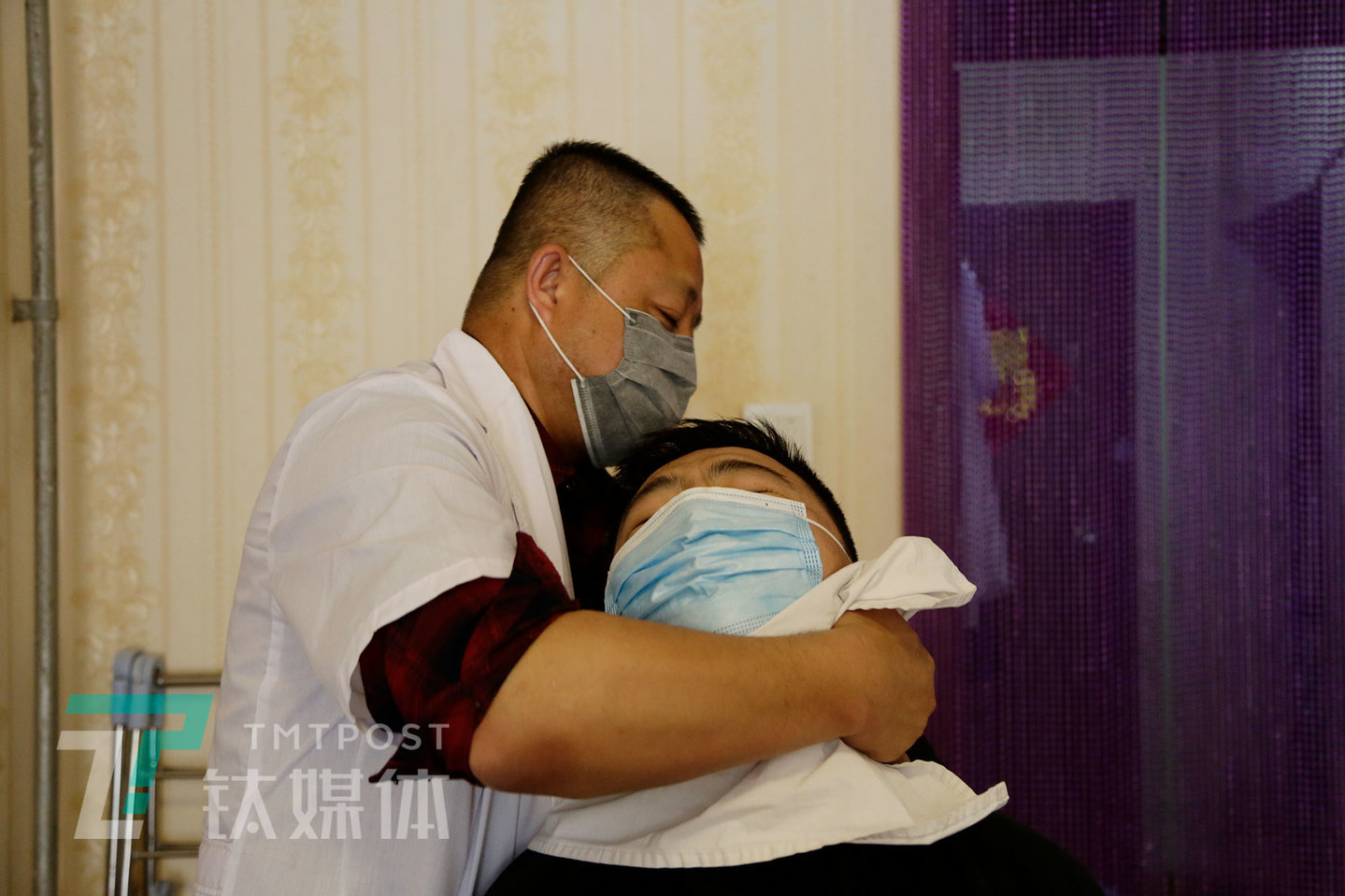
Lao Jiang giving a massage to a client.
In May 2002, Lao Jiang entered the blind school. He found that many classmates had even worse vision than him. Besides the blind, the school also had students with physical disabilities, some even paralyzed. By comparison, Lao Jiang felt a sense of contentment.
"I may be blind, but I can still walk, work, and earn a living. Many people have harder lives than me." Lao Jiang's mindset began to change. He became more outgoing.
Starting with Braille, Lao Jiang studied massage theory, acupoints, and techniques. Through interaction with classmates, his thinking became more active.
Lao Jiang felt that before entering the blind school, he was "a frog at the bottom of a well — never stepping out and not letting anyone in. After entering the school, he became a frog that had jumped out to see the world."
The teachers were "very patient." If Lao Jiang couldn't learn something in one try, the teacher was willing to teach him ten times. His studies at the blind school completely changed his life.
Lao Jiang studied at the blind school for two years, graduating in 2004. That year, at age 32, he left home alone to work and support himself. He worked in blind massage shops in cities around his hometown, as well as in the provincial capital Harbin and in Shandong province.
By 2010, Lao Jiang had become totally blind. He could no longer see anything at all.
Lao Jiang offered an analogy to TMTpost's "Online":
The feeling of losing vision is like watching a candle burn. At first you see the flame, then a weakening flame, then only a little light, then complete darkness, and finally you can't even see the candle.
Over the years, Lao Jiang encountered all kinds of clients.
At a blind massage shop in Daqing, someone once pointed at Lao Jiang and said, "Let that blind guy come and give me a massage." The "insult" enraged Lao Jiang. He shot back, "How can you talk like that? Even if you offered me ten thousand yuan, I wouldn't do it. Find whoever you want!"
Lao Jiang felt that people who truly respect others wouldn't speak that way. From then on, whenever anyone called him "blind person" directly in the shop, he would immediately show them out and refuse service.
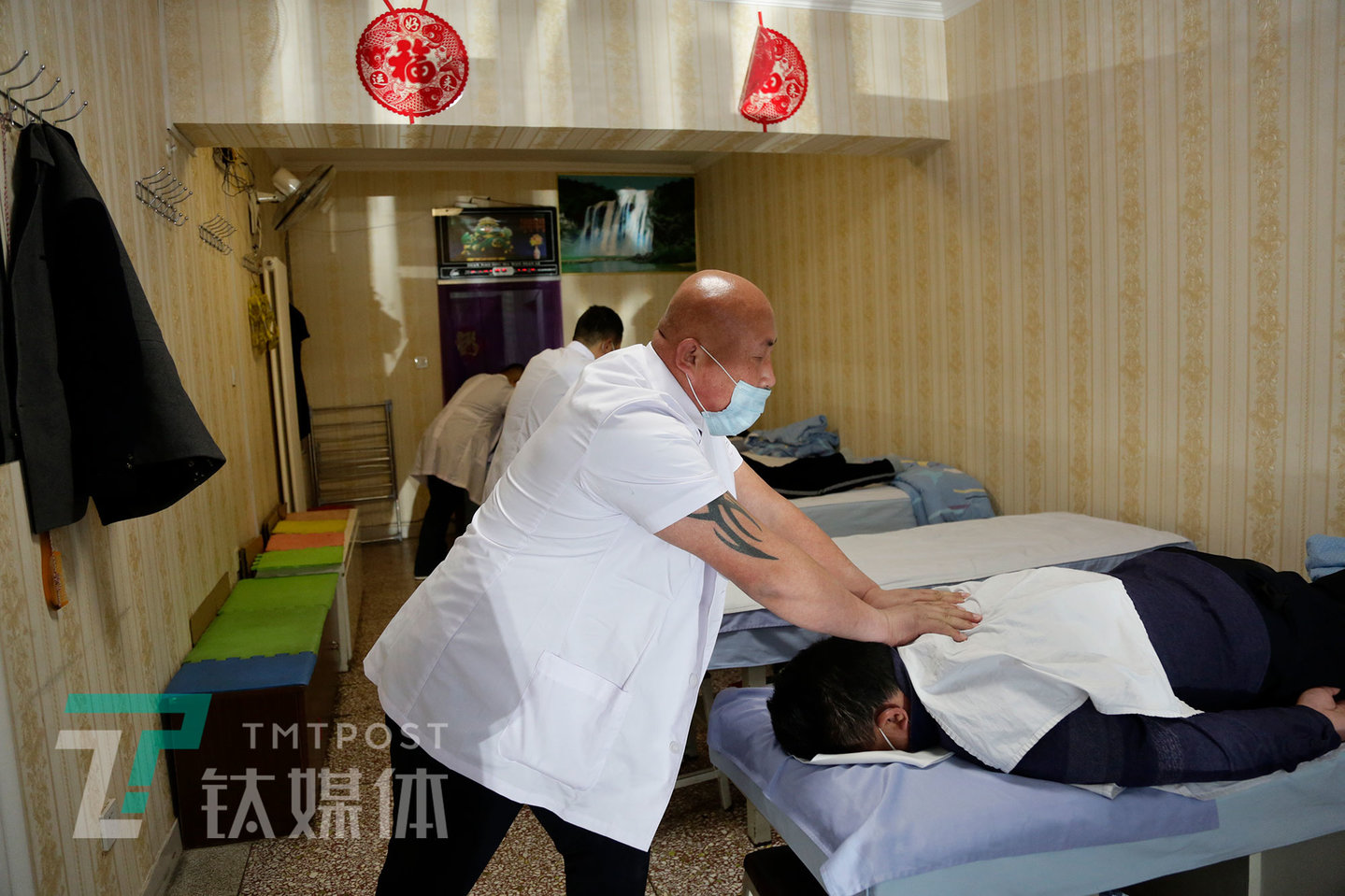
April 22, Beijing, Xinyuantang Blind Massage Shop.
Lao Jiang came to Beijing in 2015 and has been working there for five years. He really likes the city. He gets up at 7 AM every day, doesn't get off work until after 11 PM, and returns to the staff dormitory. He sees 4–10 clients daily.
"Customers are very polite. During holidays, some give us zongzi and mooncakes, and drive us to nearby attractions." Lao Jiang told TMTpost's "Online" that Beijing customers are courteous and no one has ever called them "blind person" directly in the shop.
Lao Jiang says that blind massage is very technical. Apart from pressing acupoints, it includes techniques like kneading, tapping, rubbing, chopping, and more. Most importantly, you have to understand traditional Chinese medicine.
Through massage, he can tell if a client has "a good appetite," "has internal heat or constipation," or even if "they have been injured before." Based on his assessment, he gives clients advice on how to regulate their health.
When clients feel comfortable after a massage and thank him repeatedly, Lao Jiang feels very satisfied. "It's a feeling of being needed. Their 'thank you' is my achievement. Using my own hands to relieve others' fatigue shows my value and that I am a useful person."
At 48, he longs for love and wants to stop drifting
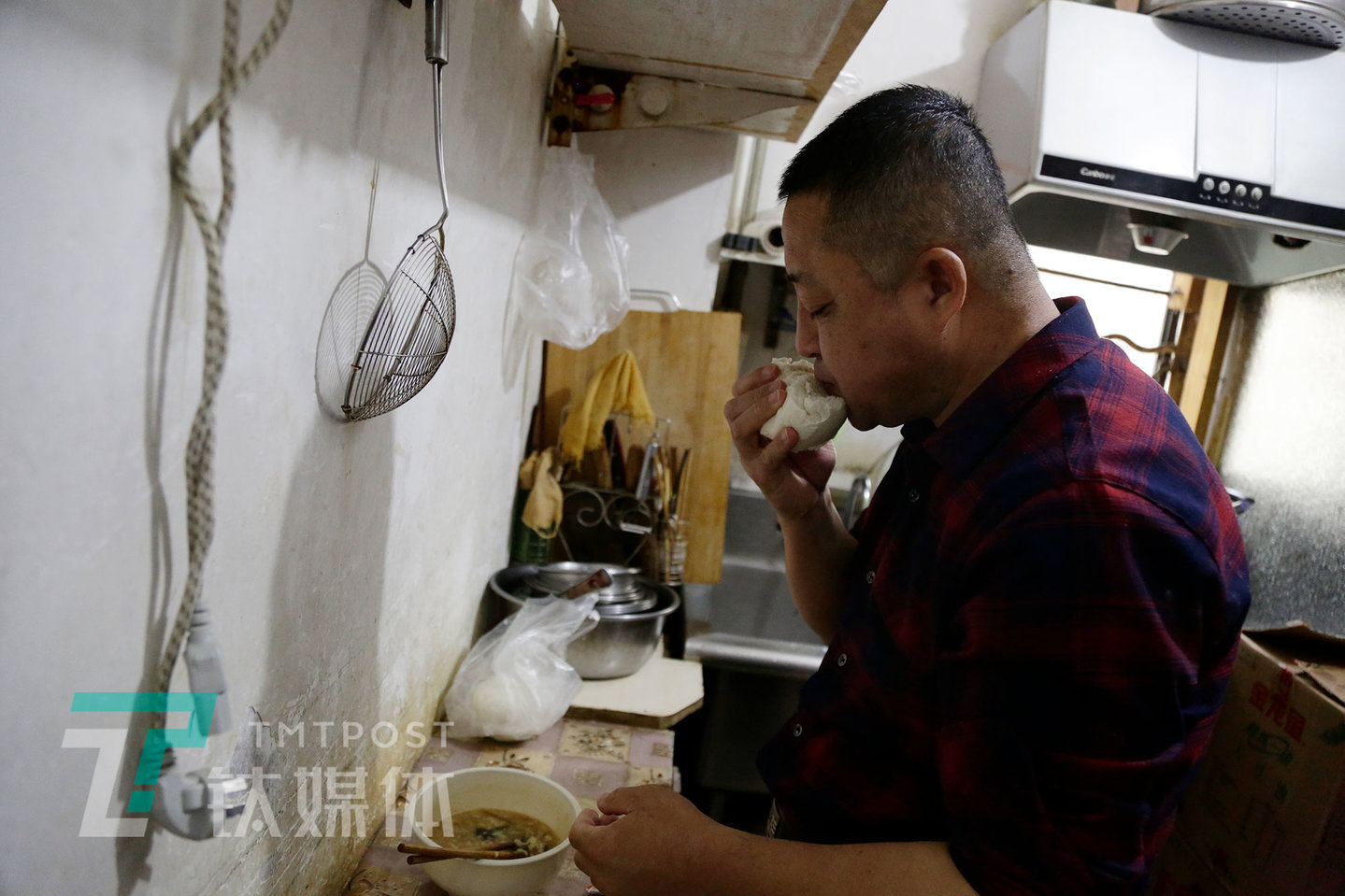
Lao Jiang eating dinner in the staff kitchen.
Lao Jiang wants to get married and start a family, but "the right fate hasn't truly arrived."
He has been in three romantic relationships, all with women he met through matchmaking. In contrast to many able-bodied people who "look at conditions," blind people look not at "status, position, car, house," but at physical ability.
His three girlfriends were, respectively, totally blind, paralyzed, and partially blind. All three relationships ended without result.
Lao Jiang says his favorite was the second woman, but her paralysis was deteriorating. She would eventually become completely unable to care for herself. Considering his own total blindness and inability to care for her in the future, he chose to let go.
"Not having a family means not having a complete life." Lao Jiang wants to find someone whose physical condition is not too much worse than his own, so they can simply live day by day, because for the rest of their lives, they need to "have the ability to take care of each other."
In his five years in Beijing, Lao Jiang has rarely gone out for recreation. Like the other massage therapists, his life is a back-and-forth between the massage shop and the dormitory.
On April 8, 2016, a friend took him to the Great Wall. While transferring buses, they passed by Beijing Normal University. The friend casually mentioning that they were passing the university gate stirred old memories for Lao Jiang.
"Walking past the school gate — it's not a long stretch of road, just a dozen steps — but that day I felt like I walked for a very long time. It was the longest passing by in my life." Lao Jiang told TMTpost's "Online."
His greatest hope is that his parents stay healthy and that he is not a burden to his family. He dreams of opening his own massage shop and ending his life of drifting. He wants to stabilize his life as soon as possible, find a kindred spirit to form a family, and live his days well.
Blind from a fever at age 2, started learning massage at 29, and at 49 regrets "the child wishes to care for parents, but they are gone"
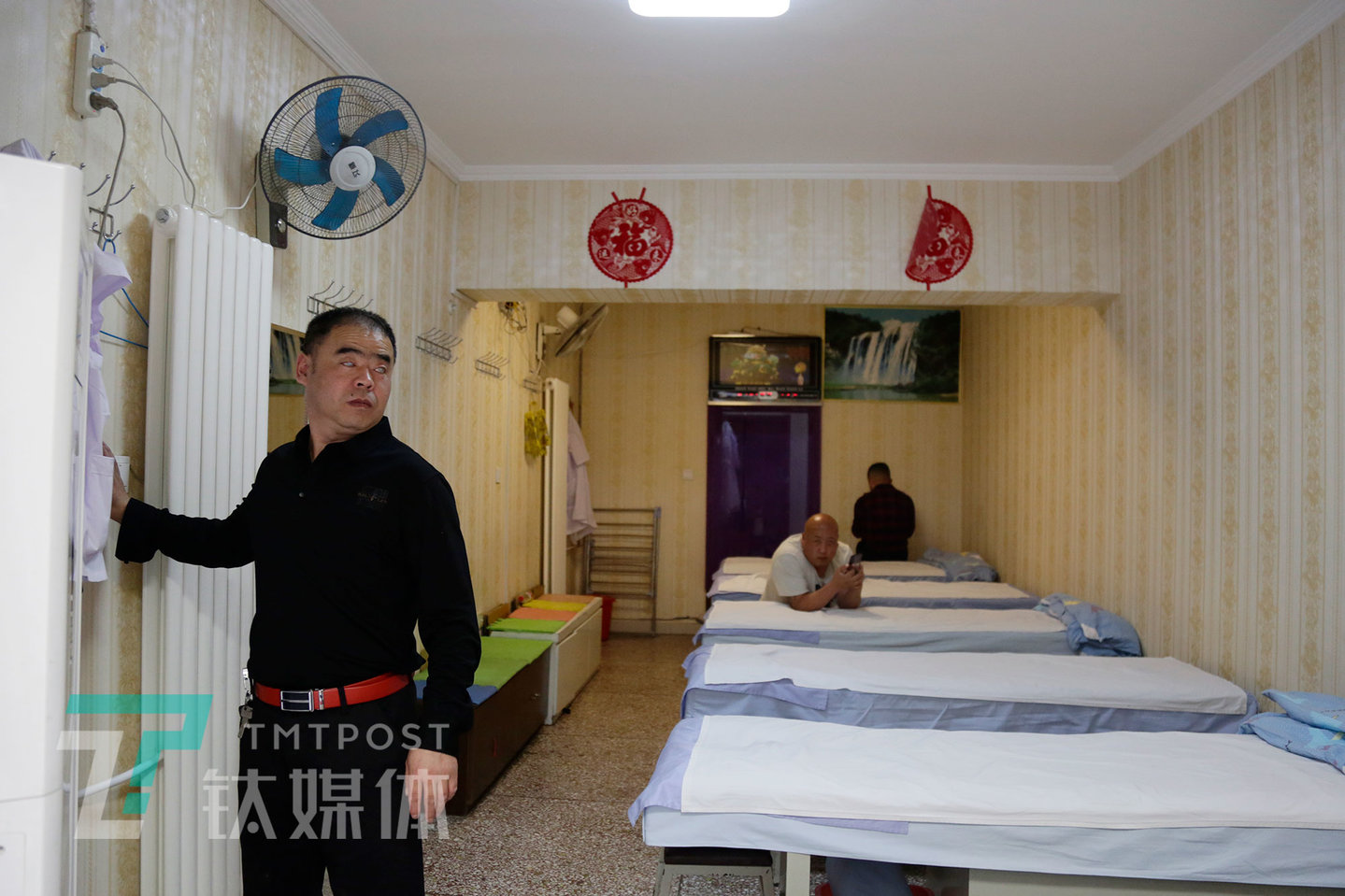
Xinyuantang Blind Massage Shop, owner Lao Li (left).
Xinyuantang's owner, Lao Li, came to Beijing in 2005 to start his business. He opened Xinyuantang four years ago. A native of Harbin, he is totally blind. A high fever when he was two years old destroyed his eyes. He has no memory of seeing the world clearly.
Although totally blind, Lao Li can still tell day from night. When he opens his eyes, the whites are all that show. He rarely opens his eyes, afraid of "scaring people."
Lao Li grew up in the countryside. His family was very poor, and being blind, he grew up with "nothing to do."
At 19, he first heard about "blind massage" on the radio. The program featured a school principal who had struggled to establish a blind massage school and train blind massage therapists who could support themselves.
Lao Li listened attentively and was deeply moved. There were so few jobs available for blind people. At that moment, he decided that if he ever had the chance, he would learn. So at 29, he enrolled in a blind school. For Lao Li, this was the biggest turning point in his life.
Before entering the school, Lao Li was very introverted. Whenever a stranger came to his home and spoke to him, he would get so nervous that his face would burn. At the blind school, Lao Li slowly opened up and began practicing public speaking to build his confidence.
He learned Braille, studied massage, and made many friends at school. After graduating, he worked as a blind massage therapist in Heilongjiang, Liaoning, and Ningxia before moving to Beijing in 2005. He opened Xinyuantang Blind Massage Shop in 2016.
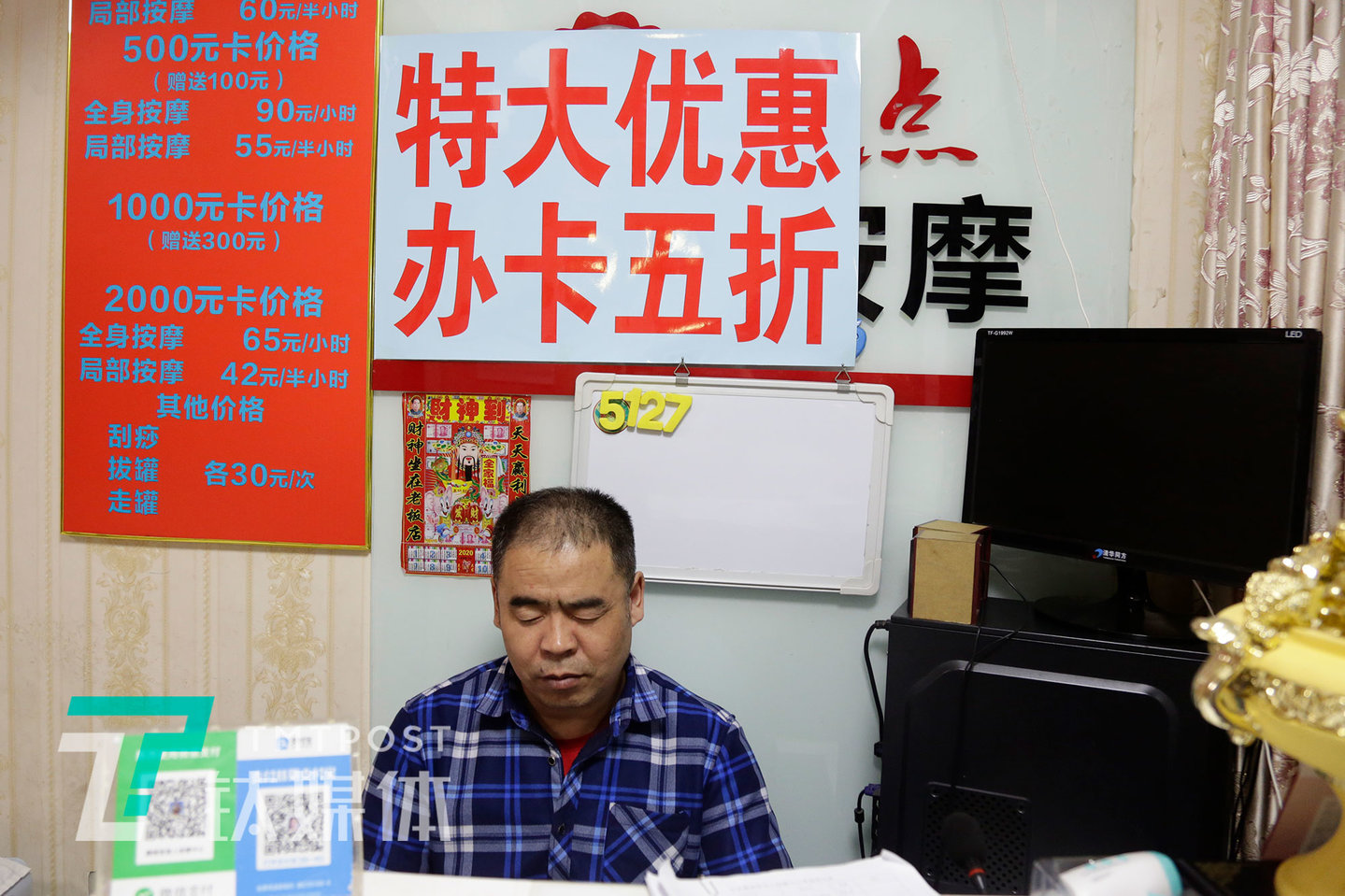
Lao Li at the cash register. Behind him, the wall features a price list and an ad for discounted membership cards.
In the shop, Lao Li doesn't do much massage. He is mainly responsible for cashiering and recording customer information.
His "memory is extraordinary." All customer information is stored in his mind. By the time a customer has spoken three sentences, he can quickly retrieve their exact details.
"When God closes a door, he opens a window." Lao Li says that blind people's hearing and memory are much better than those of sighted people.
Using screen-reading software, Lao Li can operate a computer without obstacles. In 2008, a friend told him that computers would become universal and the internet was the future. So he bought a computer and started learning from scratch.
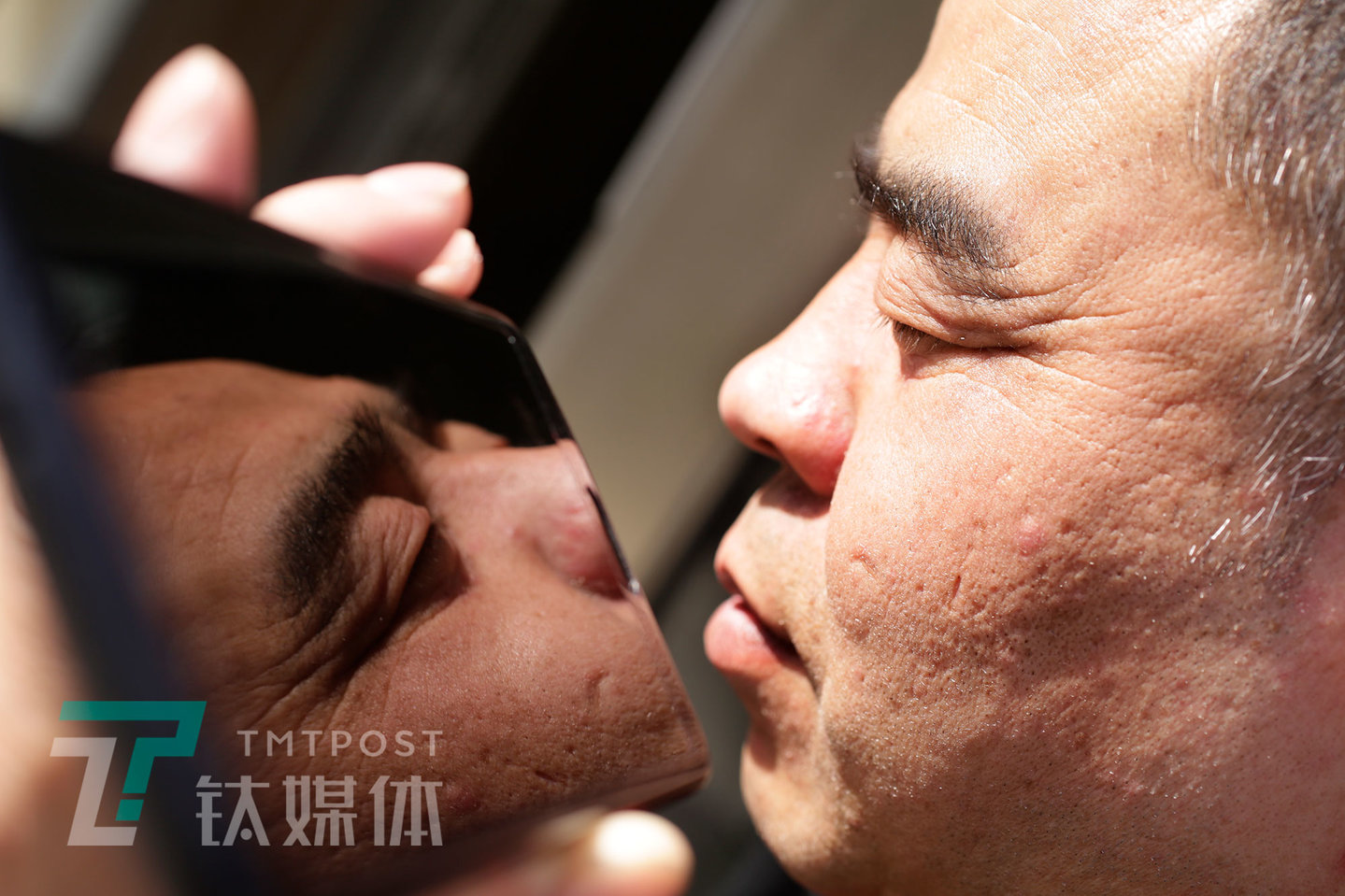
Lao Li sitting at the door, listening to the news on his phone.
Lao Li enjoys following the news — the latest pandemic developments, domestic and international events, and what new decisions US President Donald Trump is making. He pays close attention to all of it.
He also likes literature and has read the novel "Blind Massage" by Bi Feiyu. He feels the book contains too much artistic license: "Real life isn't a novel, but it's still a good thing that sighted people are willing to pay attention to our community."
Lao Li has a happy family. His wife is partially blind, and his 10-year-old son is healthy. Speaking of his son, Lao Li's face lights up with happiness. He still remembers the day his son was born.
On July 10, 2010, his wife went into labor. Five people — family members and neighbors — were waiting outside the delivery room. After more than two hours, the baby was born, and everyone crowded around to see the child, seemingly forgetting that Lao Li was blind.
Lao Li sat dumbfounded in his chair. He couldn't see anything and didn't know where to go. Only later, after they had seen the baby, did they remember Lao Li still sitting outside.
During his wife's month of postpartum confinement, Lao Li didn't dare touch his son. The first time he held his son, he felt like he was holding a bomb; his limbs stiffened.
"I couldn't touch him, didn't know how to hold him. He was so small and soft — I was afraid I'd drop him." Lao Li held the baby for just a few minutes before putting him down, but in his heart he was filled with joy.
His wife and son now live in Gu'an, Hebei. His wife stays at home full-time to care for their son. They call Lao Li whenever they have time.
His son is outgoing and always talks nonstop during their calls. Lao Li listens quietly with a smile as his son shares trivial school matters, occasionally asking about his studies and whether "he's been listening to his mother at home."
On the phone, his son likes to play brain teasers with him, something that always makes Lao Li very happy. His son, though a bit mischievous, is very understanding and is his driving force for the second half of his life.
When his son was two years old, he touched Lao Li's eyes and said, "Daddy's eyes are broken." Lao Li deliberately teased him: "Yes, Daddy's eyes are broken. I can't even walk. What should I do?" The son replied, "Don't worry, Daddy. From now on, I'll lead you wherever you go."
"My son is my eyes," Lao Li told TMTpost's "Online." As the child grew up, he indeed often took Lao Li out.
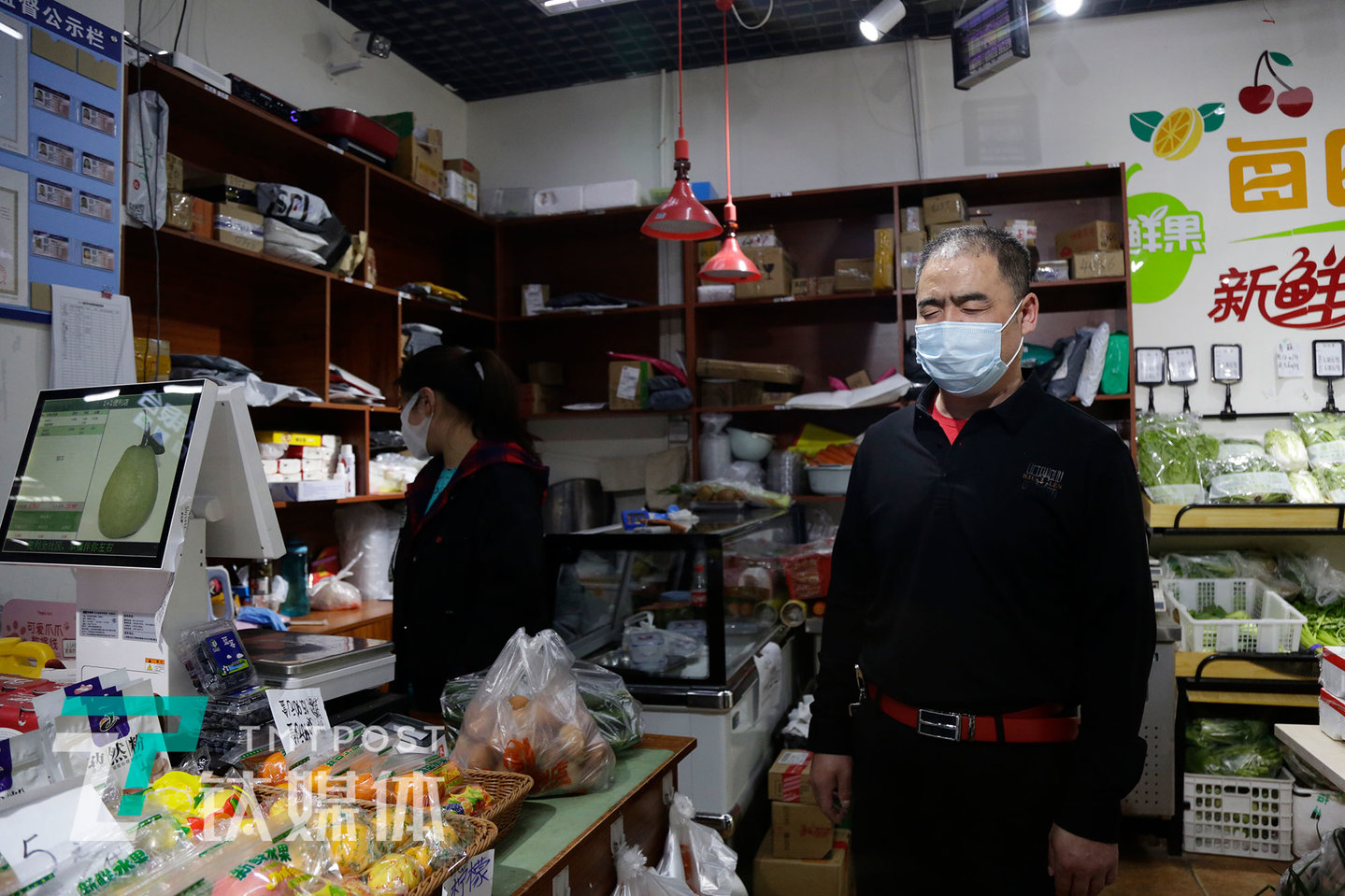
April 24, at a supermarket on Liyuan Road, Huangcun, Daxing District, Beijing. Lao Li goes shopping.
In truth, unless absolutely necessary, Lao Li rarely goes out alone. "For a totally blind person with decent self-care skills, a white cane can allow some freedom of movement, but the vast majority of people cannot do it," Lao Li told TMTpost's "Online."
Lao Li knows from experience that in many cities, tactile paving is often occupied by bicycles, motorcycles, facilities, or even utility poles — sometimes connected to manhole covers — making it "impossible for blind people to walk."
"If this happens in a big city like Beijing, it's even worse in third- and fourth-tier cities," Lao Li laments.
Taking the bus is also difficult. Many buses arrive at a stop simultaneously, but they don't have audio announcements, making it hard for blind people to know which bus is theirs.
"Occasionally you run into volunteers, but most of the time you have to ask passersby. But they're in a hurry to catch their own bus — either they board without answering or they are reluctant and impatient."
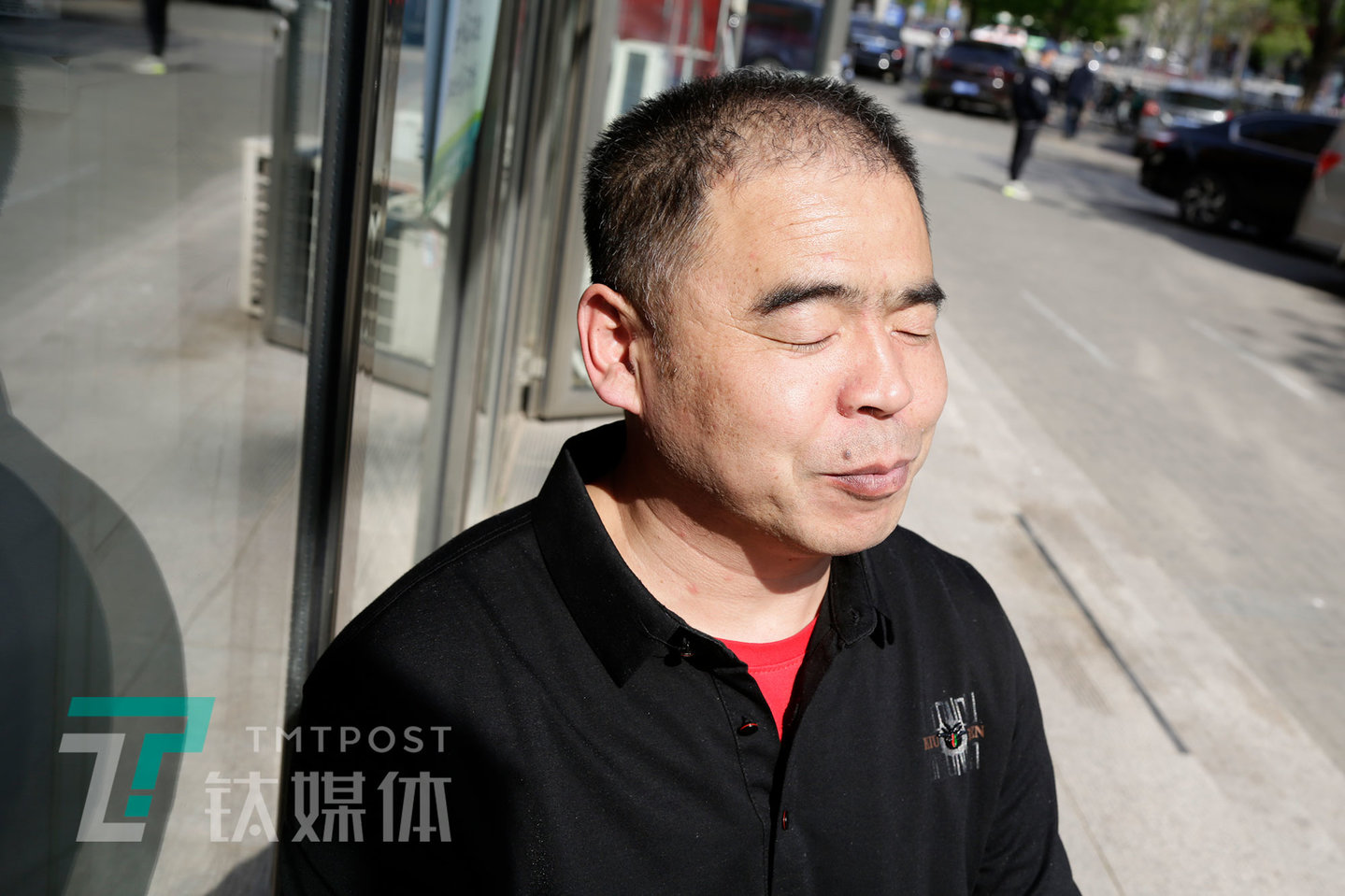
April 24, Beijing. Lao Li sits at the shop entrance, soaking up the sun.
Now 49, Lao Li is very satisfied with his life. His only regret is that he never had the chance to use his own earnings to care for his parents — "the child wishes to care for parents, but they are gone."
Before his parents died, Lao Li had not yet learned blind massage and had no job. They worried about him the most, because all their other children were healthy, but Lao Li was the one who had not yet achieved independence.
Sometimes Lao Li dreams of his mother. In the dream, he comforts her, saying, "Don't worry now. I can support myself." But when he wakes up, all that remains in his heart is regret. (This article was first published on the TMTpost App. TMTpost photographer/Sun Linhui. Editor/Chen Zheng.)
TMTpost Image Series 「Online」
Striving to accurately document individuals in the wave of internet entrepreneurship.
Images are precise, yet images are not the whole truth.
Images are free, yet images can also be traps.
In this era of 「Online」, we explore together with you.