Portable massager brand Breo has not had an easy time since going public.
As of the first half of the year, Breo had posted losses for six consecutive quarters; its share price plunged from over RMB 130 per share shortly after listing to below RMB 33 today, wiping out more than RMB 8.5 billion in market value.
Crowned the "first portable massager stock" at IPO, the company's losses have worsened. Jiedian Finance attempts to answer three key questions:
1. Is portable massage a good business segment?
2. What exactly went wrong with Breo?
3. How can it turn things around next?

By Jiedian Finance, Author: Diancai (Electro & Retail)
As "high pressure" and "fast pace" become the norm in modern life, sub-health conditions have latched onto white-collar workers and students who work or study relentlessly.
Due to prolonged sitting, head-down posture, and long hours at desks, these groups frequently suffer from neck and shoulder soreness, eye fatigue, spinal strain, etc. Traditional solutions like in-store massage are neither time-efficient nor cost-effective, opening the door for portable massagers as low-cost alternatives.
Data shows that the core consumer group for massage equipment in China is aged 24-40, accounting for 46% of the market and mainly located in second- and third-tier cities.
Financial reports from specialized portable massager manufacturer Breo reveal that the category only started to gain traction within the last five years (since 2018).
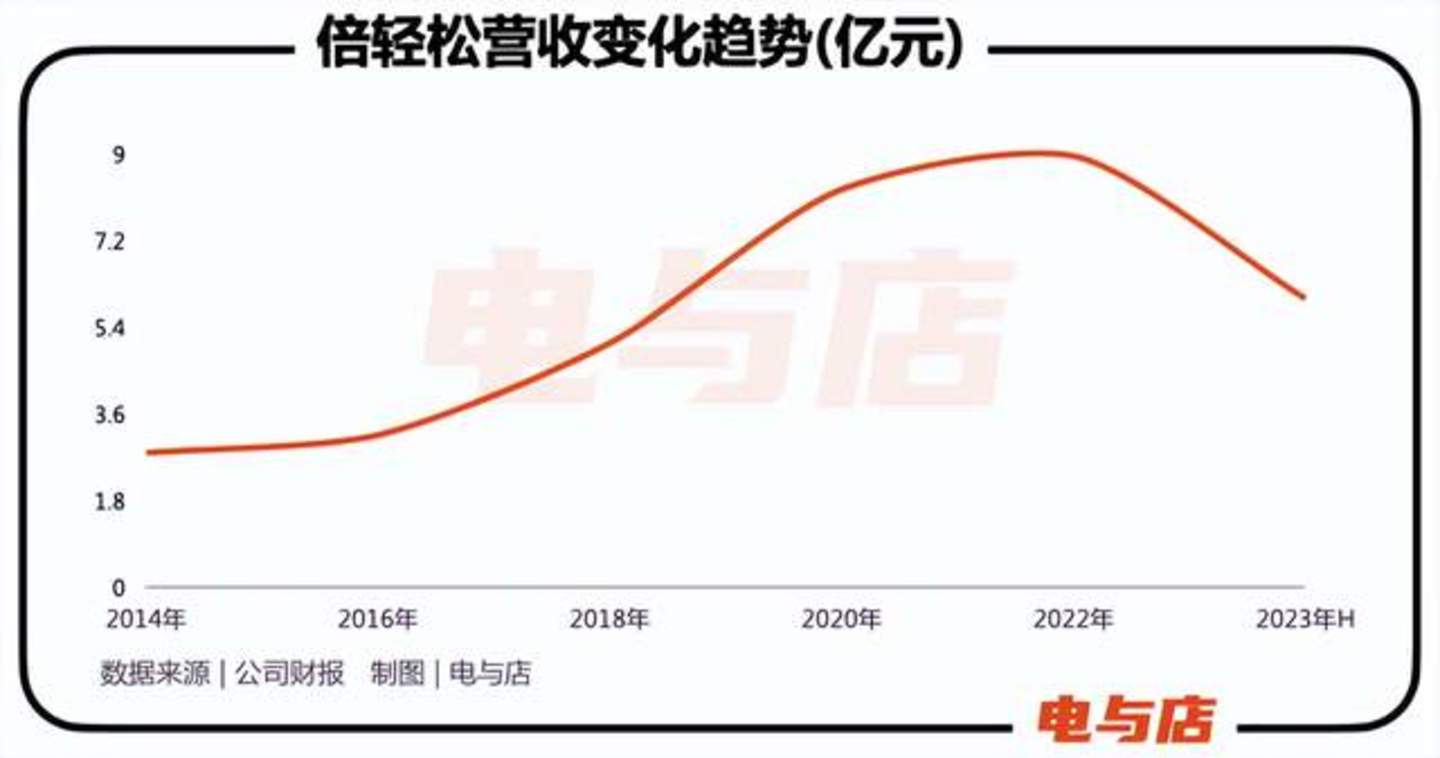
Although it emerged relatively late, the portable massager segment has moved beyond "niche" status. According to Guanyan Tianxia forecasts, China's massage instrument market will grow from RMB 14.4 billion in 2021 to RMB 23.7 billion by 2027.
Within this, the small (portable) massager segment alone is expected to range between RMB 7.8 billion and RMB 12.8 billion.
Over the past few years, this ten-billion-yuan market has nurtured specialized players like OGAWA (002614.SZ), Breo (68879.SH), and Future Wear (main brand SKG) — each with annual revenues of RMB 1-2 billion. At the same time, traditional home appliance brands such as Haier, Philips, Bear, as well as internet giants like Xiaomi and JD.com, have also entered the arena.
Because the category is classified as small home appliances and no single brand holds exclusive core technology, competition in portable massagers is extremely fierce. Qichacha data shows there are more than 3,000 registered merchants in China selling portable massagers. Searching for "portable massager" or "smart massager" on e-commerce platforms yields at least ten popular brands on the first page.
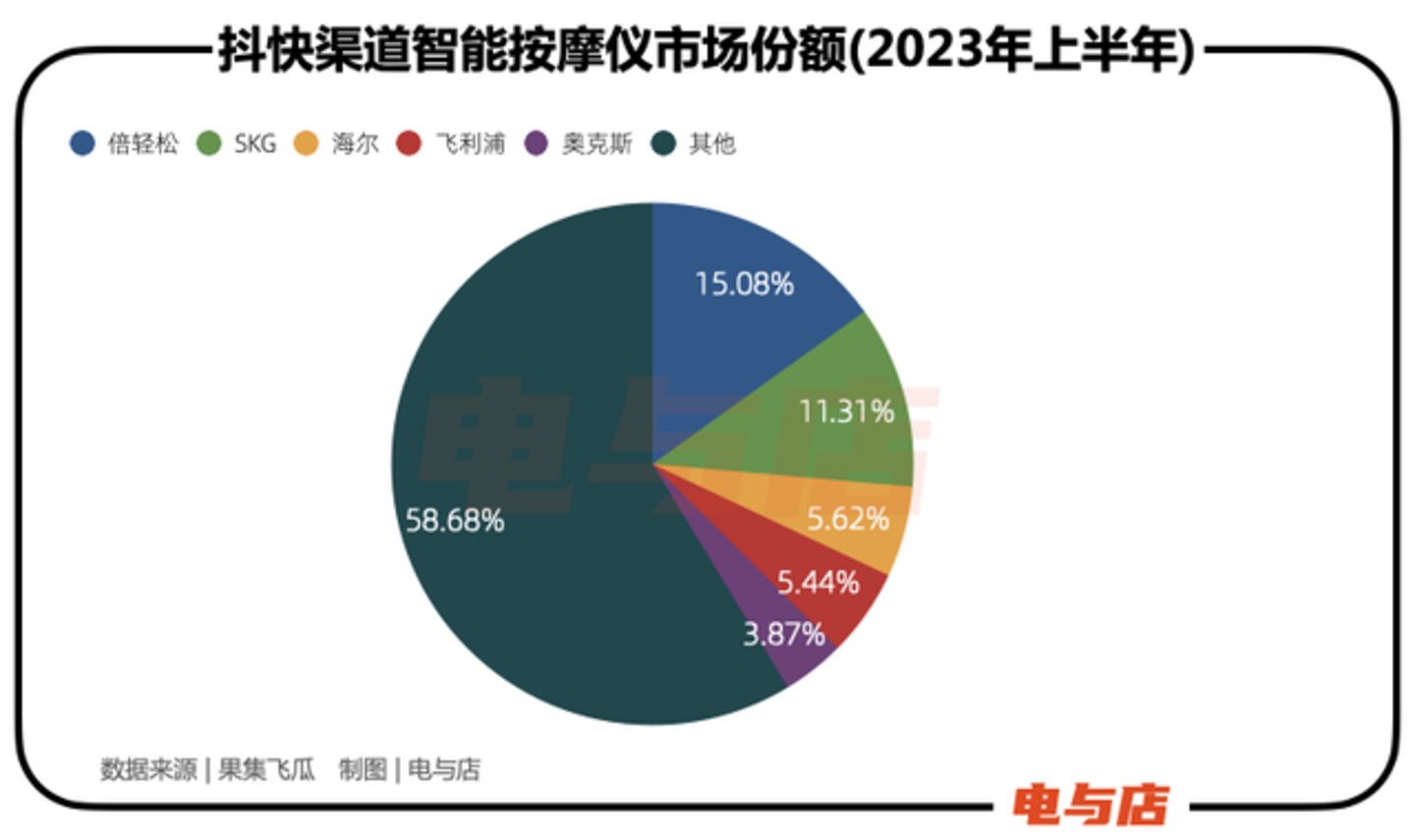
All these factors have fostered a highly fragmented market landscape. According to Guojie Feigua, in the first half of this year, the CR3 on Douyin and Kuaishou was 32% and CR5 was 41.3% (CR3 and CR5 represent the combined market share of the top 3 and top 5 brands). Breo and SKG ranked first and second with shares of 15.08% and 11.31%, respectively.
Beyond low concentration, portable massagers are also non-essential goods. Just as robot vacuums can be replaced by traditional brooms and mops, portable massagers face competition from offline massages, SPA treatments, or simply better allocation of work and rest.
In a sector characterized by fierce competition and weak demand rigidity, companies become vulnerable to headwinds. Over the past period, Breo has experienced exactly that.
Is the root cause of losses the persistently high sales expense ratio?
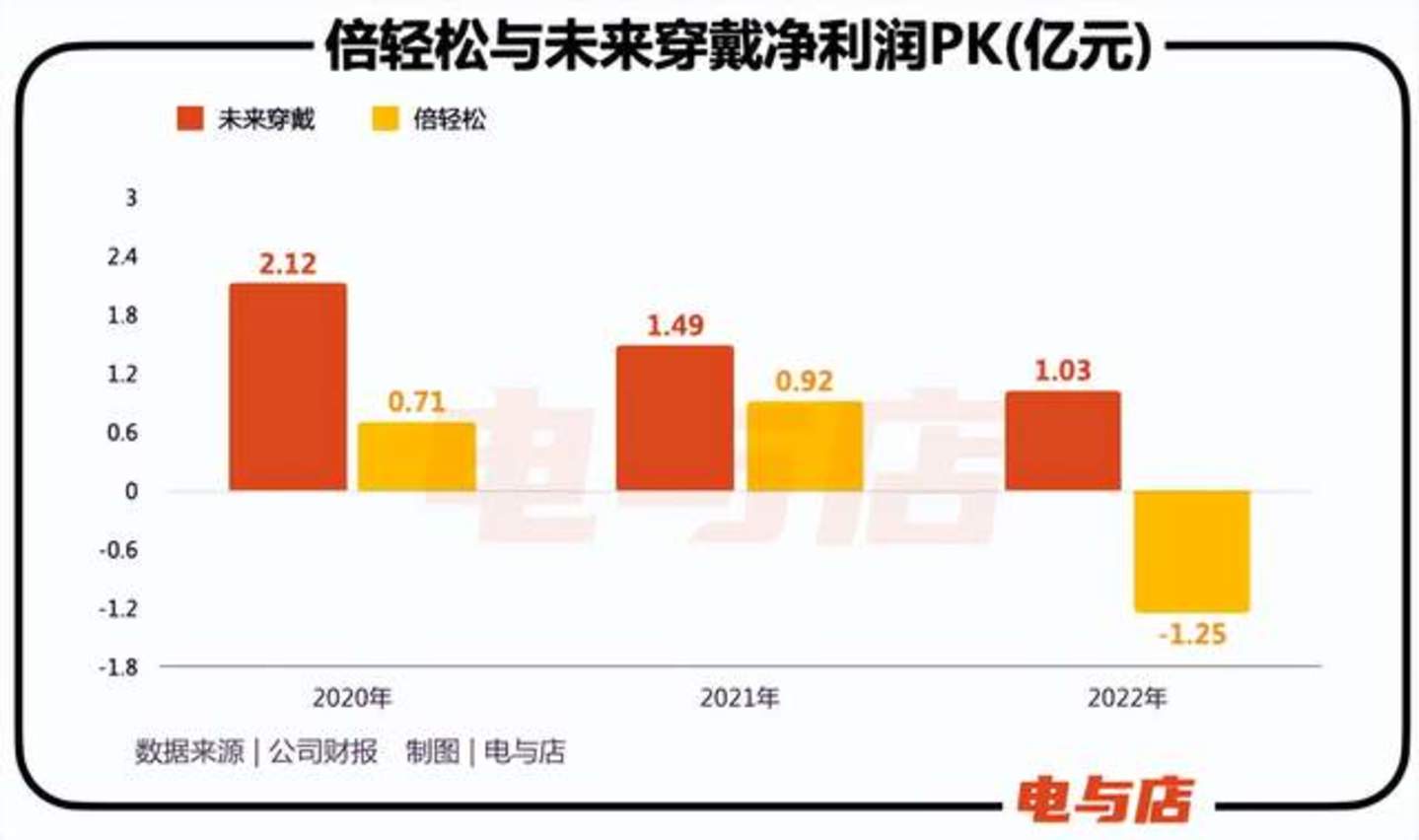
In 2022, its second fiscal year as a public company, Breo reported an annual loss of approximately RMB 125 million, triggering a sharp drop in its stock price from nearly RMB 50 to below RMB 34.
Management attributed the 2022 profit collapse to "lower foot traffic at offline stores, reduced orders from Russian OEM clients, high fixed costs of physical stores, and increased spending on new media channels."
Yet under the same macro environment, competitor Future Wear (SKG) performed much better. In 2022, Future Wear's net profit attributable to parent company fell 30.9% year-on-year but remained positive at RMB 103 million.
Both Breo and SKG are leading players in portable massagers, but they differ significantly in product focus and channel structure. Breo focuses on "neck and eye" while SKG emphasizes "neck and waist". In terms of channel mix, Breo relies more on direct operation (accounting for over 61.5% of sales), while SKG concentrates on distribution (around 95%).
The performance divergence largely stems from Breo's heavy early focus on offline direct-operated stores. When offline footfall dropped sharply in 2022, Breo bore the brunt.
According to Jiedian Finance's calculations, Breo's offline channel revenue in 2022 decreased by RMB 173 million compared to 2021, representing nearly 60% of the total revenue decline. For SKG, that proportion was only 32%.
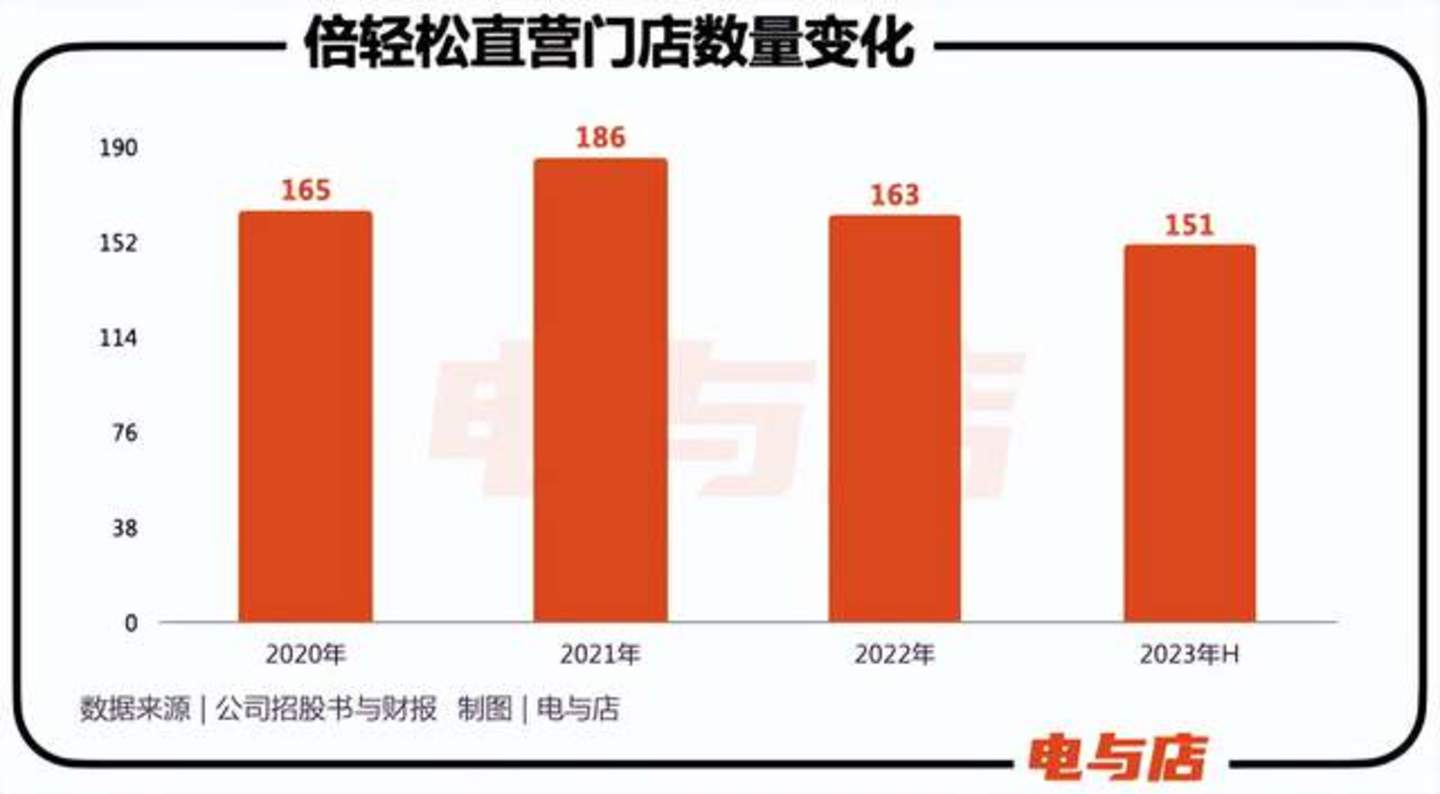
Annual report data at end-2022 showed Breo operated 163 direct-sale stores and 30 franchised stores. Meanwhile, SKG had no direct-operated stores, distributing solely through dealers.
Should portable massager brands open their own flagship stores? A veteran retail expert told Jiedian Finance: "Direct stores can assist with product display, user experience, and brand image, but the downside is high fixed costs — regardless of store performance, rent, salaries, and utilities must be paid. When you're in brick-and-mortar, you have to care about sales per square meter."
He further noted that direct stores make sense for categories like expensive jewelry, hands-on electronics (smartphones), apparel, or large home appliances, but for small appliances like massagers, online sales are arguably more convenient.
Nonetheless, Breo seems attached to physical expansion. In its prospectus, the company stated it planned to invest proceeds to open 248 new direct stores nationwide. That plan has already encountered headwinds: its 2023 interim report showed 151 direct-operated stores, a net decrease of 12 from end-2022.
While closing some physical stores, Breo simultaneously accelerated its shift to online channels. In 2022, online revenue accounted for nearly 67% of total sales, and in the first half of this year, the company said its Douyin channel had achieved explosive growth.
However, boosting online channels pushed Breo's already-high sales expense ratio even higher.
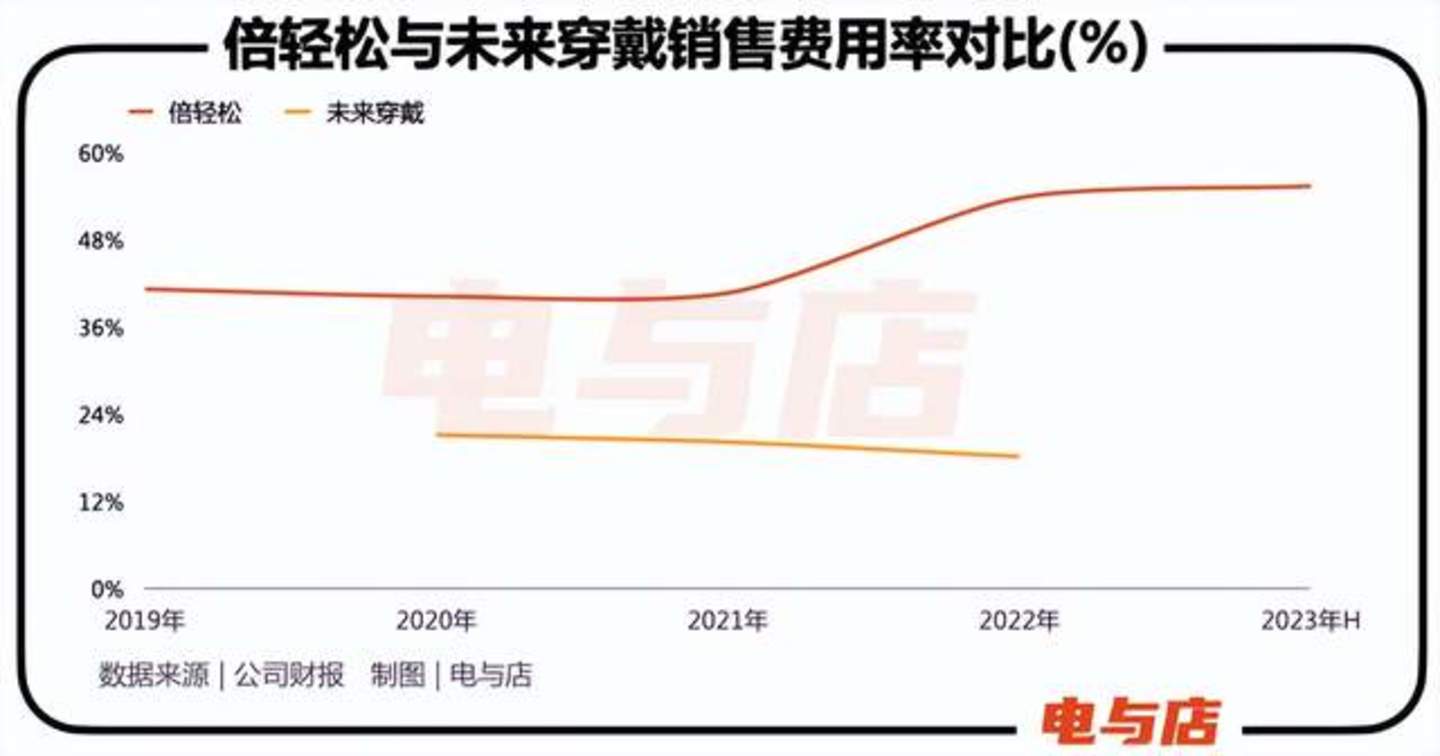
Jiedian Finance compiled data showing that from 2019 to 2021, Breo's sales expense ratio exceeded 40%, double that of Future Wear. Since 2022, with increased online spending, that ratio rose above 54% — triple the level of Future Wear.
An analyst told Jiedian Finance, "The consistently high selling expense ratio is the prime culprit behind Breo's persistent losses. Comparing the first half of 2023 with the first half of 2021, Breo is essentially playing a game of 'losing money for buzz'."
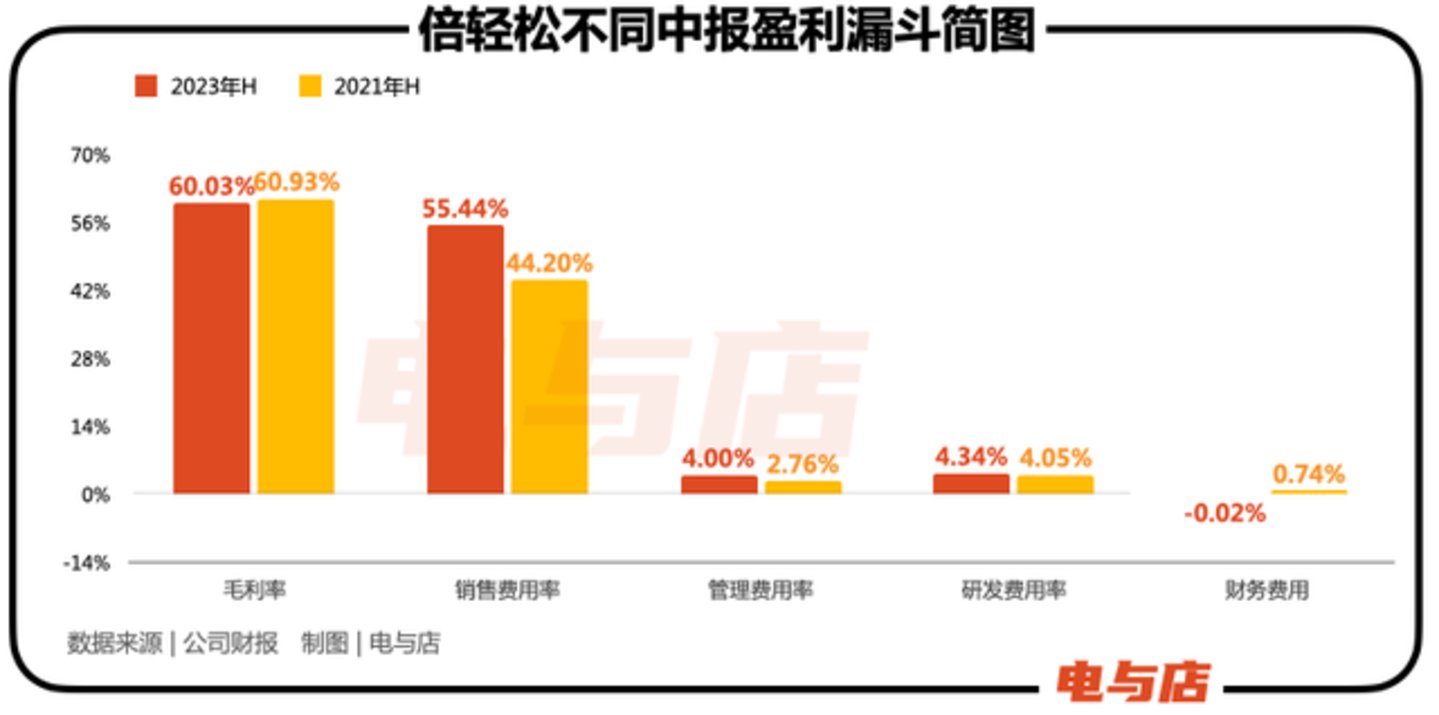
Data reveals that while Breo's gross margin remained above 60% in both 2023 H1 and 2021 H1, its sales expense ratio in 2023 H1 was 11 percentage points higher than in 2021 H1, leading to operating losses.
Further digging shows the two fastest-growing components of Breo's selling expenses in H1 were "promotion fees and advertising expenses" — the former mainly reflecting e-commerce platform marketing, the latter covering hard and soft advertising.
Notably, in September the company replaced its brand spokesperson from Xiao Zhan to Yi Yangqianxi, aiming to attract younger consumers.
Breo, once a steady and mature company, now faces doubts from investors: Is this strategic bleeding, or a sign of crisis? Turning the situation around has become a vital issue for the company.
How to break the deadlock?
Objectively speaking, Breo's aggressive marketing approach has achieved some short-term gains, as seen in the rise of its market share (its share on Douyin+Kuaishou grew by about 10 percentage points year-on-year in H1).
But even more pressing than expanding revenue is the question: how to narrow losses and ultimately become profitable?
From the above analysis, the two main culprits for Breo's revenue growth without profit are: first, high fixed costs from direct-operated offline stores; second, massive marketing investment that devours profitability.
Jiedian Finance believes Breo could tackle this from two angles: First, slow down the pace of opening new direct stores and use a franchise model to achieve wider coverage at lower cost. Second, optimize the cost-effectiveness of marketing spending while protecting the profit baseline. Deeper down, the key is to generate more repeat purchases and operate loyal users more precisely.
In terms of franchise channels, Breo signed cooperation agreements with two provincial retail service providers in Shandong and Jiangsu in the first half of the year, aiming to penetrate second- and third-tier and lower-tier markets using their existing networks. However, this channel is still in trial mode, and effectiveness will only be visible in the annual report.
At least, Breo is moving in a plausible direction.
Yet when it comes to directly controlling marketing spends, the company's adjustments are less optimistic.
In its September investor relations briefing, Breo emphasized strategies such as "using content e-commerce to drive traffic to other e-commerce platforms and offline stores to create hero products" and a "self-operated + distribution coexistence" hero-product matrix. However, the company did not indicate any commitment to protecting profit margins. Given current strategies, it remains uncertain whether Breo will return to profit by the end of 2023.
"Breo's top priority is to turn profitable. When the market was bullish, capital was patient with companies that traded profit for market share. But now, with the Shanghai Composite Index below 3,000 points, loss-making companies can hardly expect their stock price to perform well," the analyst told Jiedian Finance.
From the half-year report, reducing the sales expense ratio by just 5 percentage points would bring Breo back into the black. With a sales expense ratio over 55% while ignoring profitability, Breo seems to be running recklessly.
Conclusion
Jiedian Finance believes that as the sub-health population grows, the small massager market will further expand, making the portable massager sector a long-term promising slope.
But to travel steadily on this slope, Breo must secure a profit baseline while focusing on product innovation and reliable quality to gain more repeat customers — a more sensible approach than the current "profit sacrifice for hard advertising" strategy.