After four years of training, the second generation of Renhe Pharmaceutical (000650.SZ) officially takes over the family torch.
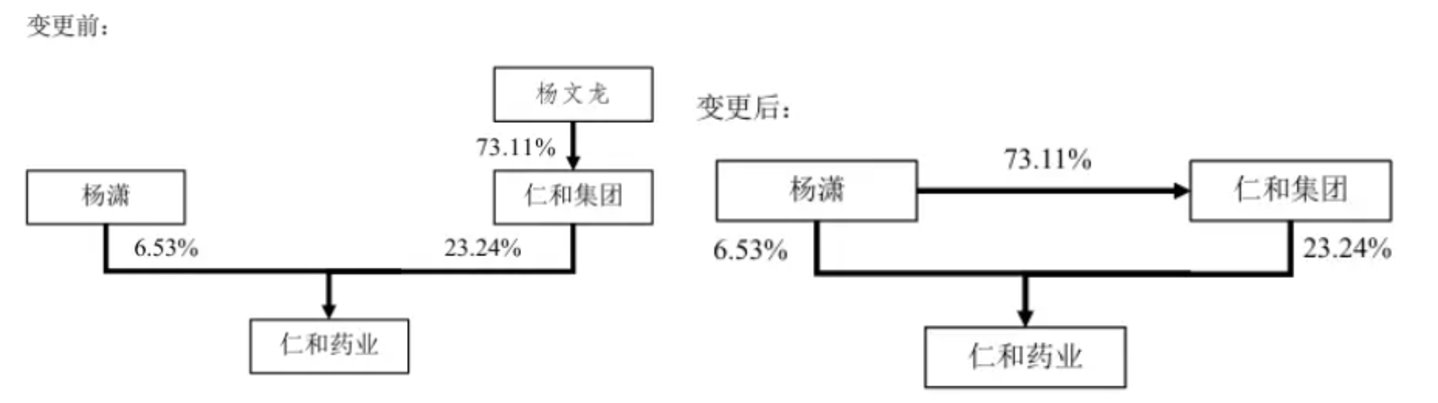
On June 11, Renhe announced that actual controller Yang Wenlong and his son Yang Xiao signed an equity transfer agreement on June 10, transferring 73.1137% of Renhe Group's shares to Yang Xiao at zero cost.
Upon completion, Yang Wenlong fully withdraws from Renhe Group. Yang Xiao indirectly holds 23.24% of the listed company through Renhe Group, plus 6.53% direct ownership, giving him a total of 29.77% — becoming the new de facto controller.
This power transfer has been in the works for years. Yang Xiao has served as chairman since March 2022, overseeing daily operations. The equity change is essentially legal finalization. For this post-90s successor, what awaits is a pharmaceutical firm trapped in a growth bottleneck, mired in "OEM king" controversy, and in urgent need of transformation — the challenge is arguably greater than his father's entrepreneurial era.
Four Years of Training, Finally at the Helm
The change occurs at the holding-company level, not directly affecting Renhe Pharmaceutical's listed equity.
Yang Wenlong transferred his RMB 138 million capital contribution to Yang Xiao at no cost. Other shareholders waived preemptive rights.
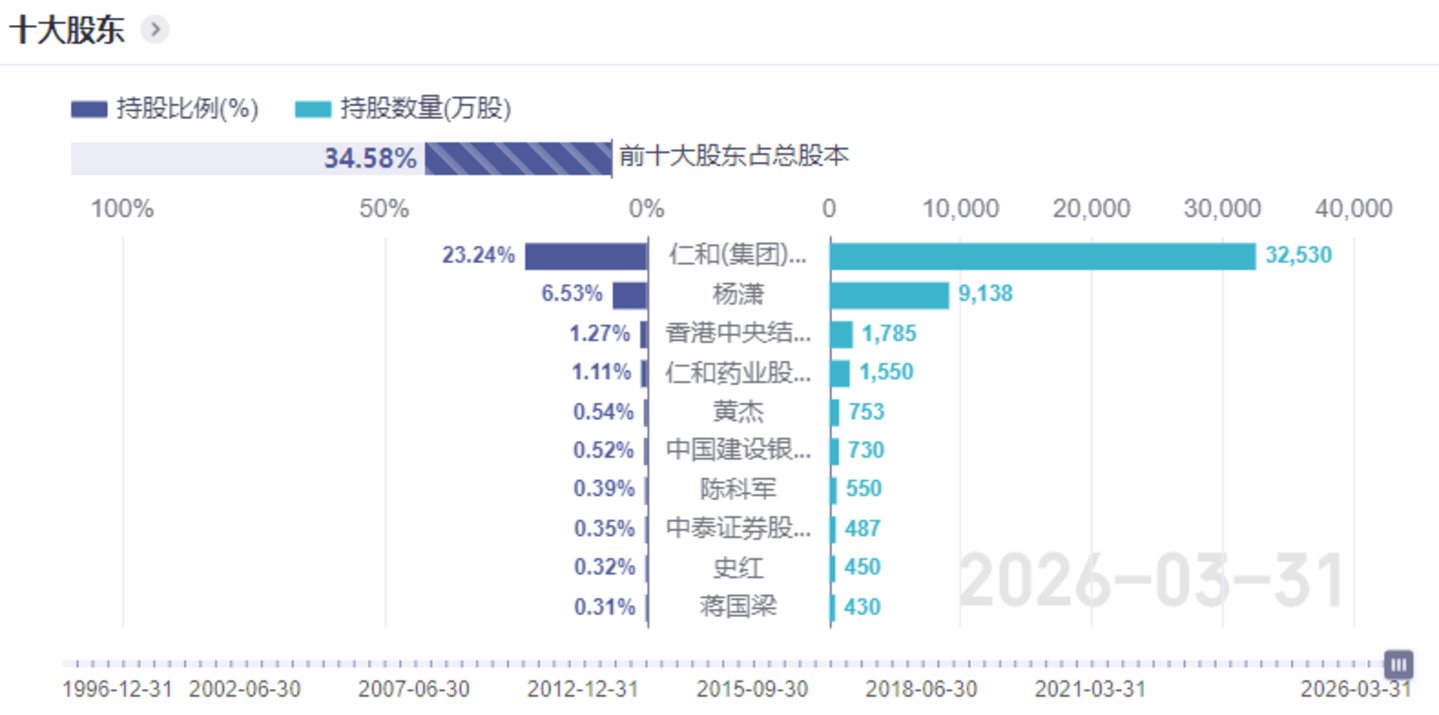
The controlling shareholder remains Renhe Group (23.24%), only the ultimate controller changes. Yang Xiao now has a "direct + indirect" dual shareholding structure.
Yang Xiao stated he has no plan to adjust the board or senior management within the next 12 months.
Yang Xiao (born Oct 1990) previously worked at the Chinese Academy of Social Sciences. He joined Renhe's board in May 2018, became chairman in March 2022, and was appointed vice chairman of Renhe Group in Feb 2023.
Beyond Renhe, the Yang family also co-created Dingdang Quick Medicine (online pharmacy).
In Sept 2022, Dingdang Health (09886.HK) listed in Hong Kong, becoming the third pharma e-commerce after Alibaba Health and JD Health.
Yang Xiao currently indirectly holds 8.96% of Dingdang Health but holds no management role there.
The Second Generation's Exam is Tougher
Yang Xiao takes the reins during a downturn cycle for Renhe.
From 2022 to 2025, revenue fell from RMB 5.153 billion to 3.536 billion, a >30% drop; net profit shrank from RMB 574M to 393M, also falling >30%.
Q4 2025 recurring net loss was RMB -27.65 million — only the second quarterly operating loss in nearly two decades.
In 2025, about RMB 144M of net profit came from government subsidies and financial gains. Core operating profit remains weak.
A major culprit: Renhe's long-standing "brand licensing + OEM control" model.
OEM allowed Renhe to expand without heavy assets, once accounting for half of total revenue (healthcare, personal care, devices).
But quality control issues, false advertising claims, and distributor disputes have eroded the brand's trust.
By 2025, the health-related segment fell to RMB 1.003 billion, making up 28.37% of total revenue.
Legacy products like FuYanJie, YouKaDan, and eye drops are saturated. No blockbuster replacements have emerged.
R&D spending was only RMB 45.07 million in 2025 (1.27% of revenue), dwarfed by sales expenses (RMB 345M).
Renhe also dabbled in industrial hemp, medical aesthetics, and recently AI smart glasses (ULOOK). Frequent project shifts signal strategic indecision.
The $0 equity transfer finalizes the family succession, but the real corporate exam has just begun. (Corporate Observation, by Cao Qian & Su Qitao)


💬 Reader Comments
Zero-cost transfer is clean, but the revenue decline is alarming. Guarding is indeed harder.
OEM white-label destroyed brand equity. Yang Xiao must cut licensing and rebuild trust.
R&D just 1.27%? They’re still living in the 2000s. No innovation = no future.
Offline pharmacy closures hit old OTC players hard. E-commerce synergy with Dingdang is yet to be seen.
Jumping into AI glasses looks like a gimmick. Focus on core pharma first!
As a fellow successor, I feel him. You inherit problems, not just assets. Good luck.
First quarterly operating loss in 20 years – that's a red flag for recurring profitability.
FuYanJie and YouKaDan are dinosaurs. Time to retire the old portfolio and innovate.
Non-recurring gains hiding weakness – beware of the real earnings power.
If they streamline the OEM mess and increase R&D, there's still hope. But it's urgent.