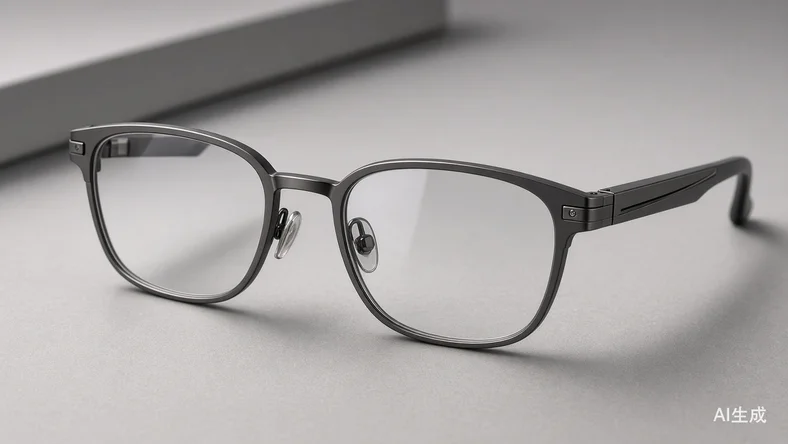
Smart glasses are getting cooler and cooler.
But for many people, before buying there is a very real question: where do I put my own myopia glasses?
Take them off? Can't see clearly.
Wear two pairs together? Your nose says why not hang a backpack on me too.
Pair with contact lenses? Seems like too much trouble, and not everyone is used to them.
So myopia sufferers don't deserve smart glasses?
Which type of glasses are you buying?
How myopia sufferers buy smart glasses first depends on which type of smart glasses you want.
To explain the prescription issue clearly, we can roughly divide smart glasses into four categories by function.
Glasses without display function.
The first type, let's call it "pseudo-smart glasses" or "pseudo-AI glasses."
It is essentially a pair of ordinary glasses, just with Bluetooth, microphone, speaker and other modules stuffed into the temples.
You can use it to listen to music, take calls, and summon voice assistants. It's like a combination of glasses and a smart speaker — "Bluetooth glasses" is probably more accurate.
The second type of smart glasses adds a camera.
These glasses can take photos and videos, and some can recognize what they capture and answer questions. Information is mainly output through voice.
The prescription approach for these two types is pretty much the same as ordinary glasses.
As long as the model supports myopia lenses and your prescription and astigmatism fall within its supported range, you can basically get an eye exam and lenses fitted in the normal way.
Glasses with display function.
The third type has a display function but no camera or speaker.
It can display information from your phone or other devices in front of your eyes and can receive voice, but it cannot shoot independently or play sound directly through a speaker.
The fourth type has a microphone, speaker, camera, and display lenses.
It can see, hear, speak, and display information — a fairly full-featured device.
Wearing it no longer feels like glasses; it feels more like hanging a digital device on your face.
For myopia sufferers, these two display-equipped types are more troublesome.
Currently there are two common approaches.
One is to use a dedicated myopia frame or lens module, attaching myopia lenses made to your prescription via clips or magnets.
This way, even if your prescription changes later, you can replace just the myopia lenses without changing the whole pair.
But this operation has an obvious downside.
Adding myopia lenses and the frame that holds them increases the overall thickness and weight of the glasses, and may also change the relative position between your eyes and the display optical components.
These changes may affect display quality and wearing comfort — for example, unclear display content, overly thick frames, pressure on the nose bridge, or eyelashes brushing the lenses.
In short, don't just look at the advertising photos.
If conditions permit, it's best to actually try on the same model, or try a finished pair already fitted with myopia lenses close to your prescription.
The other approach is to directly customize display lenses to your prescription.
Custom display lenses made to your prescription can avoid some of the problems caused by adding an extra layer of lenses and frame.
The downside is that the price is usually higher, and the customization wait may be longer.
For the pair I bought myself, non-custom models ship in about a week, but the customized one took almost a month.
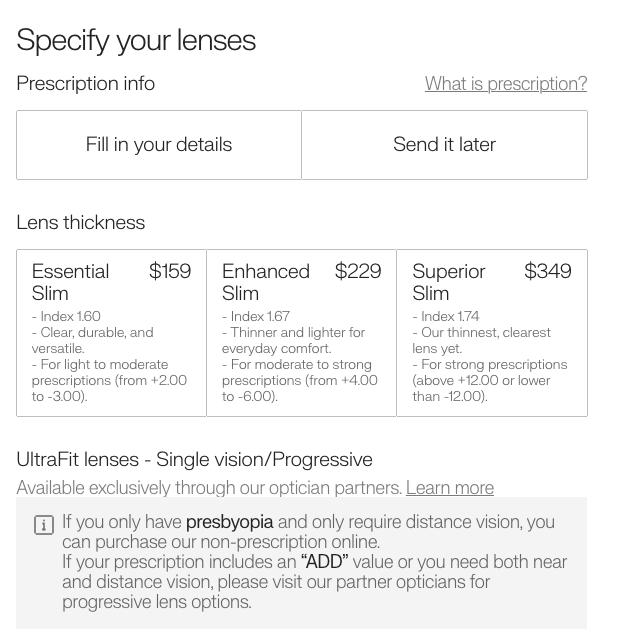
On Even's official website, you can customize myopia lenses of different refractive indices, as well as multifocal lenses suitable for both myopia and presbyopia | evenrealities
Some more specific questions
Knowing how to get a prescription doesn't mean you can order with peace of mind.
There are still some practical usage questions worth clarifying in advance. Let's go through them one by one.
The smart glasses screen is right in front of your eyes. Will prolonged use worsen myopia?
Generally not, at least there is no evidence so far.
Many smart glasses project at a virtual distance, so it looks like you are viewing something far away.
Some glasses even allow you to adjust the display distance, usually ranging from 1 to 4 meters.
By comparison, we look at phones from about 20+ cm, tablets within 50 cm, and computers around 70 cm.
Rather than simply blaming smart glasses for worsening myopia, it's better to spend less time scrolling on your phone.
Will it cause eye fatigue?
Factors such as display distance, brightness, and clarity can all affect visual comfort while wearing smart glasses.
Some products allow you to adjust these parameters, so try to find the setting that feels most comfortable to you.
Of course, eye fatigue isn't necessarily all the device's fault — continuous eye use time, rest conditions, and individual visual state also play a role.
Older people with presbyopia — can they still use display-equipped smart glasses?
Of course they can.
People with presbyopia can't see near objects clearly, but the virtual distance range is farther.
Moreover, smart glasses project a screen roughly 30 inches in front of you, with larger fonts, so presbyopia users may find smart glasses easier than looking at a phone.
They can see the display content clearly, but may still not be able to see the phone in their hand while wearing the smart glasses.
The solution is the same as for myopia: add a pair of clip-on lenses or customize multifocal lenses.
For myopia sufferers, smart glasses must be glasses first
I have used all the types of glasses mentioned above.
But at least so far, none of them can be worn all the time like ordinary glasses — they are mostly used on specific occasions.
This makes me feel that no matter how many features AI glasses have, they ultimately must first be a pair of comfortable glasses.
Especially for myopia sufferers, before buying you can't just focus on what it can shoot or display — you must first confirm whether your prescription can be fitted, and whether it will be comfortable to wear after fitting.
Specifically, you can follow this order when choosing:
First, check if your prescription can be fitted.
Especially for high myopia, don't finish looking at the features and place an order first, then ask whether your prescription can be made.
Next, check if the frame fits.
Whether the frame can sit securely on your face is also very important.
Then check the weight and thickness after fitting.
It's best to actually try it on to see if it's comfortable and whether the display effect is affected.
Finally, look at the features.
Those cool features — will you actually use them often?
After all, for myopia sufferers, it is a pair of glasses first, and smart glasses second.


