This article is from WeChat public account: Zhuang Shuai Retail E-commerce Channel, Author: Zhuang Shuai Research Team.
Yesterday (June 11), the Beijing Municipal Market Supervision Bureau summoned five e-commerce platforms: Taobao (Tmall), JD.com, Pinduoduo, Douyin, and Xiaohongshu.
The bureau reported the second batch of typical problems discovered during the comprehensive rectification of "involution-style" competition, mainly including the unsubstantiated "billions of subsidies" on some platforms, false promotional claims, chaotic rule disclosure, and lack of merchant information.
Rectification requirements were put forward.
As a retail e-commerce industry expert and founder of Bailian Consulting, I have accepted interviews from multiple institutional media and clarified two basic judgments:
1. The regulator's pointing out the long-standing "billions of subsidies" issues on the eve of 618 is mainly to strengthen warnings and compliance guidance at the critical node of the annual promotion.
However, this does not necessarily indicate a fundamental change for this year's 618; it rather reflects the continuous normalization of regulatory intensity.
2. The possibility of improving the above issues through this summons is moderate.
If platforms lack self-discipline, stronger measures such as follow-up monitoring, penalties, and legislative improvements will be needed to ensure effectiveness, including other long-standing issues like false advertising, price fraud, data security and privacy leaks, after-sale difficulties, choose-one-of-two, and algorithmic discrimination.
Looking back at the development of billions of subsidies, in 2019, Pinduoduo wanted to move from the downstream market to tier-1 and tier-2 cities.
Facing competition from JD and Taobao (Tmall), it adopted the innovative marketing strategy of "billions of subsidies."
This strategy achieved unprecedented success, helping Pinduoduo surpass 900 million users.
Soon after, in terms of sales scale, profitability, and market value, it comprehensively surpassed JD and became the second-largest e-commerce platform in China.
After falling behind in the competition with Pinduoduo, JD decided at the beginning of 2023 to invest its full platform strength to compete, launching a "billions of subsidies" channel and announcing a full-scale low-price competition strategy.
Taobao (Tmall) subsequently followed suit.
Against this background, in March 2023, I deeply studied "The Truth of Billions of Subsidies" in response to JD's follow-up:
On one hand, it pointed out that billions of subsidies is not just a simple promotional channel, analyzing how Pinduoduo used one channel to win tier-1/2 users and transactions against JD and Taobao (Tmall).
On the other hand, it pointed out the problems and hidden dangers that existed in the billions of subsidies channel back in 2023, including who is the official entity of the subsidies, and how the channel can achieve profitability and normalization.
As it turns out, this in-depth analysis article still provides some insights.
Below is the original text of "The Truth of Billions of Subsidies" from March 2023, with some deletions, for discussion and exchange.
Truth 1: Billions of subsidies becomes a product label, influencing recommendation algorithms
Based on my nearly twenty years of practice and research in China's e-commerce industry, promotional activities on e-commerce platforms, since Taobao initiated "flash sales," have gradually taken on the characteristics of "channelization and IPification."
Pinduoduo's billions of subsidies further "tagged" the promotion activity.
That is to say, on Pinduoduo's platform, billions of subsidies is not only an activity IP with a fixed channel but also tags each participating product with the "billions of subsidies" label, not just a special promotional page.
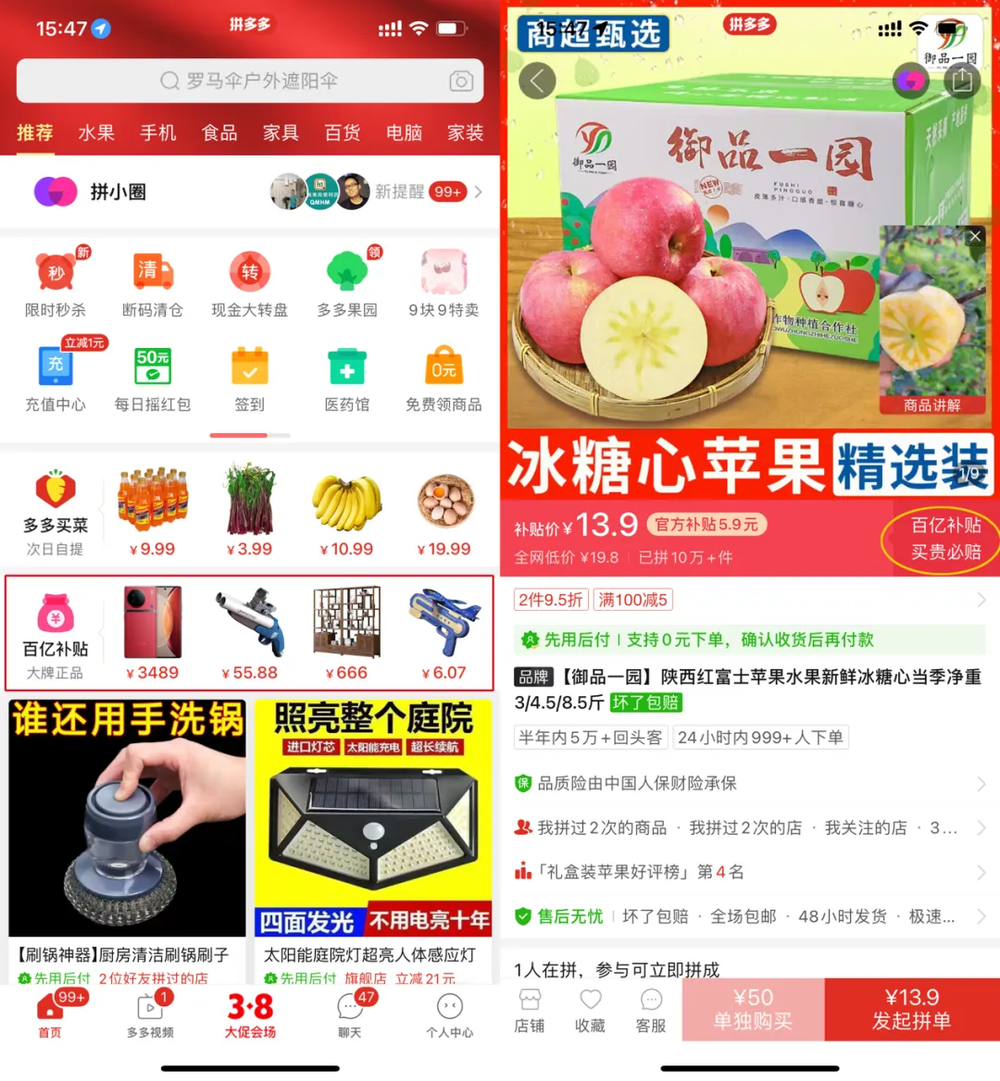
The reason for tagging is to deeply understand consumers through the billions of subsidies label.
Beyond the price factor within the billions of subsidies channel, it helps determine whether the product itself meets consumer demand.
If a user clicks on multiple products with the billions of subsidies label multiple times but does not purchase, the platform's recommendation algorithm will then combine other indicators and label data to quickly adjust and replace products from the product library.
In this way, the billions of subsidies label plays a role in narrowing the product range and making precise recommendations, improving user conversion and repurchase rates.
Of course, achieving this goal requires, on the one hand, the platform to provide a vast product library that meets the needs of a massive user base through merchant recruitment/procurement, i.e., a very rich product supply.
On the other hand, it requires the platform to invest in recommendation algorithm technology and develop product recommendation models that match price-sensitive users.
Truth 2: Billions of subsidies is not just a "price war"
Observing the billions of subsidies channels of Pinduoduo and JD, I found that Pinduoduo launched "billions of subsidies" in 2019.
Its core strategy was to recommend more branded products, thereby building platform trust and meeting the consumption upgrade in the downstream market.
It also aimed to acquire more consumers in tier-1 and tier-2 cities and effectively increase average order value.
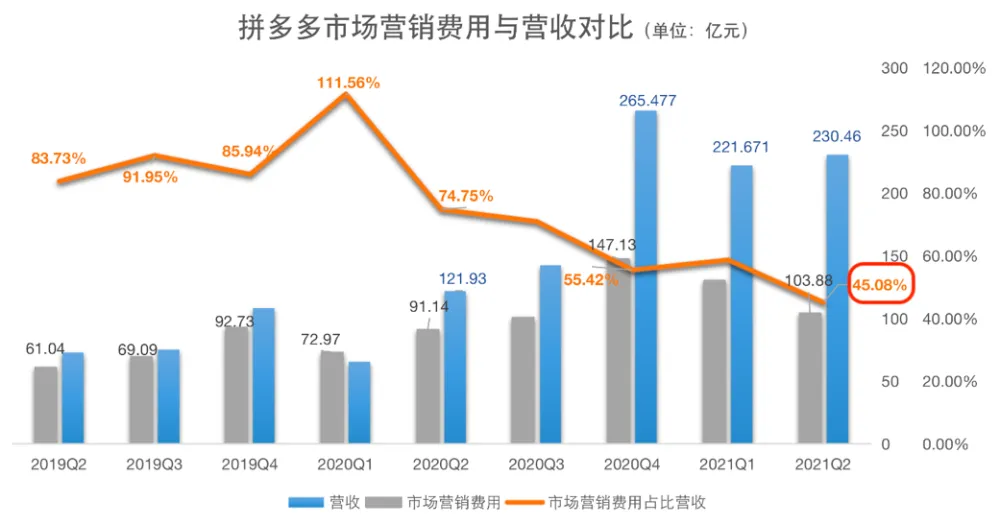
Judging from Pinduoduo's public financial data, this strategy was very successful.
According to the Q3 2019 financial report, the daily active users of the "billions of subsidies" entrance exceeded 100 million.
Over 2,800 domestic and foreign brands participated in the plan, with more than 23,000 subsidized products.
As of June 2019, the share of tier-1 and tier-2 cities in Pinduoduo's GMV had already reached 48%.
In terms of average order value, at the end of 2022, Pinduoduo's average GMV per active buyer was 3,823 yuan, already higher than JD.com's 3,515 yuan level at the end of 2022.
From the financial data, the new users brought by Pinduoduo's billions of subsidies precisely made up for its insufficient penetration in tier-1 and tier-2 cities.
The customer acquisition cost for these users was higher than that for downstream market users, but subsidizing an average of 500 yuan per iPhone to gain a high-value tier-1/2 city user was very worthwhile.
For JD, users in tier-1 and tier-2 cities are its basic base, and the gap with Pinduoduo in daily active users is mainly reflected in the downstream market.
JD's strategic intent for billions of subsidies might be to use it to gradually convert its originally strong self-operated categories (3C, home appliances, books) into open platform merchant operations, further increasing the GMV share of the open platform.
Truth 3: Who is the official entity behind billions of subsidies?
An analysis article by China Merchants Securities pointed out: JD's profit margin will inevitably be affected, but most of the subsidy might be borne by merchants.
From the products in JD's billions of subsidies channel at the time, it was also evident that most belonged to POP (JD Open Platform) products.
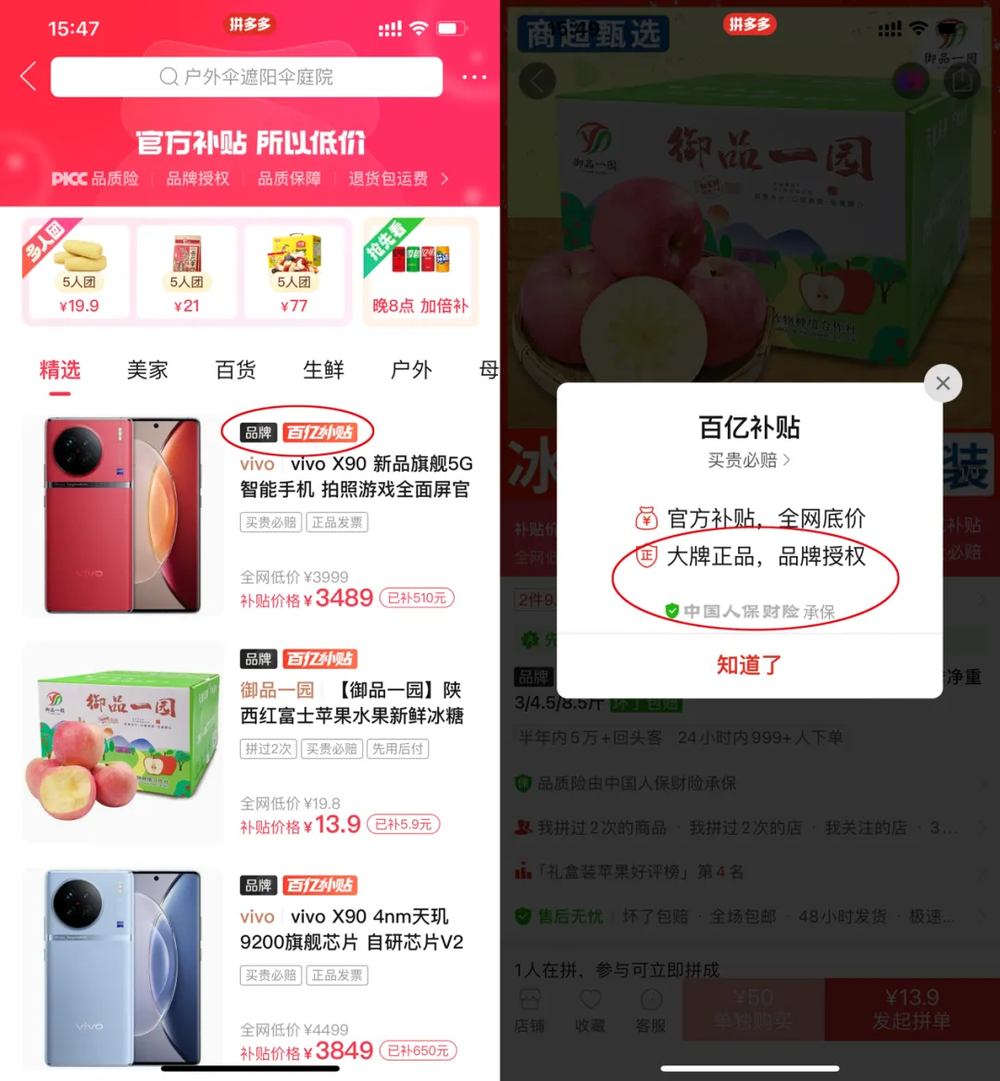
According to Pinduoduo's billions of subsidies rules, products signed up for the activity can directly enjoy official subsidies.
Consumers can see the specific official subsidy amount on the product details page of the billions of subsidies activity; this portion of money is directly provided by the platform.
Additionally, when a product signs up for the billions of subsidies activity, its price must be lower than that of other similar products within the channel.
This part represents the merchant's price concession, which is another source of subsidy in the billions of subsidies program.
A Pinduoduo merchant previously told a reporter that for the "billions of subsidies" they participated in, the merchant first subsidized, and then Pinduoduo platform provided different proportions of rebates.
It is somewhat difficult for the platform to fully bear the profit pressure brought by the subsidy without shifting it to merchants.
Truth 4: Profitability logic and normalization of billions of subsidies
The reason why Pinduoduo's billions of subsidies can be sustained and normalized, besides sharing subsidy costs with merchants, is that it brings in more brand merchants.
Compared to factory and agricultural product merchants, brand merchants have a higher willingness to advertise and on a larger scale.
By acquiring high-tier city users to buy branded products through billions of subsidies, brands grow and prove the value of Pinduoduo's platform, thus investing more in advertising fees expecting higher and faster growth.
After gaining advertising revenue from brand merchants, Pinduoduo continues to invest in strengthening the supply chains of factories and agricultural products.
Along with mini-games and social relationships, it firmly retains the vast downstream market user base.
The consumption upgrade of downstream market users, together with high-tier city users, further drives the sales of branded products, forming a virtuous cycle.
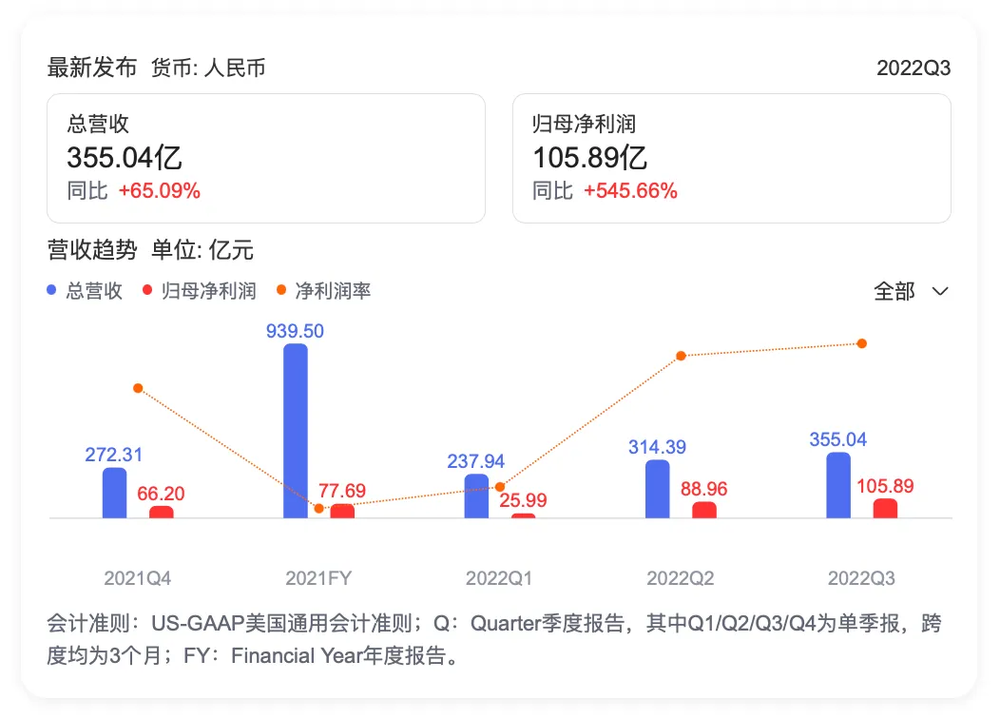
Financial data shows that Pinduoduo has achieved profitability for six consecutive quarters.
The success of billions of subsidies is not solely based on low prices; it is a long-term battle requiring platform strategy, algorithms, capital, and supply chain integration.
Conclusion
With the Beijing Municipal Market Supervision Bureau's rectification of e-commerce platforms' billions of subsidies during the 618 period, it is believed that as a promotional strategy, billions of subsidies will continue to bring healthy, quality growth opportunities for major e-commerce platforms and merchants, as well as tangible benefits to consumers.


💬 Reader comments · Industry perspectives