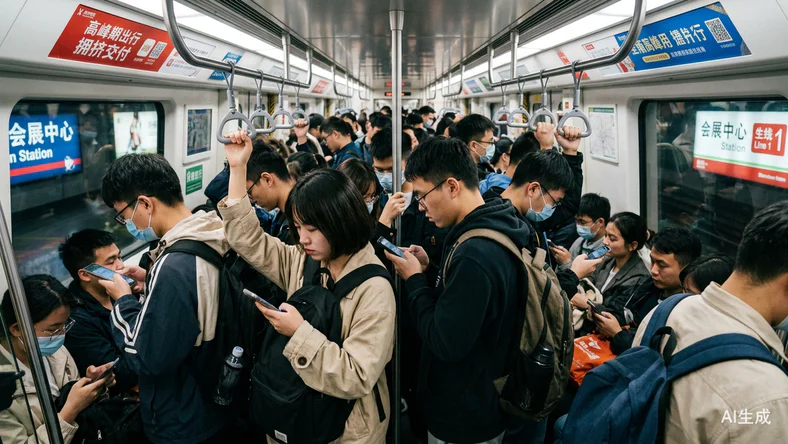
From: Shenzhen Micro Times, Author: Vennphang, Header image: AI generated.
It’s often said, “Earn in Shenzhen, spend in Shenzhen — don’t even dream of taking money home.” While many lament how hard it is to save, a more piercing voice emerges: In Shenzhen, hardly any young person is debt-free.
This is not anxiety mongering, but cold reality. According to the “China Household Wealth Report” released by the Chinese Academy of Social Sciences in early 2025, the debt ratio among post-90s reaches 78.3%, with an average debt of 121,000 yuan.
Once salary arrives, you repay credit cards and Huabei first, then pay rent. After this routine, only a few coins remain in the account. That’s not “moonlight clan”, it’s “instant-light clan.”
Some joke that landlords and Huabei are like two “daddies” for today’s youth.
But in times of spreading uncertainty, a new trend quietly emerges: more and more Shenzhen young people set “zero debt” as their goal.
Among them, some stay clear and resolute — no mortgage, no car loan, credit cards and Huabei turned off. Others, once trapped deep in debt, manage to clear everything and come ashore. Many more are still struggling to repay but consider “zero liability” their creed.
I. Shenzhen’s diverse debt spectrum
When someone adopts “zero debt” as a target in Shenzhen, it’s seldom just about discipline. From drowning in debt to scraping for clearance, then maintaining the status — this is the real trajectory for most.
Unfolding the map of Shenzhen’s debtors, every family has its own saga. The more distressing the debt, the fiercer the determination to go to zero.
The easiest trap is “frog in warm water” consumer installment plans. Lao Wang, when freshly graduated and working in Nanshan, earned only 4000 yuan a month. To be “decent” like colleagues, he gritted his teeth and bought the latest iPhone, with 24-month interest-free installments. “Back then I thought it’s only a few hundred a month — just skipping one meal outside covers it.”
But once the crack of “easily getting nice things” opens, desire cannot be shut down. Later, he fell into the photography deep hole: Sony mirrorless, different lenses, gimbal stabilizers... installment bills piled up. Unknowingly, his monthly repayment rolled from a few hundred to several thousand.
Digital payment + installment dulls the pain of spending money, making him believe his purchasing power far exceeded his income. But reality’s boomerang came fast — the next few years became the most suffocating days of his life.
Several tens of thousands in debt pressed him breathless. Before his salary even warmed his palms, it went into the bank’s repayment app. He dared not get sick, dared not quit, and even paying the bill for a casual dinner made his mind race: “It’s like running on a treadmill — you can’t stop, or you’ll fall.”
Even more painful than consumer debt is business loans paid for ambition. A Liang, 30, partnered with a friend to open a craft beer shop in Longhua, taking on hundreds of thousands in business loans. Eventually, the shop couldn’t survive and closed. Yet the bills arrived every month as scheduled, and seeing looming default, the fear of becoming a deadbeat pressed on his chest like a stone, causing sleepless nights.
If “interest-free installments” are subtle, then a mortgage is the most obvious “ultimate Huabei” for adults. Yuzi and her husband are striving toward “zero debt.” In 2018, they bought a wedding house in Changsha, with a commercial loan of 760k yuan for 30 years. Over the past seven years, they’ve been repaying their hometown mortgage with Shenzhen earnings. When rates were high, monthly payment was over 4000; after LPR cuts it dropped to 3400.
One day last year, Yuzi calculated carefully: after seven years of repayment, they had only reduced the principal by 100k yuan, yet paid over 200k in interest, leaving a principal of more than 660k yuan. This meant they had basically been working for the bank for nothing. The helplessness of being long-term shackled by a mortgage instantly hit her.
“In the past, when income kept rising, I didn’t feel it. Now it feels like a huge loss,” Yuzi admitted. In the current economic environment, unless you are good at stocks or funds, the returns from wealth management or fixed deposits simply can’t beat mortgage interest. Debt resembles quicksand — most people only realize they are trapped when it’s already late.
II. The moment of zero: no euphoria
Whatever the trigger, when the rolling numbers on the bills finally hit zero, that complex mix of relief and exhaustion is only understood by those who have been there.
For Lao Wang, deep in installment quagmire, the turning point came at a crucial life juncture — preparing for marriage. At that time he was being bled by various installment bills, robbing Peter to pay Paul just to meet minimum payments, let alone savings. The truth couldn’t be hidden forever; Lao Wang had to come clean to his fiancée about a debt hole of tens of thousands of yuan. They had a huge argument.
Only then did Lao Wang panic. The so-called dignity bought by installment consumption turned out to be a bubble, almost smashing their future life to pieces. To give their future small family a clean slate, Lao Wang swallowed his pride and borrowed money from his parents.
A man nearly thirty, ready to settle down, confessed to his parents over the phone the bad debts caused by consumer desires. Facing his parents’ long silence, he was deeply ashamed. Using his parents’ hard-earned money to fill the pit dug by vanity — this torment was excruciating. After receiving the money, Lao Wang paid off all installment bills at once. Watching all pending balances turn to “0”, he let out a long sigh. “No joy — just a feeling of weakness after a severe illness, deep guilt and lingering fear,” he recalled.
At that moment he vowed never to touch installments again: “I’m terrified of that feeling of losing control that makes the closest ones worry.” Later, Lao Wang’s career progressed, his salary increased. Over two years, through thrift and weekend side hustles, he paid back the several tens of thousands he owed his parents. The day he truly owed no one a cent — much later than when the banking app hit zero — was the moment he felt genuinely grounded.

A Liang also turned to his parents, but even draining their pension couldn’t fill the bank hole. So he had to borrow from friends with his tail between his legs. The debt didn’t disappear — it just transferred, adding human debts. He belatedly realized that this was even more suffocating than owing the bank. Owing the bank meant tension and embarrassment from collections; owing friends meant a long-term psychological torture.
For a long time he didn’t dare to proactively contact his friends. Seeing the friend who lent him money buy a house and have a baby, he even felt guilty clicking “like”. To repay friends and family as fast as possible, he found a steady job in Futian, squeezed his living costs, turned down gathering invitations, and hesitated for half a month just to buy an electric scooter.
Over a few years, A Liang paid off more than half of his debt to parents and friends. Although not fully ashore, his mind feels much lighter. “A little more pain and I’ll be debt-free, no more guilt toward my friends.” His attitude toward debt turned absolute: “Without enough risk resistance, ordinary people forcing leverage are betting the entire family’s fate.”
Yuzi and her husband haven’t fully paid their mortgage yet, but she has tasted the sweetness of early repayment. From November last year to March this year, she and her husband took out savings three times to prepay 300k yuan of the mortgage. That cut their remaining 23-year term to just 10 years, saving about 230k in interest. “Watching the remaining principal fall is deeply reassuring — feels like one step closer to freedom with every prepayment.”
For ordinary workers, shaking off debt doesn’t mean you get a triumphant life script. In Shenzhen, maintaining “zero debt” often requires hidden costs.
III. Gains and losses behind zero debt
Lao Wang, traumatized by installment bills, says “never again,” but resisting consumerism entirely is not easy. In the six months after clearing his bills, he experienced serious withdrawal symptoms. Once, a long-awaited new phone was released; after watching countless reviews and social media unboxings, he failed to resist and opened the purchase page, instinctively selecting 24 interest-free installments. But right before hitting pay, the memory of borrowing from his parents and the humiliation flashed before him, and he locked the screen like an electric shock.
To prevent backsliding, he uninstalled social shopping apps and disabled e-commerce push notifications. Lao Wang’s clarity stems from fear. “Complete insulation from consumption” is essentially slapping one’s own vanity deep at night, forcing the spending urge down. The pain of slamming the brakes in front of desire is the price of maintaining “zero debt.”
For Yuzi, achieving early repayment and “zero debt” demands extreme saving stamina and prolonged downgrading of material desires. To gather each 100k prepayment chunk, she almost cut all non-essential expenses. Weekends that used to be mall-hopping and dining out are now replaced by free parks; milk tea and coffee costing 20-30 yuan are completely gone; on workdays she brings homemade meals and pinches pennies. Having worked out the bank’s interest math, her attitude is resolute: even if money is tight now, she will keep saving to fully clear the mortgage next year — no more working for the bank for free.
Seeing most people struggle in debt quagmire, a tiny minority choose to reject from the start. A Jie has worked as a programmer in Nanshan for seven years; there are no lending/fintech apps on his phone, and his Huabei limit is manually set to zero. This instinctive defense isn’t innate — it’s shaped by childhood experience. When he was little, his family was ordinary; his parents borrowed from relatives to support his studies, often having to delicately explain “maybe next year.” The feeling of being lower than others stuck with him. After work, he set a hard rule: never owe a cent, whether to friends, relatives or banks.
“It’s not that I can’t afford things; I don’t want to be bound by debt — that feels uncomfortable.” He insists on paying in full for everything, provided it’s truly needed. The same attitude applies to cars and houses: “If I ever buy a home, I’ll pay cash; I don’t want to be a mortgage slave. If I never manage it, it’s okay — renting is fine.” Although many colleagues and friends call him “too conservative,” and some relatives label him “unsuccessful” for not owning property in Shenzhen, A Jie doesn’t care, because the solid savings in his card give him the power to say “no” at work and in life.
Conclusion
Some say “zero debt” is the ultimate life configuration for modern youth. But in my view, “zero debt” is not the only answer; it’s a lifestyle that carries its own hidden price. Its essence is not the zero on the bills, but taking back the reins of life, bit by bit.
This doesn’t mean consumer credit or leverage is wrong. As long as it’s within bearable limits, they can be valid choices. Having debt or not is never the yardstick to judge right or wrong. What truly matters is whether you know yourself well enough — understand where you are, what life you want, and what price you can bear. Then take responsibility for each decision you make. Instead of obsessing over which camp to join, ask yourself: Does this decision let me sleep soundly at night?


