In the gaps of algorithms, be a leisurely lotus. The 13th issue of Reader will be published in 2026
Where lotus petals fall, there are butterflies resting and resting
Text / Reader Jun
The latest issue of Reader arrives with the height of summer.
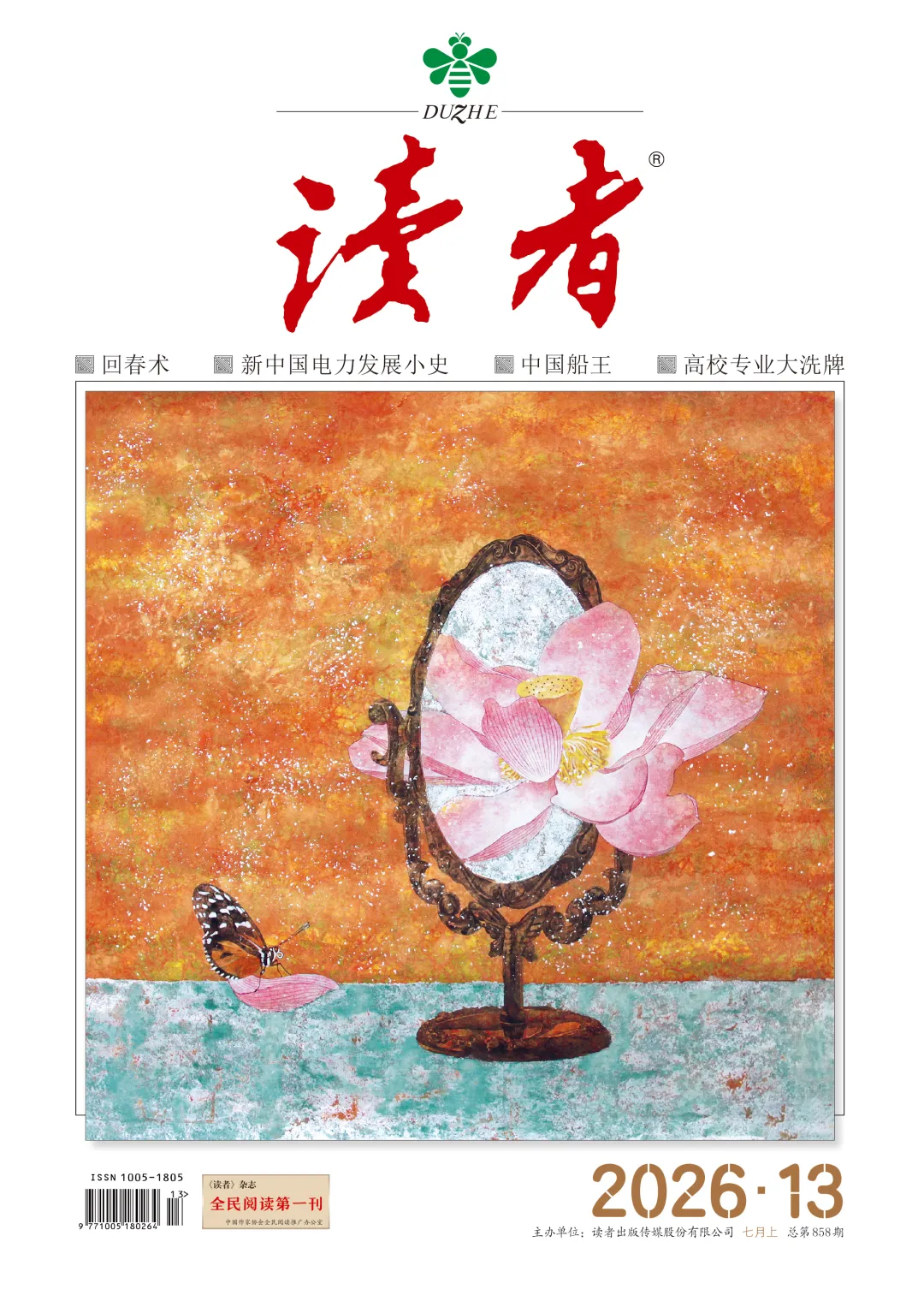
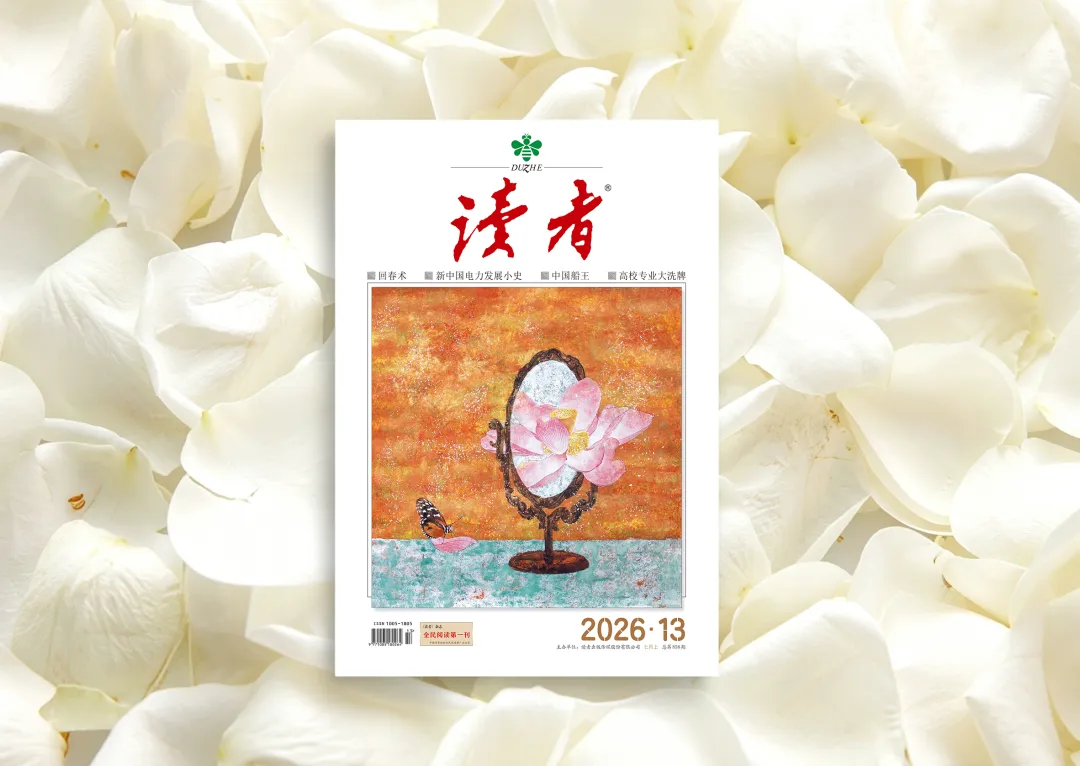
Unlike the fresh blue-green tones of early summer, the cover of Issue 13, 2026 is a painting that invites contemplation.
The warm orange-gold background is scattered with fine silver-white, like twilight or light snow — hazy and gentle.
At the center stands an ornate European-style mirror, and in it blooms a full pink lotus, petals soft and luxuriant.
The lotus grows quietly, suspended between real and imagined. Outside the mirror, a fallen petal lies still, and a butterfly rests upon it.
The petal is the fragment of daily life; the butterfly is the possibility of transformation and renewal.
— Life outside may be plain and trivial, but the inner world can be vast and flourishing.
The fallen petal and the lotus in the mirror echo each other — the mundane and the refined, the real and the ideal.
This issue carries both the weight of the times and the healing power of words.
Amid the烟火 of everyday life, keep a lotus in your heart. Reading offers us the gentlest gift: to see ourselves more clearly.

Antidote for Living with AI
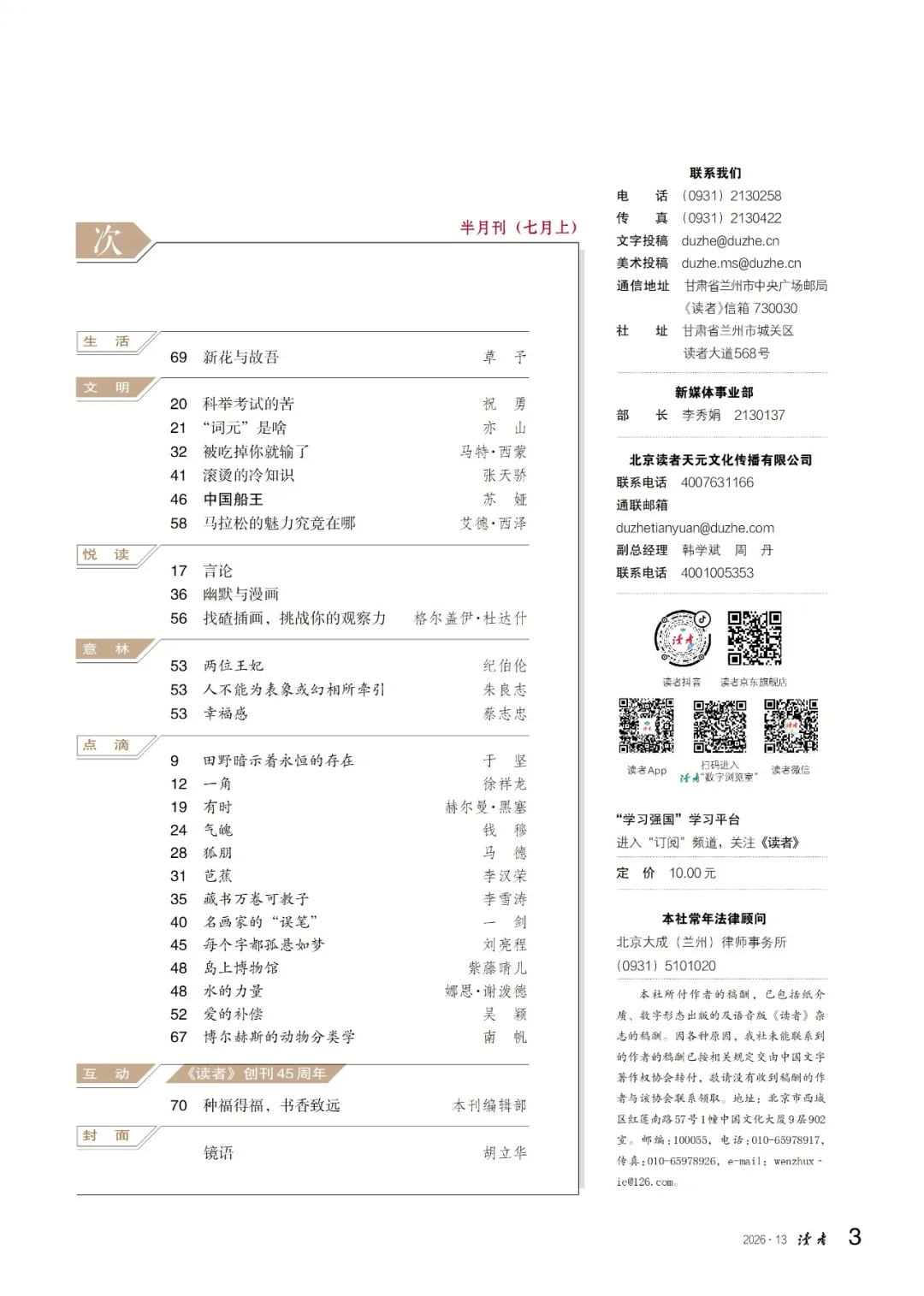
“The Non-Existent ‘Dalton’” opens the issue.
An AI-generated virtual singer climbs the iTunes charts — her look and voice entirely fabricated, yet she fulfills real human needs.
The author reflects: we once thought AI would do the drudge work so we could focus on art; instead, it does dishes, writes songs, paints — and not badly.
It seems harsh, but the essay pivots: the joy of creation itself is something AI cannot give.
“When we can applaud the non-existent ‘Dalton’ and also smile at our own random hums, we enter the realm of freedom that AI opens up.”
Perhaps that is the antidote for living with AI.
“What Are Tokens?” uses the metaphor of beads on a necklace to explain how large language models process language — understanding this deepens your grasp of AI costs, operations, and capabilities.
“The Great Reshuffle of University Majors” shows the real impact of AI: Communication University of China cut photography and translation majors — not because they are worthless, but because “everyone can be a recorder, and photography alone no longer sustains a major.”
The article wisely notes: no major stays evergreen, but what you love may still become your path.
“Rethinking ‘Handcraft’” questions the meaning of manual work: a top global publisher withdrew a bestseller that was 78% AI-generated; MIT research found that prolonged use of ChatGPT for writing flattens personal creativity.
Its conclusion is clear: AI generates text with algorithms, but every human-written word carries the warmth of joys and sorrows.
Fiction · Wandering Through Human Connections
“The Art of Rejuvenation” is one of the most memorable stories in this issue.
Apprentice Jiang Hulu enters the Rejuvenation Hall, where his master imposes three prohibitions: never enter the back courtyard, never touch the blue-and-white medicine jar, never approach the shadowless pagoda.
Hulu breaks all three — yet he is not dismissed.
Only later, on his deathbed, does the master reveal the truth: there is no magic rejuvenation art; the prohibitions were made to be broken.
Chinese medicine is not hard; it requires care, courage, diligence, and wisdom. “Too honest, and you’ll never be a good doctor,” the master says.
From a reckless boy who rode his bike into walls to a renowned physician who cured plagues, what truly awakened him was not a secret manual, but the experience of not running from fear, his master’s frail body, and skills honed over long years.
“The Koi and the Small Inkstone” tells of a love broken for over a decade.
A man brings a small inkstone she once loved but could not afford. They exchange polite words, the air dry with estrangement. As he leaves, she gives him a lonely goldfish — “strange, it killed all its mates, now it swims alone.” He only hands her the inkstone at the door, then hurries away.
“At the corner, he looked back and saw her still standing at the door, holding the inkstone, the paper box already opened.”
Some things arrive late — but at least they finally reach the right hands.
“Dream Beast” is a short piece by Jian Zhen, full of imagination.
A dream is a beast that slips into one’s bed at midnight, rummaging through drawers for snacks, scattering symbols like sunflower seeds.
Sometimes it travels miles to another’s bed, negotiating with their dream beast: “My owner is suffering — let them meet!” At dawn, lovers in two places wake at once, sighing: “Ah! I dreamed of you.”
That is the dream beast’s proudest moment.
Those Long Summers of Life
“So Fat, So Long” by Pang Yuliang is a heart-wrenching piece about his father.
At 19, his father rushed back from the grain station to force him to muck out the pigsty. He refused to eat, threw the pitchfork into the wheat field, and collapsed on the ridge with the manure buckets.
His father, then 66, scolded him — “lazy ox, piss and shit everywhere” — but silently carried the last load himself.
Later, his father suffered a stroke, grew thin, and died. After the sweltering summer of 1994, his father left one afternoon in September.
The author did not cry until six years later, deep in the night after finishing “Half a Father in Pain” — “holding the manuscript, letting tears soak my now-plump body.”
This piece reminds us of our own fathers, of that silent, clumsy love.
“My ‘Relative’ Lu Yao” is a memoir by Chen Cang.
After graduation, he was assigned to a remote cultural station in the Qinling Mountains, idly carrying a shotgun. One day he found a yellowed magazine and was captivated by Lu Yao’s “Life”.
He read it in one sitting; when he looked up, the rain outside had stopped, “the clouds parted, and the sun shone brightly on the world again.”
He put away his gun, began to read and write, and eventually crossed the Qinling Mountains to Xi’an.
He never met Lu Yao, but he always called him his “relative” — “I am shaped by him; what flows in my veins is his words, his spirit, his loess land, our shared suffering and love.”
“Hometown” by Xu Zechen: he takes his son back to his hometown, but the boy feels nothing — until a neighbor boy calls from the high-speed train: “Uncle, wait, I’ll set off a firecracker for you, a loud one.”
The author puts it on speaker, waits a few seconds — “Boom!” — a loud bang that “made the speeding train tremble.”
“Dusk Falls, People Remain” chronicles martial arts director Yuan Heping’s life.
He was lazy in his youth, spent 15 years on set before his first lead role — playing an ape.
Later he created Drunken Fist, worked on “The Matrix” in Hollywood, and taught Stephen Chow the “Buddha’s Palm”.
Now 81, with martial arts films out of fashion, he is still shooting “Blades of the Guardians” in the Gobi desert.
The article ends with Yuan Heping, wine gourd on his back, sighing: “From now on, it’s the young people’s turn.”
A young wanderer, leading his horse, passes by with curiosity and innocence. May the jianghu continue.
Another Kind of Arrival
“Fragrant and Sticky” recalls the street cries of fried ginkgo nuts in old Suzhou and Shanghai.
Wang Zengqi, Zhu Ziqing, Zhang Ailing, and Ye Shengtao all wrote about it. The “sticky” texture, Wang used to describe Tie Ning’s novels — delicate, soft, yet resilient. Northerners may not get it, but those from the Wu dialect area do.
“My First 5 Days in Beijing” by Ming Qiancha: Xiao Lin, just back from abroad, is taken in for five days by a friend of her mother’s.
The aunt takes her to eat fried liver, watch pigeon whistles, and watch sunset from her 22nd-floor studio.
Later Xiao Lin moves out, works, practices electric guitar — two years pass without meeting.
She gradually realises it was an almost legendary encounter. They exchanged precious “supplies” in the sea of people, warmed each other’s solitude — but that doesn’t mean they would walk the same path.
The aunt’s unspoken words: “When your life has passed through the fjords and rapids and is on track, I will quietly see you off, asking nothing in return.”
“Money Slang” reveals ancient bargaining codes.
“Pingtou” means hundreds — the first stroke of “平” is horizontal; “Waitou” means thousands — the first stroke of “歪” is slanting.
Li Boyuan wrote to borrow “Mao Shi” — meaning 300 yuan (the Book of Songs has 300 poems); borrowing one “Dao De Jing” means 5,000 yuan (the classic has 5,000 characters).
All cultural codes on the surface, but all about money underneath.
“Travel, ‘Far Away’ and the Self” writes about another kind of arrival.
Chekhov visited Sakhalin Island not to exoticise it, but to document the daily lives of exiles.
Many found it lacking in literary flair, but Chekhov himself considered it his best work — it grounded his thinking and shaped a new, broader self.
“New Blossoms and Old Selves” is light, yet profound.
“As many times as new blossoms bloom, so many times will seasons wither. And conversely, as many times as seasons wither, new blossoms will bloom again.”
The article asks: if fate repeatedly knocks us down, do we have the resilience to endure?
Final Words
This issue includes an essay titled “We Don’t Have to Resign”.
The author begins with the dodo bird, which “lost the sky by staying in one corner”, and reflects: modern humans face a similar predicament.
Yet we don’t have to resign —
“Even without wings, we can fly against the wind; even confined, we can thrive.”
“The size of your wings doesn’t matter — what matters is that you keep the desire to fly.”
The desire to fly is the hope of living. These seemingly useless passions and expectations are the light and warmth that never fade from our lives.
June 25, 2026 — Issue 13 of Reader is available nationwide.
Where petals fall, butterflies alight.
This summer, may you and I drift like a lotus, unhurried and free.
For more, visit the “Reader” App.
📬 Call for Submissions
Reader Magazine welcomes submissions of outstanding works from various publications, books, and online platforms. Please include author, publisher, publication date, and your full name, address, and phone number.
We are currently seeking original fiction and interactive pieces. Fiction should be compelling, well-plotted, and culturally enriching, within 5,000 words. Interactive pieces (letters, reader responses, micro-topics, artist/illustrator stories) should be lively, authentic, and within 1,500 words. No plagiarism; mark “original first publication” and ensure it has not been published elsewhere. No simultaneous submissions. Include your name, address, and phone. Submission implies granting us rights for publication, compilation, and online distribution.
Email your electronic manuscript to: duzhe@duzhe.cn
Accepted pieces will receive remuneration and a sample copy in accordance with copyright law. Our payment covers all usage and licensing fees.
We receive thousands of submissions daily; due to limited resources, we cannot return them. If you do not hear from us within 3 months, please consider your submission not accepted.
Reader Editorial Department
📊 Analysis (within 500 words)
This issue of Reader navigates the space between algorithmic logic and humanistic values. The opening essay “The Non-Existent ‘Dalton’” confronts AI’s encroachment on creative fields but resists techno-panic, asserting that “the joy of creation is something AI cannot give.” The trio of articles on tokens, major reshuffles, and handcraft builds a layered reflection: from understanding technical fundamentals, to professional choices, to defending manual craft — a sober yet hopeful guide to living with AI.
The fiction section — “The Art of Rejuvenation”, “The Koi and the Small Inkstone”, “Dream Beast” — carries Reader’s signature warmth, using prohibitions, old objects, and dreams as vessels for ordinary people to find their own “rejuvenation” within rules and emotions. The essays “So Fat, So Long”, “My ‘Relative’ Lu Yao”, “Hometown”, and “Dusk Falls, People Remain” delve into father-son bonds, literary idols, hometowns, and the jianghu, retrieving golden fragments of memory from long summers.
The section “Another Kind of Arrival” — from fried ginkgo to Beijing days, money slang to travel and new blossoms — reveals the fine texture of daily life. The closing essay “We Don’t Have to Resign” uses the dodo as a metaphor, emphasising that “the desire to fly” is the ultimate antidote to mediocrity.
Overall, this issue bridges technological reason and literary sensibility, addressing contemporary questions without losing its gentle, reflective tone — a clear-eyed and tender companion.
🧩 Core Issue · Solution · Validation
- Core Issue: How can individuals maintain spiritual independence and richness in an era of rapid AI change, blurred professional boundaries, and accelerating life?
- Solution: Through deep reading and personal writing, reaffirm human value — embrace technology without being defined by it; find warmth in handcraft and creation; settle between hometown and elsewhere; discover poetry in the ordinary.
- Validation Model: ① Does the reader develop new thinking about AI and creation? (Ask: do I value my own scribbled words more?) ② Does a story or essay touch you deeply, and would you share it? ③ Can you draw courage from the cycle of “new blossoms and old selves” to face change?


