At AWE 2026, AI became the undisputed protagonist across the entire exhibition.
During the show, the author exclusively learned from Haier that the sales volume of Haier massage appliances has surpassed 5 million units, and its massage chair ranks first on JD.com in its category.
Going forward, Haier's massage appliance division will focus on the precision massage segment, leveraging AI technology to continuously upgrade its massage chair products.
Public data shows that in 2024, the penetration rate of intelligent massage models equipped with AI body detection and health cloud algorithms reached 37%, a year-on-year increase of 12 percentage points.
From 2020 to 2025, the CAGR (compound annual growth rate) of the intelligent massage chair industry is expected to be as high as 36.6%, significantly outperforming traditional massage chair categories.
However, the penetration rate of smart massage chairs in China is forecast to be only 4% in 2025, far lower than mature markets such as Japan (20%) and South Korea (10%), indicating substantial growth potential.
“Haier entered the massage chair industry around 2019. Our short-term goal is to leverage intelligent technology to make Haier massage chairs rank among the top three in the domestic market.”
Wang Jiantao, Director of Intelligent Massage Products at Haier’s Health & Aging Division, told the author that from the very beginning, Haier equipped all its massage products with Wi-Fi modules, integrating them as a key part of Haier Smart Home's intelligent terminal ecosystem, providing users with movie-watching, leisure, and other scenario-based services.
Additionally, Haier massage chairs achieve data interconnection with other smart home devices, transforming from passive command-executing tools to proactive smart terminals, laying the foundation for future integration into a broader service ecosystem.
During AWE, Haier officially launched the Lingxi Precision Massage System 3.0 and unveiled the first AI precision massage robot equipped with this system.
For a long time, the massage chair industry has faced a “one-size-fits-all” experience dilemma: fixed programs cannot adapt to the wide variance in users’ body types and pressure preferences, forcing consumers to either endure discomfort or passively accept standardized massage routines.
“Traditional massage chairs use the displacement distance of the massage heads as the force benchmark, but users’ body shapes and muscle tolerance vary drastically, causing vastly different sensations at the same intensity level,” Wang explained.
Lingxi Precision Massage System 3.0 aims to ensure that users of different body types and heights achieve a consistent and comfortable massage experience on the same chair.
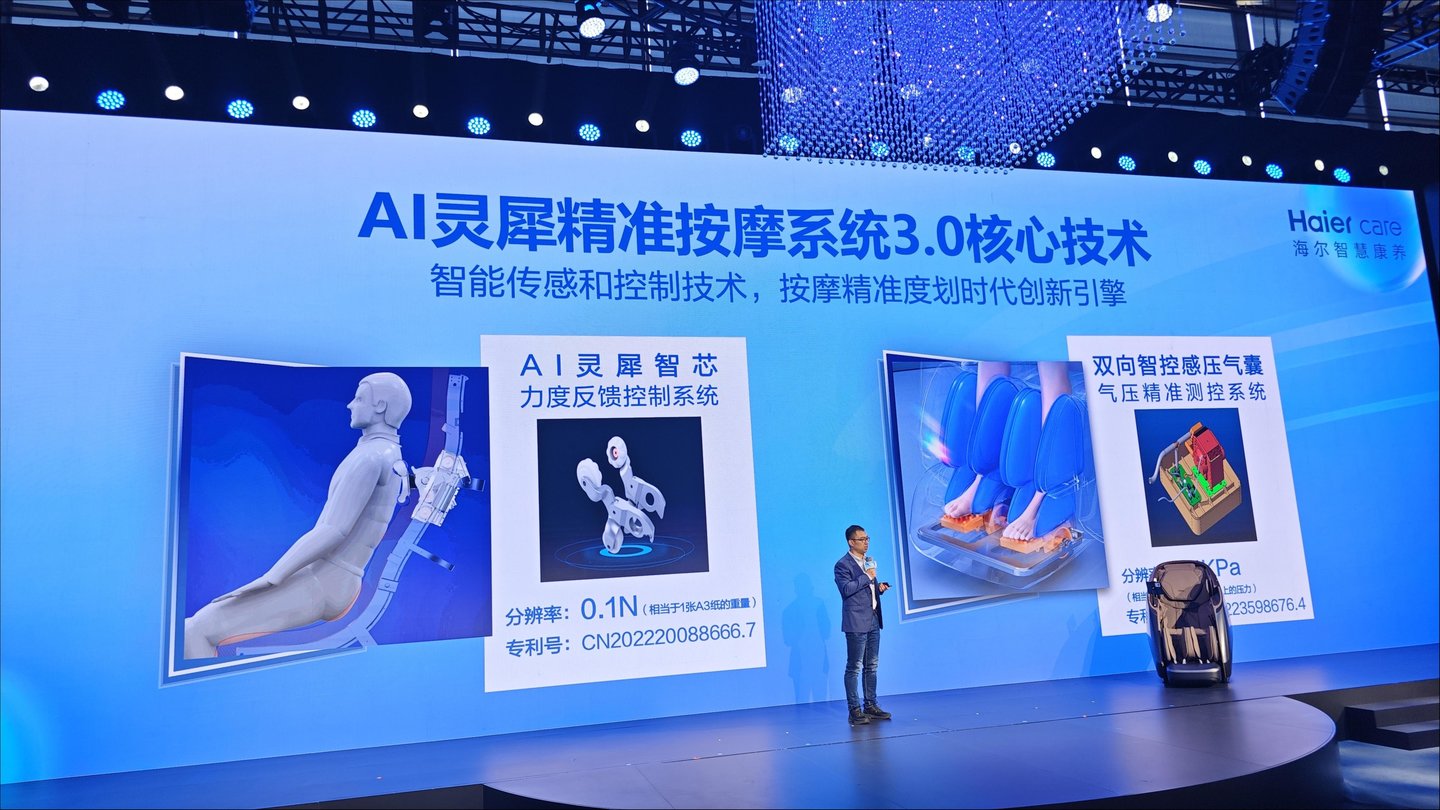
To achieve this goal, the Lingxi Precision Massage System 3.0 features a new-generation AI Lingxi massage mechanism. Leveraging intelligent sensing technology and real-time feedback control algorithms, it continuously monitors and precisely adjusts the instantaneous force applied by the massage heads to the human body, enabling dynamic optimization of the force application process.
At the same time, the system improves force adjustment accuracy to the 0.1 Newton level, allowing users to achieve stepless fine-tuning according to personal preferences.
This signifies that massage chairs no longer execute fixed programs, but deliver an intelligent experience of “massage tailored to each individual, on demand.”
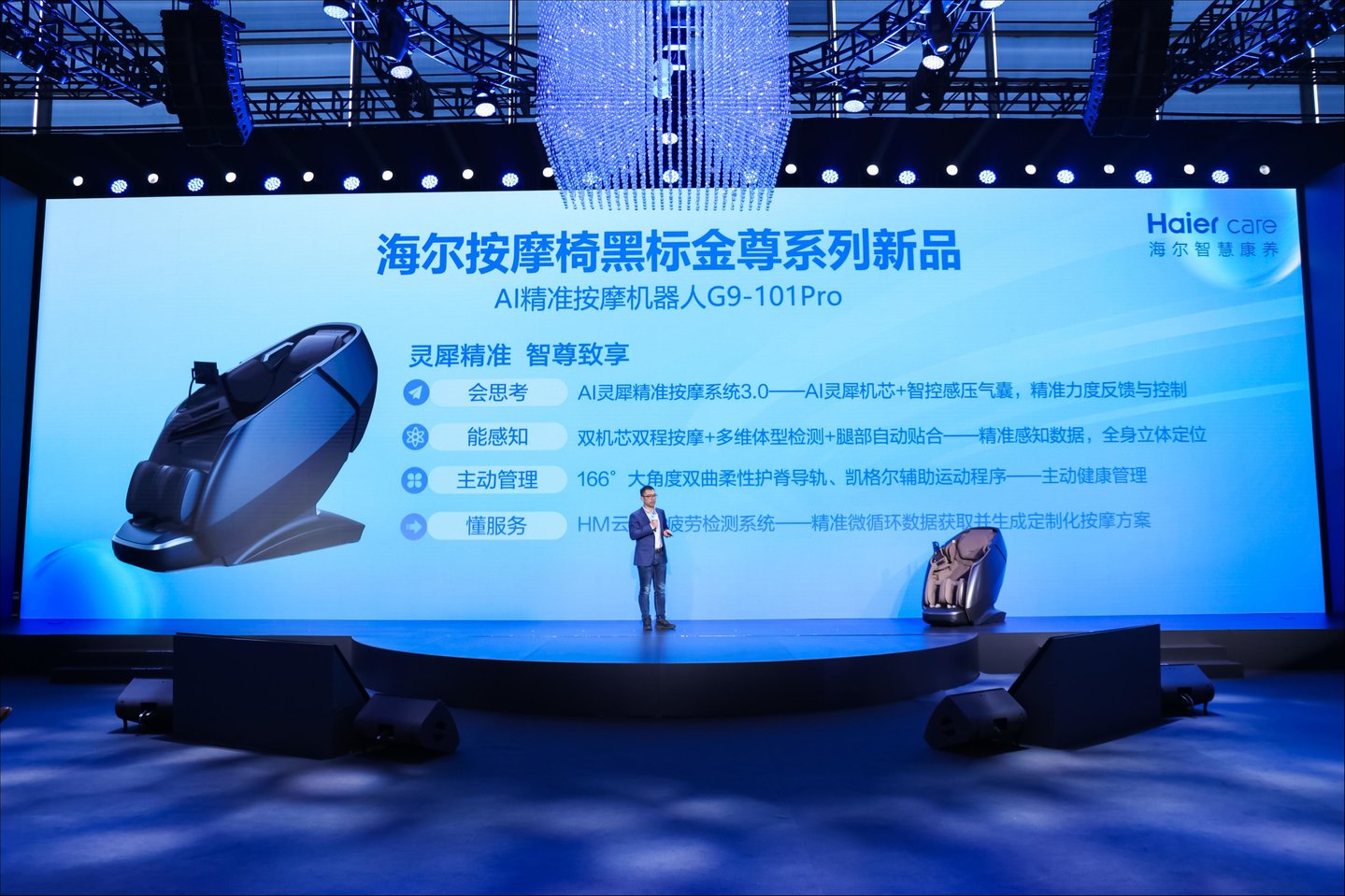
The first massage chair featuring the AI Lingxi Precision Massage 3.0 system—the Haier Black Label Supreme Series G9 Pro—implements multi-dimensional body detection and full-body stereotaxic positioning to accurately capture user body data.
With coordinated operation of the massage mechanism and airbags, it achieves precise force feedback and freely adjustable intensity. At AWE, Euromonitor International awarded Haier a market position statement certificate as the “First Smart Precision Massage Chair Launch Brand in China.”
“In the future, growth in the intelligent massage chair market will mainly benefit from consumption upgrades, rising health awareness, an aging population, and the integration of AI, IoT, and other technologies,” Wang told the author.
Haier massage chairs will continue to focus on “AI + precision” technology, driving the upgrade of massage experiences from “passive relaxation” to “proactive health management.”
According to data from relevant agencies, the CAGR for the intelligent massage chair industry from 2020 to 2025 is projected to reach 36.6%. From 2025 to 2030, the industry is expected to expand at an average annual rate of 15%-18%, with the market size potentially exceeding RMB 40 billion by 2030.
(By TechLatent | Author: Rao Xiangyu | Editor: Zhong Yi)